
St Tudwal's Island Monastery
St Tudwal's Island Monastery is historically associated with the hermitage of Saint Tudwal, a 6th-century figure. Located on the Saint Tudwal's Islands off the Llŷn Peninsula in North Wales, the site features the remains of a priory on the eastern island. While the islands are known for their natural beauty and wildlife, the monastic significance primarily relates to its early Christian origins.
Key Facts
- ›Traditionally identified as the site of a hermitage used by Saint Tudwal in the 6th century.
- ›The islands are a small archipelago lying south of Abersoch on the LLŷn Peninsula.
- ›Features the remains of a priory on Saint Tudwal's Island East, mentioned in 1291 tax rolls.
- ›Saint Tudwal's Island West houses the St Tudwal’s Lighthouse.
- ›The islands are part of the LLŷn Area of Outstanding Natural Beauty.
- ›Known for wildlife, including wild birds and grey seal breeding sites.

Remains of A Priory, St Tudwal’S Lighthouse, Wildlife Habitat
Ynysoedd Tudwal, Studwells
Saint Tudwal
Hermitage Established By Saint Tudwal, Priory Referenced In 1291 Tax Rolls
About St Tudwal's Island Monastery
St Tudwal's Island Monastery is intrinsically linked to the early Christian hermitage tradition of Wales, with its origins tracing back to the 6th century. The site is situated on the Saint Tudwal's Islands, a small archipelago off the Llŷn Peninsula in North Wales. These islands are not only recognized for their natural beauty and wildlife but also for their historical association with Saint Tudwal, who is traditionally believed to have used the eastern island as a hermitage.
Historical Context and Remains
The primary monastic significance of the site lies in the remains of a priory found on Saint Tudwal's Island East (Welsh: Ynys Tudwal Fach). This priory is noted in historical records, specifically appearing in the tax rolls of 1291. While no active monastic community currently resides there, the remnants signify a past period of religious settlement and activity. The western island, Saint Tudwal's Island West (Welsh: Ynys Tudwal Fawr), is known for housing the St Tudwal’s Lighthouse.
Location and Natural Significance
The Saint Tudwal's Islands lie a short distance from the mainland, approximately 1 kilometer east of the southern tip of the Llŷn Peninsula. They are part of the Llŷn Area of Outstanding Natural Beauty, celebrated for their diverse wildlife, including various wild birds and being a breeding site for grey seals. Small vessels regularly transport visitors from the nearby town of Abersoch to explore the islands and their natural attractions, offering a glimpse into both the historical and ecological heritage of the region.
Source: Wikipedia ↗
Frequently Asked Questions
Where are St Tudwal's Islands located?
St Tudwal's Islands are a small archipelago situated south of Abersoch on the Llŷn Peninsula in North Wales, at the western end of Tremadog Bay. They are located approximately 1 kilometer east of the southern tip of the Llŷn Peninsula.
What is the historical significance of St Tudwal's Island Monastery?
The islands are traditionally identified as the site of a hermitage used by Saint Tudwal during the 6th century. The eastern island contains the remains of a priory, which is referenced in historical tax rolls from 1291.
What are the main islands and their features?
The two main islands are Saint Tudwal's Island West and Saint Tudwal's Island East. The western island is higher and features the St Tudwal’s Lighthouse, while the eastern island, believed to be the original hermitage site, has the remains of a priory.
Are the islands open to visitors?
Small ships sail from the nearby town of Abersoch to take passengers to view the wildlife on the islands. The islands are also popular for water sports.
Who has owned the islands recently?
Saint Tudwal's Island East was owned by author Carla Lane from 1991 until her death in 2016. Saint Tudwal's Island West was sold into private ownership in 1935 and was later purchased by adventurer Bear Grylls.
Related Monasteries

Bangor Monastery
Bangor Cathedral, dedicated to its founder Saint Deiniol, stands on a site of Christian worship since the sixth century. Originally established as St Deiniol's Monastery, it has a long and tumultuous history marked by destruction and rebuilding, evolving from its Norman origins to its current Gothic Revival appearance. The cathedral is a significant religious and historical landmark in Gwynedd, Wales, known for its architectural evolution and notable features.
Caergybi Monastery
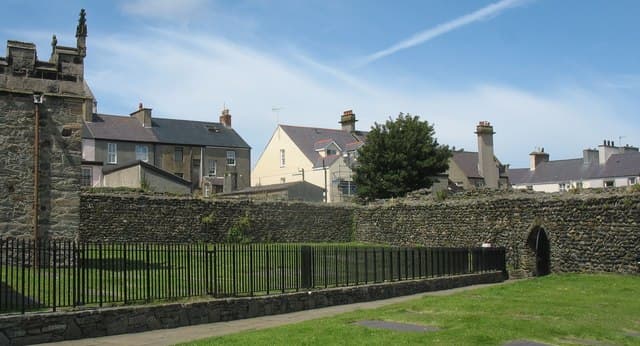
Caergybi Monastery, also known as the Church of St Cybi, is a historical religious site in Holyhead, Wales, with origins tracing back to a Roman fortlet. It was refounded as a monastery in the 6th century by Saint Cybi, and the church on the site today preserves elements of its long history, including its Roman foundations and a chapel reputedly over the saint's grave.

Llancarfan Monastery
Llancarfan Monastery was a significant 6th-century clas, a center of learning in the Vale of Glamorgan, Wales, founded by Saint Cadoc. It was renowned for its educational offerings, attracting many holy men who studied and taught there. Although the original monastic structures are not extant, the site is marked by its parish church, which still contains medieval wall paintings.