
St. Peter's Island
Christian·Switzerland·hotel and restaurant·12th century
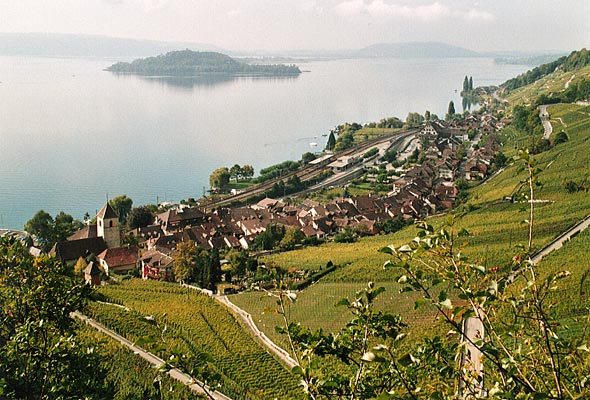
St. Peter's Island is a peninsula in Lake Biel, Switzerland, known for its historical monastic origins. Originally an island, it became a peninsula due to late 19th-century water level changes. The site was first inhabited by monks of the Cluniac order, who established a monastery in 1127, and it later gained fame when Jean-Jacques Rousseau spent a significant period there in 1765.
Key Facts
- ›Formed during the last Ice Age by the Rhône Glacier.
- ›Became a peninsula in the late 19th century due to Jura water correction works.
- ›Monks of the Cluniac order built a monastery in 1127.
- ›Jean-Jacques Rousseau described his two-month stay in 1765 as the 'happiest time of his life'.
- ›The former priory building is a Swiss heritage site of national significance.
- ›The priory building is currently used as a hotel and restaurant.
Swiss Heritage Site of National Significance, Historical Monastic Site
îLe Saint-Pierre, Sankt Petersinsel, Island of the Counts
Jean-Jacques Rousseau, Count Wilhelm Iii of Burgundy-MâCon, Count Wilhelm Iv of Burgundy-MâCon
- Founding of the Monastery By Cluniac Monks
- Burial of Wilhelm Iv of Burgundy-MâCon
- Stay of Jean-Jacques Rousseau
- Dissolution of the Priory
- Transfer of Buildings To Niederen Spital, Bern
- Demolition of the Monastery Church
About St. Peter's Island
St. Peter's Island (French: Île Saint-Pierre; German: Sankt Petersinsel) is a notable peninsula located in Lake Biel, within the canton of Bern, Switzerland. Its history is deeply intertwined with monastic life and significant historical figures.
History and Significance
The site's monastic history began in 1127 when monks of the Cluniac order established a monastery. The priory itself was founded earlier, in 1107, when Count Wilhelm III of Burgundy-Mâcon donated his lands to Cluny Abbey. Archaeological findings suggest an even earlier presence, with traces of Merovingian graves and a Carolingian wooden monastery discovered. The island, then known as the "Island of the Counts," was a center of religious activity. In the 18th century, the philosopher Jean-Jacques Rousseau spent two months on the island in 1765, a period he later described as the "happiest time of his life."
Transformation and Current Status
Originally an island, St. Peter's Island became a peninsula in the late 19th century due to extensive engineering works known as the Jura water correction. These projects lowered the water levels of the Seeland lakes, revealing a previously submerged isthmus and connecting the island to the mainland, though it remains separated by a canal. The former priory building, which has undergone numerous modifications and renovations over centuries, is now a designated Swiss heritage site of national significance. Today, the priory building functions as a hotel and restaurant, continuing to draw visitors to this historically rich location.
Source: Wikipedia ↗
Frequently Asked Questions
When was the monastery on St. Peter's Island founded?
Monks of the Cluniac order were the first inhabitants of the island and built a monastery here in 1127. The priory itself was founded in 1107 when lands were given to Cluny Abbey.
What is the significance of St. Peter's Island?
St. Peter's Island holds historical significance as the site of a Cluniac monastery and as a place where Jean-Jacques Rousseau spent a memorable period in 1765. The former priory building is recognized as a Swiss heritage site of national importance.
How did St. Peter's Island become a peninsula?
St. Peter's Island was historically an island. Following engineering works on the Jura water correction in the late 19th century, the water level of the surrounding lakes dropped, revealing an isthmus and permanently linking it to the mainland, thus transforming it into a peninsula.
What is the current use of the former priory building?
The former priory building, a listed Swiss heritage site, is currently operated as a hotel and restaurant. It has undergone extensive modifications and renovations over the centuries.
What historical structures were found on St. Peter's Island?
Archaeological discoveries near the current building have revealed traces of Merovingian graves, a Carolingian wooden monastery, and an abandoned 11th-century basilica, indicating a long history of settlement and religious activity on the site.
Related Monasteries

Bonmont Abbey
Bonmont Abbey, a former Cistercian monastery in Vaud, Switzerland, was founded between 1110 and 1120. Initially adhering to strict Benedictine and Cistercian rules, it grew wealthy through donations, leading to architectural and decorative changes. Secularized in 1536 during the Reformation, its buildings were repurposed for agricultural and administrative uses, though the church was preserved and later restored as a national monument.

Bubikon Commandery
Bubikon Commandery, also known as Bubikon Castle, was a medieval monastery of the Knights Hospitaller. Founded between 1191 and 1198, it grew to own significant lands across the present-day Canton of Zürich. The commandery was secularized during the Reformation, and its buildings now house a museum dedicated to its history and the Order.
Ittingen Charterhouse
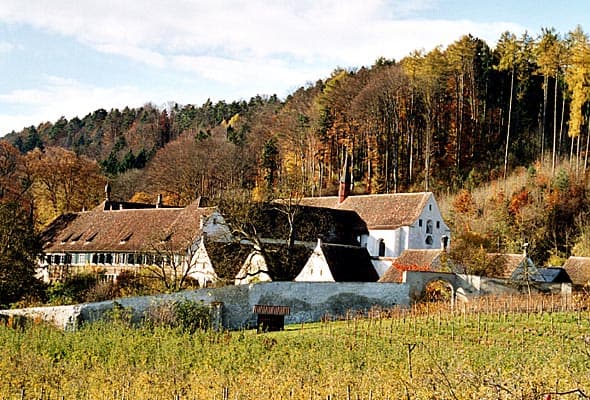
Ittingen Charterhouse, located near Warth in Switzerland's Canton Thurgau, was initially founded as a monastery for Canons Regular in 1150. It later became a Carthusian monastery in 1461, enduring destruction during the Reformation and eventual dissolution in 1848. Today, the meticulously restored precinct serves as an education and seminar center, housing museums, a farm, hotels, and a residential home for individuals with mental illnesses or learning difficulties.