
St Clears
St Clears is a town and community in Carmarthenshire, Wales, with a history rooted in Norman settlement and a significant religious past. The town grew around a Norman motte-and-bailey castle built around 1093, and later featured a Cluniac priory founded around 1100, the Priory Church of St Mary Magdalene, which still stands and showcases notable Norman stone carving. St Clears has also been a site of historical events such as the Rebecca Riots and experienced changes due to the arrival of the South Wales Railway.
Key Facts
- ›The Priory Church of St Mary Magdalene, a Cluniac priory, was founded around 1100.
- ›The church contains some of the best surviving Norman stone carving in Carmarthenshire.
- ›A Norman motte-and-bailey castle was established at St Clears around 1093 by Bretel de St Clair.
- ›St Clears was an epicentre of the 'Rebecca Riots' in 1842.
- ›The town's railway station, closed in 1964, is scheduled to reopen by 2024.
- ›It is situated on the River Taf and had a population of 2,995 at the 2011 census.

Norman
Priory Church of St Mary Magdalene, Norman Stone Carving, Motte-and-Bailey Castle Remains
SanclêR
Bretel De St Clair, William De St Clair, Owain GlyndŵR, Thomas Charles, Sir William Lower, John Protheroe, Stanley Phillips, Neville Hughes
Norman Conquest and Castle Establishment, Foundation of Cluniac Priory, Surrender To Owain GlyndŵR, Establishment of Early Telescope, Rebecca Riots, Construction of South Wales Railway, Closure of Railway Station, Reopening of Railway Station
About St Clears
St Clears is a town and community situated in Carmarthenshire, Wales, on the banks of the River Taf. Its historical significance is marked by its origins as a Norman settlement and the presence of a notable religious institution.
History and Religious Significance
The town's history is intertwined with the Norman period, beginning around 1093 when Bretel de St Clair established a timber-and-earth motte-and-bailey castle. The settlement subsequently developed into a Marcher borough around this fortress, which later surrendered to Owain Glyndŵr in 1405.
A key ecclesiastical feature of St Clears is the Priory Church of St Mary Magdalene. Founded circa 1100 as a Cluniac priory under its mother house, St Martin-des-Champs, the church is a Grade II* listed building. It holds particular importance for its surviving Norman stone carving, considered among the finest in Carmarthenshire.
Historical Events and Development
St Clears has been the site of various historical occurrences. In 1842, it was an epicentre for the "Rebecca Riots," with at least one local toll gate being destroyed. The construction of the South Wales Railway in the 1850s significantly altered the town's landscape and commercial focus, leading to the decline of some older ports.
In more recent history, the town's railway station, closed to passengers in 1964, is slated for reopening by 2024 following a successful campaign. The town has also been associated with significant figures in science, such as the amateur astronomer Sir William Lower, and cultural figures like photographer Stanley Phillips.
Source: Wikipedia ↗
Frequently Asked Questions
What is the historical significance of St Clears?
St Clears has a history dating back to the Norman conquest, with the establishment of a castle around 1093. It also housed a significant Cluniac priory, the Priory Church of St Mary Magdalene, founded around 1100, which is noted for its Norman architecture. The town has witnessed events like the Rebecca Riots and the impact of the railway's development.
What is notable about the Priory Church of St Mary Magdalene?
The Priory Church of St Mary Magdalene is a Grade II* listed building and is considered to have the best surviving Norman stone carving in Carmarthenshire. It was originally a Cluniac priory founded around 1100 and has undergone several restorations.
What was the role of the castle in St Clears?
A Norman motte-and-bailey castle was constructed at St Clears around 1093 by Bretel de St Clair. The town subsequently grew around this fortress. The castle eventually surrendered to Owain Glyndŵr in 1405.
Has St Clears always been a town?
The settlement grew around a Norman castle, developing into a Marcher borough. Its development was later influenced by the construction of the South Wales Railway in the 1850s, which led to changes in its commercial centre.
Is the railway station in St Clears currently operational?
No, trains have not stopped at St Clears railway station since 1964. However, following a local campaign, funding has been secured to reopen the station, with a target completion date of 2024.
Related Monasteries
Abergavenny Priory
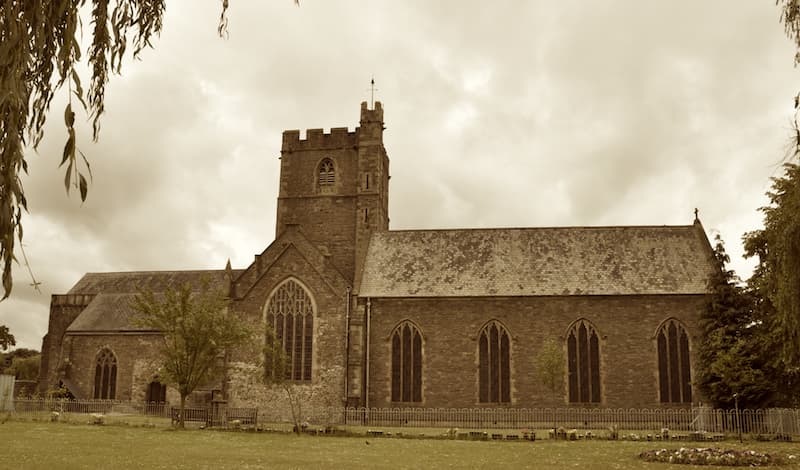
The Priory Church of St Mary, Abergavenny, is a significant parish church in Monmouthshire, Wales, often referred to as "the Westminster Abbey of Wales" due to its size and collection of high-status tombs. Originally established as a Benedictine priory in the late 11th century, it became a parish church after the Dissolution of the Monasteries. The church is renowned for its numerous medieval effigies and notable architectural features, including 15th-century choir stalls and a unique 15th-century wooden carving known as "The Jesse."

Monmouth Priory
Monmouth Priory is a historic building in Wales that incorporates the remains of monastic structures attached to St Mary's Priory Church. Founded as a Benedictine priory in 1075, it played a significant role in the region before its dissolution in 1536. Today, after substantial redevelopment in the 19th century and subsequent restoration, it functions as a community centre.

Bangor Monastery
Bangor Cathedral, dedicated to its founder Saint Deiniol, stands on a site of Christian worship since the sixth century. Originally established as St Deiniol's Monastery, it has a long and tumultuous history marked by destruction and rebuilding, evolving from its Norman origins to its current Gothic Revival appearance. The cathedral is a significant religious and historical landmark in Gwynedd, Wales, known for its architectural evolution and notable features.