
Monmouth Priory
Christian·Wales·Community centre·11th century
Monmouth Priory is a historic building in Wales that incorporates the remains of monastic structures attached to St Mary's Priory Church. Founded as a Benedictine priory in 1075, it played a significant role in the region before its dissolution in 1536. Today, after substantial redevelopment in the 19th century and subsequent restoration, it functions as a community centre.
Key Facts
- ›Founded as a Benedictine priory in 1075 by Withenoc.
- ›Incorporates remains of medieval monastic buildings, including prior's lodgings.
- ›Features a notable MID-15th century oriel window, often mistakenly linked to Geoffrey of Monmouth.
- ›The priory was dissolved in 1536.
- ›The surviving buildings were redeveloped for use as St Mary's National School and now serve as a community centre.
- ›Designated a Grade II* listed building.

Medieval, Victorian
Mid-15th Century Oriel Window, Corbels Depicting Carved Heads, Remains of Prior's Lodgings, Geoffrey Tapestry
Withenoc
Dissolution of the Monasteries
About Monmouth Priory
Monmouth Priory, located on Priory Street in Monmouth, Wales, is a structure that preserves remnants of the monastic buildings once associated with St Mary's Priory Church. The priory was established as a Benedictine foundation in 1075 by Withenoc, a Breton who held the lordship of Monmouth. While evidence suggests an earlier Celtic church may have occupied the site in the 8th century, the Benedictine priory was consecrated in 1101 and its church was expanded to serve as the parish church later in the 12th century.
History and Development
The priory met its end with its dissolution in 1536. The monastic buildings, situated to the north of the priory church, have seen significant transformation over the centuries. Traces of an infirmary were uncovered in 1906, but the most recognizable surviving medieval element is a "sumptuous mid-15th century oriel window." This window, often mistakenly attributed to Geoffrey of Monmouth, likely formed part of the priory gatehouse and features three high-quality carved head corbels, subject to differing interpretations of their depiction.
The prior's lodgings underwent substantial redevelopment in the nineteenth century for use as St Mary's National School. Further restoration, supported by the Heritage Lottery Fund and completed in 2002, has prepared the buildings for contemporary use. Today, Monmouth Priory serves as a community centre, hosting a variety of events. Its historical significance is recognized by its designation as a Grade II* listed building and its inclusion on the Monmouth Heritage Trail.
The Geoffrey Tapestry
A notable recent addition to the priory's cultural offerings is the Geoffrey Tapestry, completed in May 2003. This wallhanging, illustrating the life of Geoffrey of Monmouth, was a collaborative effort by 14 volunteers who dedicated 2,750 hours to its creation over six months. The work commenced in July 2001 during festivities celebrating the Priory's 900th anniversary.
Source: Wikipedia ↗
Frequently Asked Questions
When was Monmouth Priory founded?
Monmouth Priory was founded in 1075 by Withenoc, a Breton who became lord of Monmouth. It was consecrated in 1101.
What religious order was associated with Monmouth Priory?
Monmouth Priory was a Benedictine foundation. It was granted to the Abbey of St Florent at Saumur.
What remains of the original priory buildings?
The surviving buildings primarily consist of the prior's lodgings. A notable medieval feature is a mid-15th century oriel window, likely from the priory gatehouse.
What is the current use of the Monmouth Priory buildings?
After being redeveloped for use as St Mary's National School in the nineteenth century, the buildings now function as a community centre, available for events such as weddings, conferences, and exhibitions.
Is Monmouth Priory a protected historical site?
Yes, Monmouth Priory is a Grade II* listed building, signifying its importance as a historical structure. It is also part of the Monmouth Heritage Trail.
Related Monasteries
Abergavenny Priory
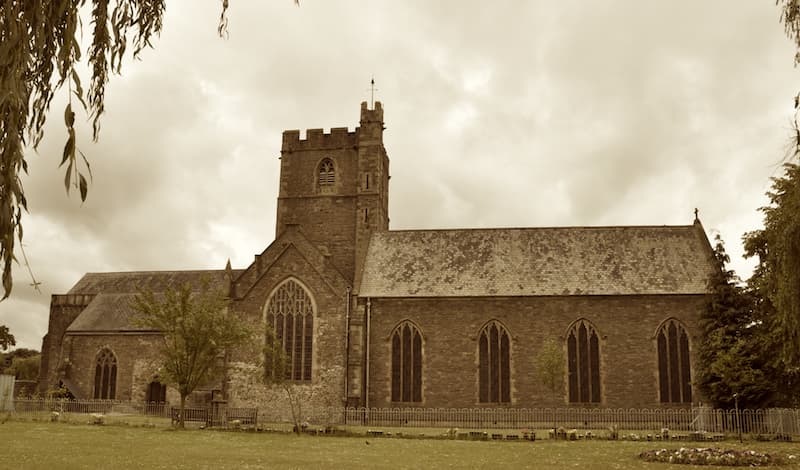
The Priory Church of St Mary, Abergavenny, is a significant parish church in Monmouthshire, Wales, often referred to as "the Westminster Abbey of Wales" due to its size and collection of high-status tombs. Originally established as a Benedictine priory in the late 11th century, it became a parish church after the Dissolution of the Monasteries. The church is renowned for its numerous medieval effigies and notable architectural features, including 15th-century choir stalls and a unique 15th-century wooden carving known as "The Jesse."

St Clears
St Clears is a town and community in Carmarthenshire, Wales, with a history rooted in Norman settlement and a significant religious past. The town grew around a Norman motte-and-bailey castle built around 1093, and later featured a Cluniac priory founded around 1100, the Priory Church of St Mary Magdalene, which still stands and showcases notable Norman stone carving. St Clears has also been a site of historical events such as the Rebecca Riots and experienced changes due to the arrival of the South Wales Railway.

Aberconwy Abbey
Aberconwy Abbey was a significant Cistercian monastery, initially founded near Caernarfon in 1186 before moving to Conwy. It rose to prominence as the most important abbey in North Wales during the 13th century, largely due to the patronage of Llywelyn the Great, who was buried there. The abbey was later forcibly relocated by King Edward I to Maenan to make way for Conwy Castle and was eventually suppressed in 1537.