
Sokolica Monastery
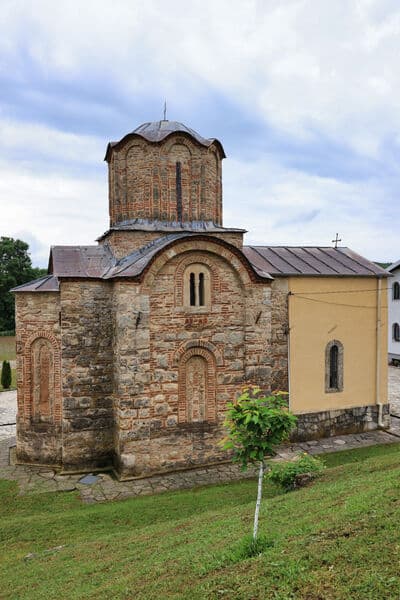
Sokolica Monastery is a Serbian Orthodox monastery located in Kosovo, recognized as a cultural monument of exceptional importance. Likely founded in the early 14th century, it is named after the falcons that historically nested in the surrounding hills. The monastery features a small church with later additions, primitive stone carvings, and preserved frescoes, though it suffered looting during World War II.
Key Facts
- ›Likely founded at the beginning of the 14th century.
- ›Named after the falcons that nested in the surrounding 'Sokolovo brdo' (Falcon's Hill).
- ›The monastery church has a later added narthex and a bell tower built between the World Wars.
- ›Features primitive drawings of people and animals on its facades.
- ›Suffered looting by Albanians during World War II.
- ›Houses three old and valuable books: a 17th-century Russian Psalter, a 1816 Bulgarian book, and an 1838 Prayer Book.

Medieval Serbian
Primitive Drawings On Facades, Severely Damaged Frescoes, Collection of Old Books
Musa
Looted By Albanians During World War Ii
About Sokolica Monastery
Sokolica Monastery is a significant religious and cultural site located in the village of Boletin, within the municipality of Zvečan in Kosovo. It falls under the jurisdiction of the Eparchy of Raška and Prizren of the Serbian Orthodox Church and is recognized as an immovable cultural asset of exceptional importance.
History and Naming
The monastery's construction is believed to have taken place at the beginning of the 14th century, with tradition attributing its founding to Musa, the lord of Zvečan and son-in-law of Prince Lazar. Its name, Sokolica, originates from the local term 'Sokolovo brdo' (Falcon's Hill), referring to the falcons that have historically nested in the surrounding forests. In medieval times, falconry was an integral part of hunting, and it is said that every householder was required to breed falcons for their lord.
Architecture and Art
The monastery church is characterized by its small dimensions, featuring a spacious narthex added at a later stage. A bell tower was erected between the two World Wars. The structure is built from skillfully worked stone and possesses a shallow, semi-circular apse. The facades, particularly the northern one, bear primitive drawings of human figures and animals, alongside ancient inscriptions. Despite damage sustained over time, particularly during Turkish rule, some frescoes remain visible. These include representations of Christ Pantokrator in the vault, the Assumption of the Virgin Mary on the western wall, and an adoration scene with an archbishop in the apse. Fragments of figures dressed in lay attire, presumed to be the founders, are also discernible on the south wall.
Cultural Significance and Preservation
Sokolica Monastery holds three valuable old books within its church: a Russian Psalter from the 17th century, a Bulgarian text titled 'Zavomaje ogledalo' from 1816, and a Prayer Book from 1838. The monastery experienced a period of hardship when it was looted by Albanians during World War II. Efforts to preserve its heritage have included architectural restoration and conservation work undertaken in 1995/96. A new inn was also constructed on the premises in the 1980s.
Source: Wikipedia ↗
Frequently Asked Questions
When was Sokolica Monastery likely founded?
The monastery was most likely built at the beginning of the 14th century. It is believed to have been founded by Musa, the lord of Zvečan and son-in-law of Prince Lazar.
Why is it called Sokolica Monastery?
The monastery derives its name from the hill it is situated on, known as Sokolovo brdo, which means Falcon's Hill. This name comes from the falcons that have built their nests in the surrounding forests for centuries.
What are some notable architectural features of the monastery church?
The monastery church is of small dimensions with a spacious narthex added later, and a bell tower constructed between the two World Wars. It is built of skillfully worked stone with a shallow, semi-circular apse. Primitive drawings of people and animals, along with old inscriptions, are found on its facades, particularly the northern one.
What historical events have affected Sokolica Monastery?
During World War II, the Sokolica Monastery was looted by Albanians. Restoration and conservation of its architecture were carried out in 1995/96, and a new inn was built in the 1980s.
What valuable items are kept at Sokolica Monastery?
The church at Sokolica Monastery houses three old and valuable books: a Russian Psalter from the 17th century, 'Zavomaje ogledalo' in Bulgarian from 1816, and a Prayer Book from 1838.
Related Monasteries
Budisavci Monastery
Budisavci Monastery is a medieval Serbian Orthodox monastery located in the village of Budisavci, near Klina and Peja. Founded in the early 14th century, the church is dedicated to the Transfiguration of Jesus Christ and is considered an important religious and cultural monument of medieval Serbian heritage. While its original frescoes are lost, significant repainting occurred in the 16th century, and the monastery remains an active spiritual center.

Gorioč Monastery
Gorioč Monastery is a Serbian Orthodox monastery located in Kosovo, serving as a dependency of Visoki Dečani Monastery. Traditionally founded in the 14th century by Serbian King Stefan Dečanski as a gift to Saint Nicholas, the monastery complex includes a church dedicated to the saint, dormitories, a bell tower, and economic buildings. It is recognized as a cultural monument of exceptional importance in Serbia.

Gračanica Monastery
Gračanica Monastery is a Serbian Orthodox monastery in Kosovo, built by King Stefan Milutin in 1321. Recognized as a Monument of Culture of Exceptional Importance and a UNESCO World Heritage site, it is celebrated for its Serbo-Byzantine architecture and well-preserved frescoes, particularly those within the narthex depicting the Nemanjić dynasty genealogy. The monastery has endured significant historical events, including damage during Ottoman rule and recent bombings, but continues to operate as an active convent and a vital spiritual and cultural center for the Serbian community in Kosovo.