
Budisavci Monastery
Budisavci Monastery is a medieval Serbian Orthodox monastery located in the village of Budisavci, near Klina and Peja. Founded in the early 14th century, the church is dedicated to the Transfiguration of Jesus Christ and is considered an important religious and cultural monument of medieval Serbian heritage. While its original frescoes are lost, significant repainting occurred in the 16th century, and the monastery remains an active spiritual center.
Key Facts
- ›Founded in the early 14th century.
- ›Church is dedicated to the Transfiguration of Jesus Christ.
- ›Historically served as a dependency of the Patriarchate of Peć.
- ›Restored and repainted in 1568 under Patriarch Makarije Sokolović.
- ›Features frescoes primarily from the 16th century.
- ›Remains an active monastery today.
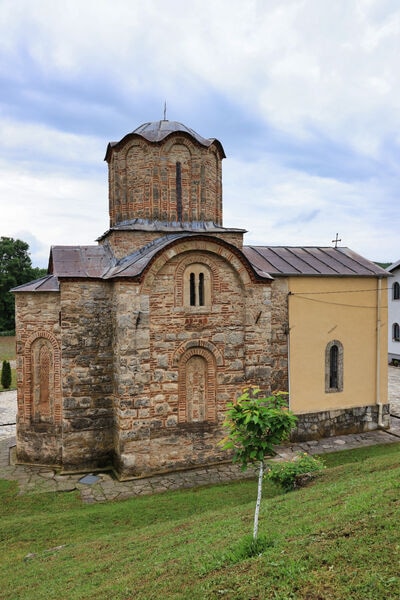
Byzantine Cross-In-Square
16th-Century Frescoes, Octagonal Dome, Alternating Stone and Brick Walls
Manastiri I Budisavcit
Stefan Uroš Ii Milutin, Makarije Sokolović, Hieromonk Stefan Purić
- Restoration and Repainting In 1568
- Addition of A Narthex In the 19th Century
- Disappearance of Hieromonk Stefan Purić During the Post-Kosovo War Period
About Budisavci Monastery
Budisavci Monastery is a significant medieval Serbian Orthodox monastery situated in the village of Budisavci, near the towns of Klina and Peja. The monastery church is dedicated to the Transfiguration of Jesus Christ and stands as a vital religious and cultural testament to medieval Serbian heritage in the region.
History and Architecture
The monastery's foundation dates to the early 14th century, though its precise founder remains a subject of scholarly debate, with some attributing it to King Stefan Uroš II Milutin and local traditions linking it to his daughter. Historically, Budisavci Monastery functioned as a metochion, or dependency, of the Patriarchate of Peć. The church itself is an exemplar of the Byzantine cross-in-square architectural style, characterized by its octagonal dome and a three-sided apse. The construction features distinct alternating layers of stone and brick, a common technique in medieval Serbian ecclesiastical architecture.
Art and Restoration
While the original 14th-century frescoes have not survived, the church underwent significant restoration and repainting in 1568 under the auspices of Patriarch Makarije Sokolović, whose portrait is preserved within the nave. The frescoes predominantly date from this 16th-century period and depict notable figures such as Saint Sava and Stefan Nemanja, alongside Serbian archbishops and scenes from the Great Feasts and the Passion of Christ cycles. A narthex was added to the western side of the church during the 19th century, which partially covers earlier frescoes.
Modern Significance
Budisavci Monastery continues to be an active monastic community. The annual celebration of the Transfiguration (Preobraženje) in August attracts hundreds of Orthodox faithful, underscoring its enduring spiritual importance. The monastery has also benefited from recent restoration efforts, including roof repairs. It is also associated with the disappearance of Hieromonk Stefan Purić during the post-Kosovo War period, an event that is commemorated annually.
Source: Wikipedia ↗
Frequently Asked Questions
When was Budisavci Monastery founded?
Budisavci Monastery was built in the early 14th century. The exact founder is not definitively known, with some scholars suggesting Stefan Uroš II Milutin, while local tradition links it to his daughter.
What is the architectural style of Budisavci Monastery?
The monastery church is constructed in the Byzantine cross-in-square style. It features an octagonal dome and a three-sided apse, with walls built using alternating layers of stone and brick, characteristic of medieval Serbian ecclesiastical architecture.
What significant artworks are preserved at Budisavci Monastery?
While the original 14th-century frescoes have not survived, the monastery preserves significant frescoes from the 16th century. These include depictions of Saint Sava, Stefan Nemanja, Serbian archbishops, Makarije Sokolović, and scenes from the Great Feasts and the Passion of Christ.
Is Budisavci Monastery still active?
Yes, Budisavci Monastery remains an active monastery. It draws hundreds of Orthodox believers annually for the feast of the Transfiguration in August and has undergone restoration efforts in recent years.
What is the historical significance of Budisavci Monastery?
Budisavci Monastery is an important religious and cultural monument of medieval Serbian heritage. It historically functioned as a dependency of the Patriarchate of Peć and its church showcases Byzantine architectural elements and 16th-century frescoes.
Related Monasteries

Gorioč Monastery
Gorioč Monastery is a Serbian Orthodox monastery located in Kosovo, serving as a dependency of Visoki Dečani Monastery. Traditionally founded in the 14th century by Serbian King Stefan Dečanski as a gift to Saint Nicholas, the monastery complex includes a church dedicated to the saint, dormitories, a bell tower, and economic buildings. It is recognized as a cultural monument of exceptional importance in Serbia.

Sokolica Monastery
Sokolica Monastery is a Serbian Orthodox monastery located in Kosovo, recognized as a cultural monument of exceptional importance. Likely founded in the early 14th century, it is named after the falcons that historically nested in the surrounding hills. The monastery features a small church with later additions, primitive stone carvings, and preserved frescoes, though it suffered looting during World War II.

Gračanica Monastery
Gračanica Monastery is a Serbian Orthodox monastery in Kosovo, built by King Stefan Milutin in 1321. Recognized as a Monument of Culture of Exceptional Importance and a UNESCO World Heritage site, it is celebrated for its Serbo-Byzantine architecture and well-preserved frescoes, particularly those within the narthex depicting the Nemanjić dynasty genealogy. The monastery has endured significant historical events, including damage during Ottoman rule and recent bombings, but continues to operate as an active convent and a vital spiritual and cultural center for the Serbian community in Kosovo.