
Serbian Kovin Monastery
The Serbian Kovin Monastery, officially the Monastery of the Dormition of the Holy Mother of God, is an Eastern Orthodox Christian monastery located in Ráckeve, Hungary. It is recognized as one of the oldest monasteries in Hungary, with a history potentially dating back to the 12th century. The monastery has undergone significant architectural transformations and holds importance as a spiritual center for Serbs in Hungary.
Key Facts
- ›Potential medieval heritage dating back to the first half of the 12th century.
- ›Traditionally attributed to Queen Helena, wife of Hungarian King Bela II.
- ›Relocated to the island of Csepel in 1440 after devastation by the Turks.
- ›Transformed from a parish church into a monastery around the MID-16th century.
- ›Abolished in 1777 during the reforms of Maria Theresa, later re-established as a monastery.
- ›Features architectural elements of Early Gothic, Serbian Baroque, and later additions.

Early Gothic, Serbian Baroque
- Iconostasis Dating From 1770
- Frescoes Depicting Saints and Serbian Rulers
- Isolated Bell Tower
- Chapels Dedicated To the Nativity of St. John the Baptist and St. Unmercenary Physicians and Wonderworkers Cosmas and Damian
Manastir Srpski Kovin, RáCkevei Szerb Monostor
Queen Helena of Hungary, King Bela Ii of Hungary, King Vladislav of Hungary, Archimandrite Josif Stanojević, Abbot Andrej Pandurović, Teodor Simeonov
- Devastation By Turks In 1439
- Granting of the Church On Csepel Island In 1440
- Abolishment In 1777
- Re-Establishment As A Monastery
About Serbian Kovin Monastery
The Monastery of the Dormition of the Holy Mother of God, commonly known as the Serbian Kovin Monastery, is an Eastern Orthodox Christian monastic complex situated in Ráckeve, Hungary. It falls under the jurisdiction of the Eparchy of Buda of the Serbian Orthodox Church and holds the distinction of being one of the oldest monasteries in Hungary. Its history is believed to stretch back to the first half of the 12th century, with tradition pointing to Queen Helena, wife of Hungarian King Bela II, as its founder.
History and Development
Following the Turkish conquest of Smederevo in 1439, refugees from the Kovin region migrated inland and were granted a Gothic church on the island of Csepel by Hungarian King Vladislav in 1440. This event marked the establishment of Serbian Kovin on its current site. It is possible that the parish church was transformed into a monastery around the mid-16th century, as evidenced by a 1546 Turkish census recording monks and a priest. Historical data from 1680 confirms the monastery's existence. However, during the monastic reforms of Maria Theresa, the Serbian Kovin Monastery was abolished in 1777, with its monastic community likely relocating to the Grabovac Monastery and its church reverting to a parish. After more than two centuries, the shrine was re-established as a monastery.
Architecture and Art
The original church, dating to the late 13th century, was a one-nave Early Gothic structure. After its acquisition by the Serbs in 1440, it was adapted for Orthodox worship with minor modifications. The eastern aisle was converted into the altar area, and a new iconostasis was installed in 1770, featuring main icons painted in 1746 by unknown Russian and Ukrainian masters, with others attributed to masters from Moshopolis. The bell tower showcases a blend of earlier foundations and a Baroque section built in 1756. The monastery's frescoes were executed in three major campaigns, with the most significant and preserved works dating from 1765 and 1771, by artists led by Teodor Simeonov. These frescoes impressively integrate Byzantine and Serbian painting traditions within the Gothic architectural framework, depicting saints, Serbian rulers, and biblical narratives.
Source: Wikipedia ↗
Frequently Asked Questions
When was the Serbian Kovin Monastery founded?
According to preserved tradition, the monastery has a medieval heritage and may have appeared in the first half of the 12th century. Queen Helena, wife of Hungarian King Bela II, is mentioned as its founder.
What is the historical significance of the monastery's relocation?
After the Turks devastated Kovin and surrounding villages in 1439, those who escaped moved inland. On October 10, 1440, Hungarian King Vladislav granted them an Early Gothic church on the island of Csepel, leading to the establishment of Serbian Kovin there.
What architectural styles are present at the Serbian Kovin Monastery?
The monastery's structures exhibit elements of Early Gothic style from its initial church building, with later additions including Serbian Baroque architecture, particularly in the bell tower. The iconostasis dates from 1770, with earlier main icons from 1746.
Has the monastery always been active?
The monastery was abolished in 1777 during the reforms of Maria Theresa, and its church was turned into a parish. After more than two centuries, it regained its status as an active monastery.
What is notable about the frescoes in the monastery?
The church has been painted three times: in 1320, 1514, and 1765. The frescoes, executed by artists led by Teodor Simeonov from Moshopolis, depict saints, Serbian rulers, and biblical scenes, adapting them to the Gothic architectural divisions.
Related Monasteries
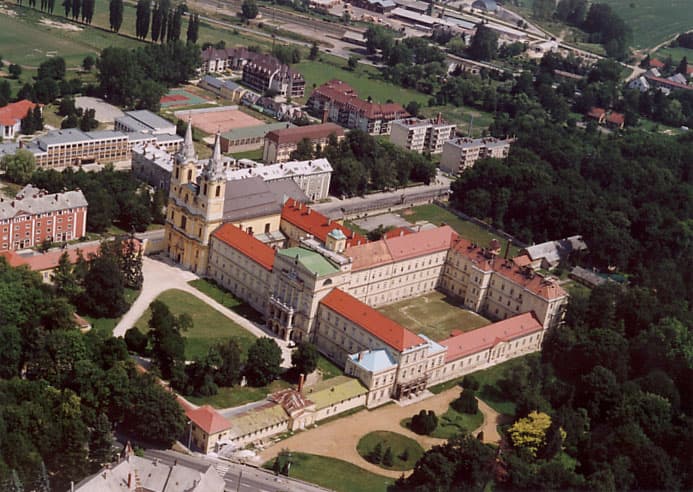
Zirc Abbey
Zirc Abbey, also known by its Latinized names Zircensis or Boccon, is a Cistercian abbey located in Zirc, Hungary. Its history is marked by periods of prosperity and decline, including destruction and abandonment in the 15th and 16th centuries, followed by revival and resettlement by monks from other Cistercian abbeys. The abbey was dissolved in 1950 but re-established in 1989, continuing its monastic tradition.

Gellért Hill Cave
The Gellért Hill Cave, also known as Saint Ivan's Cave, is a significant cave network in Budapest, Hungary, historically associated with a hermit and thermal springs. In the 1920s, Pauline monks transformed it into a chapel and monastery, serving as a place of worship and a World War II field hospital. After being sealed by the authorities in 1951, it reopened in 1989 and the Pauline Order returned, continuing its religious functions while also functioning as a popular tourist attraction.

Hungary
Hungary is a landlocked nation in Central Europe with a rich history dating back to the late ninth century. It transformed from a principality into a Christian medieval kingdom, experienced periods of division and reunification under various empires, and played a significant role as part of the Austro-Hungarian Monarchy. The country has a strong cultural heritage, with notable contributions to arts, music, literature, and science, and is a popular tourist destination.