
Royaumont Abbey
Cistercian·France·Cultural centre and tourist attraction·13th century
Royaumont Abbey is a former Cistercian abbey located near Asnières-sur-Oise, France, built between 1228 and 1235 with the support of Louis IX. Dissolved during the French Revolution, it later became a voluntary hospital during World War I and is now a cultural center and tourist attraction managed by the Royaumont Foundation.
Key Facts
- ›Founded between 1228 and 1235.
- ›Supported by King Louis IX of France.
- ›Served as a voluntary hospital during World War I (Hôpital Auxiliaire 301).
- ›Became the first private French cultural foundation in 1964 (Royaumont Foundation).
- ›Has been used as a filming location and hosted concerts, including Pink Floyd.
- ›Its sacristy, cloister, and refectory remain intact after the Revolution.

Sacristy, Cloister, Refectory, Royaumont Foundation
Louis Ix, Vincent of Beauvais, Frances Ivens
Construction Supported By Louis Ix, Dissolved During the French Revolution, Served As HôPital Auxiliaire 301 During Wwi, Creation of the Royaumont Foundation, Pink Floyd Concert
About Royaumont Abbey
Royaumont Abbey is a significant former Cistercian monastery situated near Asnières-sur-Oise in the Val-d'Oise department of France, approximately 30 kilometers north of Paris. Its construction, which spanned from 1228 to 1235, was notably supported by King Louis IX, who also decreed that royal children were to be interred there.
History and Transformation
The abbey flourished for centuries before its dissolution in 1791 during the French Revolution. While parts of the structure were repurposed, its sacristy, cloister, and refectory survived. In the early 20th century, the property was acquired by the Goüin family, leading to the establishment of the Royaumont Foundation in 1964, marking it as the first private French cultural foundation. This transformation repositioned the abbey as a vital center for arts and culture.
Notable Roles and Events
During World War I, Royaumont Abbey served a critical humanitarian role, operating as a voluntary hospital, Hôpital Auxiliaire 301, from 1915 to 1919. It gained recognition for its treatment of soldiers, particularly those from the Battle of the Somme. The abbey's historical buildings have also found a place in popular culture, serving as a filming location and hosting significant musical events, including a performance by Pink Floyd in 1971. Today, Royaumont Abbey continues its legacy as a cultural hub and a popular tourist destination, welcoming visitors to explore its historic architecture and engage with its vibrant artistic programming.
Source: Wikipedia ↗
Frequently Asked Questions
When was Royaumont Abbey built?
Royaumont Abbey was built between 1228 and 1235. Its construction was supported by King Louis IX of France.
What happened to Royaumont Abbey during the French Revolution?
The abbey was dissolved in 1791 during the French Revolution. Some of its stones were used to build a factory, but the sacristy, cloister, and refectory were preserved.
Did Royaumont Abbey play a role in World War I?
Yes, from January 1915 to March 1919, the Abbey was converted into a voluntary hospital known as Hôpital Auxiliaire 301. It was operated by the Scottish Women's Hospitals under the French Red Cross and notably treated soldiers from the Battle of the Somme.
What is the current function of Royaumont Abbey?
Today, Royaumont Abbey serves as a tourist attraction and a cultural center. It is managed by the Royaumont Foundation, which was established in 1964.
Are there any notable figures associated with Royaumont Abbey?
Yes, King Louis IX supported its construction, and the 13th-century encyclopedist Vincent of Beauvais was a brother there. Miss Frances Ivens, the Chief Medical Officer of the WWI hospital, was also a significant figure associated with the abbey.
Related Monasteries

La Clarté-Dieu
The Abbey of La Clarté-Dieu was a Cistercian monastery founded in 1239 in Saint-Paterne-Racan, France. Conceived by Peter des Roches, Bishop of Winchester, it was established as part of a pair with Netley Abbey in England. Despite suffering damage during the Hundred Years' War and facing financial strain, it survived until the French Revolution, after which it was secularized and partially used as a farm. Today, much of the medieval and post-medieval structures remain in excellent condition and are preserved as a monument historique, open to the public.

Maubuisson Abbey
Maubuisson Abbey, also known as Notre-Dame-la-Royale, is a former Cistercian nunnery founded in 1236 by Blanche of Castile, Queen of France. It served as a royal residence and necropolis, and despite periods of decline and conflict, it played an important role in the local economy. Today, the surviving buildings are listed as a monument historique and the site houses a Centre of Contemporary Arts.
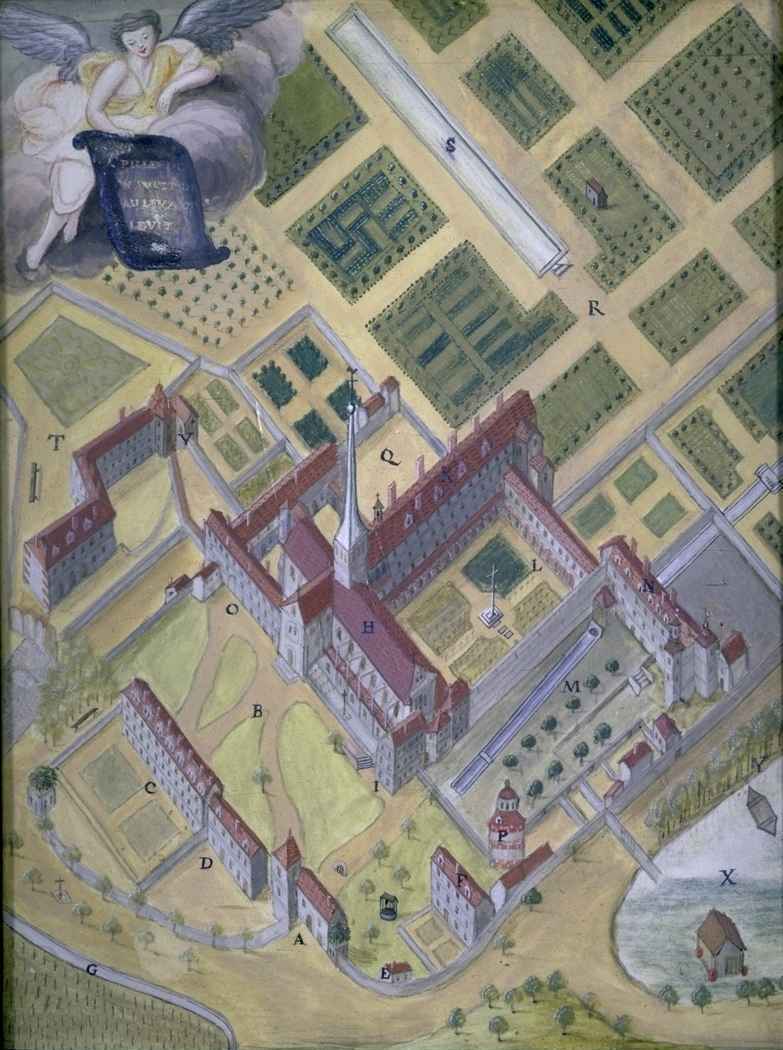
Port-Royal-des-Champs
Port-Royal-des-Champs was a Cistercian abbey that gained significant cultural and theological influence in the 17th century, particularly through its association with Jansenism and the prominent Arnauld family. It established renowned schools and became a center for intellectual and religious reform, attracting figures like Blaise Pascal. Despite its influence, it faced persecution and was eventually suppressed by papal bull, with most of its buildings razed.