
Roche Abbey
Roche Abbey is a ruined Cistercian monastery located in South Yorkshire, England, founded in 1147. Known for its impressive surviving transept walls and Gothic architecture, the abbey was dissolved in 1538. The site was later landscaped by Capability Brown in the 18th century, and excavations in the 20th century revealed its medieval foundations.
Key Facts
- ›Founded in 1147 by Richard de Busli and Richard Fitzturgis.
- ›It was a Cistercian monastery, part of the "White Monks" order.
- ›The great church, dedicated to the Virgin Mary, was completed by the end of the 12th century.
- ›At its height, it supported a community of around 175 men.
- ›Dissolved by Henry VIII on June 23, 1538, leading to its ruin.
- ›The site is now administered by English Heritage and is a scheduled monument.

Norman Gothic
- Surviving Transept Walls
- Impressive Gothic Architecture
- Medieval Foundations
- 13th-Century Wastewater System Over Maltby Beck
Richard De Busli, Richard Fitzturgis, Capability Brown, Michael Sherbrook, Thomas Cromwell, Henry Viii
- Founding of the Abbey
- Completion of the Great Church and Other Buildings
- Dissolution of the Monasteries By Henry Viii
- Landscaping By Capability Brown
- Excavations Revealing Medieval Foundations
About Roche Abbey
Roche Abbey is a significant ruined monastery situated in the valley of Maltby Dyke in South Yorkshire, England. Founded in 1147 by Richard de Busli and Richard FitzTurgis, it was established as a Cistercian house, belonging to the order known as the "White Monks." The abbey's construction began with stone buildings raised on the north side of the beck, with the grand church dedicated to the Virgin Mary largely completed by the end of the 12th century in the Norman Gothic style.
At its zenith, Roche Abbey supported a thriving community of approximately 175 men, including choir monks and lay brothers. The site was noted for its almost otherworldly atmosphere, located near the edge of Sherwood Forest, and is even associated with local legends of Robin Hood attending Mass there. A 13th-century innovation was its wastewater system, which utilized the running water of Maltby Beck for sanitation.
The abbey met its end during the Dissolution of the Monasteries under King Henry VIII, being suppressed on June 23, 1538. The subsequent spoliation led to the abbey's ruin, with valuable materials like lead and stone being removed. An account by Michael Sherbrook, who was a child at the time of the suppression, vividly describes the dismantling of the abbey, though modern reassessment suggests a more organized process of removal.
In the 18th century, the renowned landscaper Capability Brown was employed to redesign the grounds, which involved demolishing structures and altering the topography, burying the medieval remains beneath parkland. Excavations in the 1920s brought the abbey's foundations back to light, and today, the site is managed by English Heritage. Visitors can still appreciate the impressive surviving walls of the transepts, which stand to their full height, offering a glimpse into the abbey's former Gothic grandeur. The site is a scheduled monument and holds Grade II* listing in the National Register of Historic Parks and Gardens, attracting visitors interested in its history, architecture, and the dramatic landscape.
Source: Wikipedia ↗
Frequently Asked Questions
When was Roche Abbey founded?
Roche Abbey was founded in 1147. The stone buildings were raised on the north side of the beck in that year, shortly after the monks arrived from Newminster Abbey.
What religious order was Roche Abbey a part of?
Roche Abbey was a Cistercian monastery. The Cistercians were also known as the "White Monks" due to their habit.
What happened to Roche Abbey?
Roche Abbey was dissolved by Henry VIII on June 23, 1538, and subsequently reduced to ruins. Timber, lead, and stone were removed from the site.
Who administers Roche Abbey today?
Today, Roche Abbey is administered by English Heritage. It is a scheduled monument and a Grade II* listed historic park and garden.
What is notable about its architecture?
The abbey's great church, completed by the end of the 12th century, was built in the Norman Gothic style. The surviving walls of the north and south transepts are still impressive, showcasing the Gothic French idealism of its design.
Are there any legends associated with Roche Abbey?
Yes, local legends mention ghosts, tunnels to other buildings, and a lost wishing well. It is also said that Robin Hood went to Mass here.
Related Monasteries

Ankerwycke Priory
Ankerwycke Priory was a small and relatively poor Benedictine nunnery established around 1160 in Buckinghamshire, England. Dedicated to St. Mary Magdalene, it held lands across several counties. Dissolved in 1536, its revenues were transferred to Bisham Abbey, and the priory site later saw the construction of a manor house. Today, only a small section of ruins remains, situated in Berkshire.
Buildwas Abbey
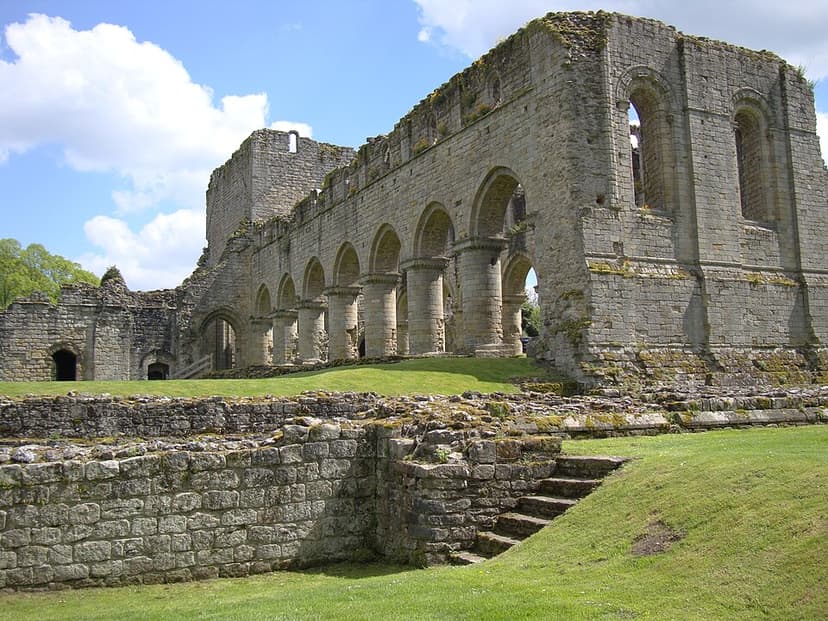
Buildwas Abbey was a significant Cistercian monastery in Shropshire, England, founded in 1135. It experienced periods of substantial growth and wealth, becoming a center of learning with a notable library. Despite facing challenges from economic crises and conflict, it played a role in royal administration, particularly concerning Ireland and Wales, before its suppression in 1536. Today, substantial remains of the abbey church and monastic buildings are maintained by English Heritage.

Byland Abbey
Byland Abbey was a Savigniac and later Cistercian monastic institution founded in 1135 in North Yorkshire, England. Despite an unstable early history with multiple relocations, it eventually settled at its final site near Coxwold. Once established, it became a significant religious and economic center, renowned for its sheep rearing and wool exports, and boasting a church described as one of the finest 12th-century structures in Europe. Though dissolved in 1538, extensive ruins remain, including the west front of the church with its notable rose window, and the site is maintained by English Heritage.