
Ravenstonedale Priory
Ravenstonedale Priory was a Gilbertine monastic house located in Cumbria, England. Founded during the reign of Henry II, it was initially intended to house a master and three canons, and was assigned to Watton Priory. Historical records indicate periods of dispute and a lack of resident canons, with the priory's existence largely tied to its parent house.
Key Facts
- ›Founded during the reign of Henry II.
- ›Was a Gilbertine priory, a cell of Watton Priory.
- ›Historical records suggest a small community, with claims of non-resident canons.
- ›Ruins were described in the late 17th century but had significantly diminished by the early 18th century.
- ›Excavations in the late 20th century revealed foundations and the east range of the cloister.

Medieval
- Visible Ruins of the East Range of the Cloister
- Foundations of Other Structures Uncovered By Excavation
- A Vault Mentioned As A Prison For Capital Offences
Torphin, Son of Robert, Son of Copsus, Robert Chause, George Fothergill, Machell, Bishop Nicholson, E P Frankland, P Turnbull, D Walsh, Matthew Hyde, Nikolaus Pevsner, C R Irwin, M Irwin
- Founding During the Reign of Henry Ii
- Dispute Over Lands With Bishop Robert Chause
- Appropriation of Ravenstonedale Church By Watton Priory In 1336
- Enquiry Into Maintenance of the House In 1405
- Dissolution of Watton Priory In 1539
- Excavations In 1928–29
- Extensive Excavation In 1988-89
- Consolidation Work
About Ravenstonedale Priory
Ravenstonedale Priory was a monastic institution belonging to the Gilbertine order, situated in Cumbria, England. Its foundation is attributed to the reign of King Henry II, when Torphin, son of Robert, son of Copsus, granted the manor and advowson of Ravenstonedale to Watton Priory in Yorkshire. The priory was intended to house a small community, comprising a master and three canons.
Historical documentation regarding the internal life of Ravenstonedale Priory is sparse. Nevertheless, records indicate a land dispute with Bishop Robert Chause of Carlisle in the late 13th century, confirming the priory's affiliation with Watton. Further evidence of Watton's possession comes from 1336, when the church of Ravenstonedale was appropriated by the parent priory. By 1405, an inquiry revealed that canons had not been in residence for some time, suggesting periods of diminished community life.
Following the dissolution of Watton Priory in 1539, Ravenstonedale Priory's assets passed to the Archbishop of York and subsequently to the Wharton family. After the sequestration of the Wharton estate in 1729, the lands were acquired by the Lowther family. Early antiquarian accounts from the late 17th and early 18th centuries, by figures such as George Fothergill, Machell, and Bishop Nicholson, describe the priory ruins. Nicholson noted a visible vault that had served as a prison for those convicted of capital offences at the manorial court.
Significant excavations took place in 1928–29, led by E. P. Frankland, who identified the site as a Gilbertine cell. These excavations uncovered the presently visible ruins and a range of foundations now reburied. A more extensive excavation was conducted in 1988–89 by Cumbria County Council. This led to consolidation work, revealing the east range of the cloister, likely dating from a late 13th to 14th-century remodelling. An interpretation plaque is present on the site, offering information to visitors.
Source: Wikipedia ↗
Frequently Asked Questions
When was Ravenstonedale Priory founded?
Ravenstonedale Priory was founded during the reign of King Henry II. This places its establishment in the latter half of the 12th century.
What religious order did Ravenstonedale Priory belong to?
Ravenstonedale Priory was part of the Gilbertine order. It functioned as a cell of the larger Watton Priory in Yorkshire.
What is the current state of Ravenstonedale Priory?
The priory is now in ruins. While substantial foundations and the east range of the cloister are visible following excavations and consolidation, much of the original structure has disappeared over time.
Were there many canons at Ravenstonedale Priory?
Historical records suggest a small community, with the initial intention being for a master and three canons. An inquiry in 1405 claimed that the canons had not been in residence for some time.
Who owned Ravenstonedale Priory after its dissolution?
Following the dissolution of Watton Priory in 1539, Ravenstonedale Priory passed to the Archbishop of York. Subsequently, it was acquired by the Wharton family, and later by the Lowther family in 1729.
Related Monasteries

Ankerwycke Priory
Ankerwycke Priory was a small and relatively poor Benedictine nunnery established around 1160 in Buckinghamshire, England. Dedicated to St. Mary Magdalene, it held lands across several counties. Dissolved in 1536, its revenues were transferred to Bisham Abbey, and the priory site later saw the construction of a manor house. Today, only a small section of ruins remains, situated in Berkshire.
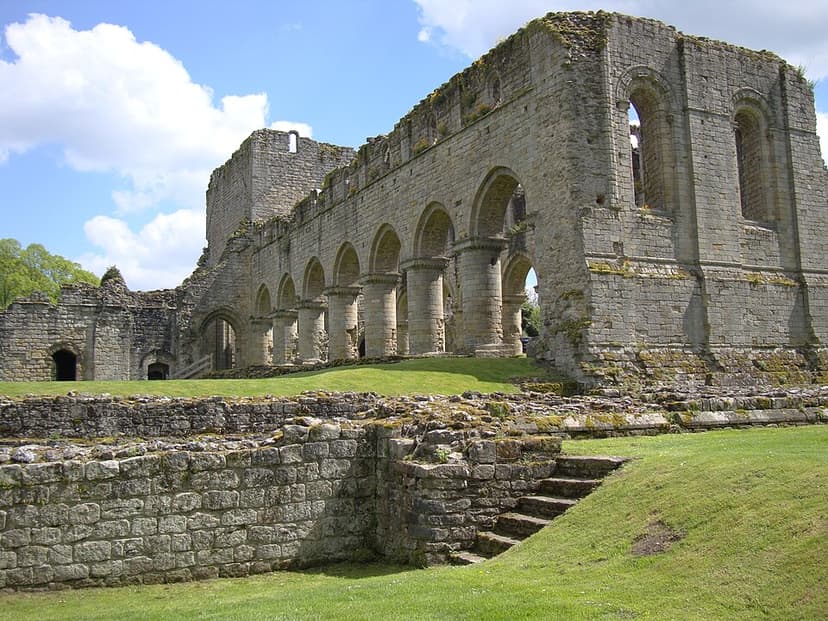
Buildwas Abbey
Buildwas Abbey was a significant Cistercian monastery in Shropshire, England, founded in 1135. It experienced periods of substantial growth and wealth, becoming a center of learning with a notable library. Despite facing challenges from economic crises and conflict, it played a role in royal administration, particularly concerning Ireland and Wales, before its suppression in 1536. Today, substantial remains of the abbey church and monastic buildings are maintained by English Heritage.

Byland Abbey
Byland Abbey was a Savigniac and later Cistercian monastic institution founded in 1135 in North Yorkshire, England. Despite an unstable early history with multiple relocations, it eventually settled at its final site near Coxwold. Once established, it became a significant religious and economic center, renowned for its sheep rearing and wool exports, and boasting a church described as one of the finest 12th-century structures in Europe. Though dissolved in 1538, extensive ruins remain, including the west front of the church with its notable rose window, and the site is maintained by English Heritage.