
Pontefract Priory
Pontefract Priory was a Cluniac monastery founded around 1090 by Robert de Lacy, the 2nd Baron of Pontefract, in Yorkshire, England. It served as a dependency of the Abbey of la Charité-sur-Loire and was dedicated to St. John the Evangelist, though later charters also mention St. Mary. The priory played a role in local history, notably as the burial site for Thomas, 2nd Earl of Lancaster, and continued until its dissolution by Henry VIII in 1540.
Key Facts
- ›Founded circa 1090 by Robert de Lacy, 2nd Baron of Pontefract.
- ›A dependency of the Abbey of la Charité-sur-Loire.
- ›Dedicated to St. John the Evangelist and later also St. Mary.
- ›Housing 16 monks in 1262 and 27 monks in 1279.
- ›Buried Thomas, 2nd Earl of Lancaster, who was later venerated for claimed miracles.
- ›Dissolved on November 23, 1540, by Henry VIII.

- the Cartulary of the Priory Survives As A Primary Source.
- Burial Site of Thomas, 2nd Earl of Lancaster.
Robert De Lacy, 2nd Baron of Pontefract, Henry De Lacy, 4th Baron of Pontefract, Pope Celestine, Thomas, 2nd Earl of Lancaster, Edward Ii of England, James Thwayts
- Foundation of the Priory
- Confirmation of Donations By Pope Celestine's Bull
- Visitation Records Showing 16 Monks In 1262 and 27 in 1279
- Beheading of Thomas, Earl of Lancaster, and His Burial At the Priory
- Construction of A Chantry Dedicated To St. Thomas
- Dissolution By Henry Viii
About Pontefract Priory
Pontefract Priory was a significant Cluniac monastery located in Yorkshire, England, founded around 1090 by Robert de Lacy, the 2nd Baron of Pontefract. As a dependency of the Abbey of la Charité-sur-Loire, it was initially dedicated to St. John the Evangelist, with later records also mentioning dedication to St. Mary. The priory held a notable collection of historical documents, including its surviving Cartulary.
History and Significance
The priory's history is documented through various records, including visitation returns that indicate a community of 16 monks in 1262 and growing to 27 by 1279, under a particularly capable prior who significantly reduced the monastery's debts. A pivotal event in its history occurred in 1322 when Thomas, 2nd Earl of Lancaster, was beheaded at Pontefract and subsequently buried within the priory church. Claims of miracles at his tomb led to offerings being impounded by King Edward II, but a chantry dedicated to St. Thomas was later built on the execution site, with permission granted in 1343 for Masses to be celebrated there.
Dissolution
In the Valor Ecclesiasticus of 1535 (26 Henry VIII), Pontefract Priory's annual revenue was recorded as £472 16s. 10½d. gross, with a clear value of £337 14s. 8½d. The monastery was surrendered to King Henry VIII on November 23, 1540, by the last prior, James Thwayts, along with seven brethren and one novice. The prior was granted a pension of fifty pounds per annum following the dissolution.
Legacy
Today, Pontefract Priory exists only as ruins, with its church and buildings completely destroyed. The site's historical significance is preserved through its name, Monk-hill, and the surviving historical records, such as its Cartulary and various charters.
Source: Wikipedia ↗
Frequently Asked Questions
When was Pontefract Priory founded?
Pontefract Priory was founded around the year 1090. It was established by Robert de Lacy, the 2nd Baron of Pontefract.
What religious order did Pontefract Priory belong to?
Pontefract Priory was a Cluniac monastery. It was a dependency of the Abbey of la Charité-sur-Loire in France.
What happened to Pontefract Priory?
The priory was dissolved by King Henry VIII on November 23, 1540. The church and buildings have been completely destroyed since then.
Who was buried at Pontefract Priory?
Several notable figures were buried at Pontefract Priory, including Robert de Lacy, Maud de Perche, Ilbert II de Lacy, Richard Plantagenet (3rd Duke of York), Thurstan, and Thomas, 2nd Earl of Lancaster.
Is there anything left of Pontefract Priory today?
The church and buildings of Pontefract Priory have been completely destroyed. However, the site is still indicated by the name of Monk-hill.
Related Monasteries
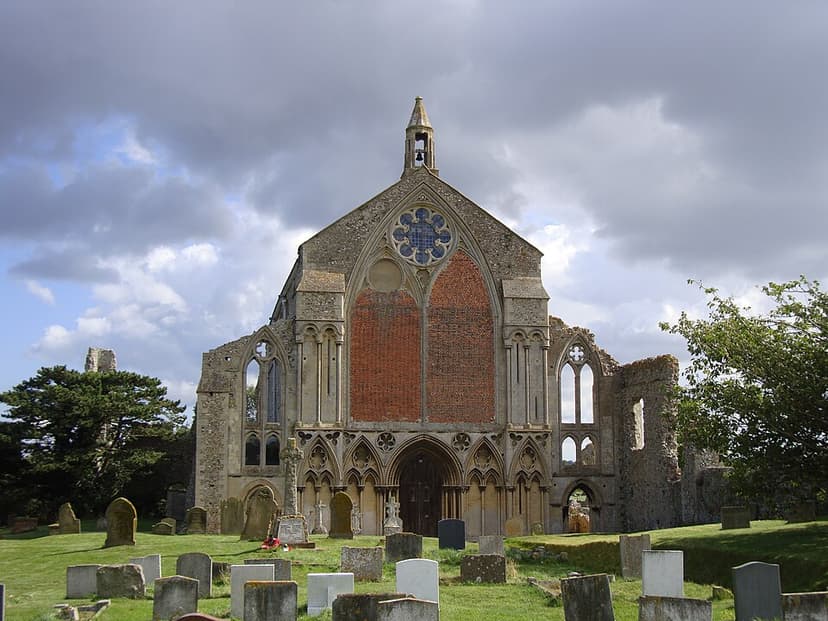
Binham Priory
Binham Priory, officially St Mary's Priory, Binham, was a ruined Benedictine priory in Norfolk, England, founded in 1091. Its history is marked by scandal and unscrupulous priors, culminating in its dissolution and partial destruction in 1539. The surviving nave of its priory church continues to serve as the parish church of St. Mary and the Holy Cross.

Chatteris Abbey
Chatteris Abbey was a Benedictine monastery for nuns founded in 1016 by Eadnoth, Bishop of Dorchester. Despite surviving an early fire and the initial wave of monastic dissolutions, it was ultimately surrendered to the King's commissioners in 1538 and demolished. While a portion of its cloister buildings was incorporated into a later mansion, the abbey site has largely vanished, with only a few wall fragments remaining.

Derby Priory (Cluniac)
St. James Priory, also known as Derby Cluniac Priory, was a Benedictine monastery established between 1072 and 1076. Situated in Derby City Centre, it developed from a Saxon-era chapel and was later associated with the Cluniac order. The priory served as a hospital for the poor and unwell in the 13th century and experienced periods of financial difficulty and rebuilding after a fire in 1335. It ceased to exist during the Dissolution of the Monasteries.