
Podlastva Monastery
The Podlastva Monastery is a Serbian Orthodox monastery situated in Lastva Grbaljska, Montenegro, dedicated to the Nativity of the Theotokos. Legend attributes its founding to Emperor Dušan around 1350, and throughout its history, it has been a significant spiritual, cultural, and political gathering place for the local community, even housing a school at one point. Despite enduring destruction and renovation, including damage from a 1979 earthquake, the monastery's church features historic frescoes from the 15th and 17th centuries.
Key Facts
- ›Founded around 1350 according to local legend.
- ›Dedicated to the Nativity of the Theotokos.
- ›Has a history of being pillaged, burned, destroyed, and renovated.
- ›Suffered damage from the 1979 Montenegro earthquake.
- ›Served as a common gathering place for local events and education.
- ›Features rare, historic frescoes from the 15th and 17th centuries.
Serbian Orthodox
Historic Frescoes, Bell Tower, Barrel-Vaulted Ceilings, Site of Historical Gatherings and Education
Manastir Podlastva
Emperor DušAn
- Pillaged, Burned, Destroyed, and Renovated Several Times
- Damaged By the 1979 Montenegro Earthquake
About Podlastva Monastery
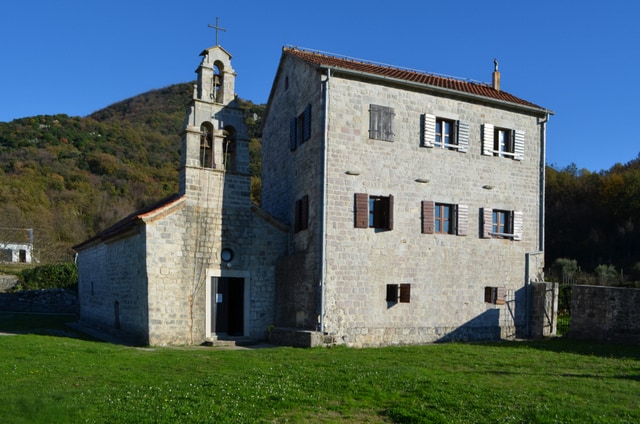
The Podlastva Monastery is a Serbian Orthodox monastic complex located in Lastva Grbaljska, within the Grbalj region of Montenegro. Its church is dedicated to the Nativity of the Theotokos. The monastery's name, "Podlastva," originates from its position downhill or "below" (pod) the nearby village of Lastva.
History and Significance
Local tradition attributes the founding of Podlastva Monastery to Emperor Dušan, who is said to have established it around 1350. Throughout its long history, the monastery has endured numerous challenges, including periods of being pillaged, burned, and destroyed, necessitating repeated renovations. It has consistently served as a vital common gathering place for the people of Grbalj, a region known for its turbulent history. Many significant spiritual, cultural, and political events have unfolded on its grounds. Furthermore, the monastery played an educational role by operating a local school during certain periods.
Architecture and Features
The monastery church is characterized by its construction of stone masonry beneath a tiled roof. An attached bell tower stands beside an independent narthex, which is structurally linked to both the nave and an adjacent monastery building. The east end of the nave features an apse. Both the narthex and nave are covered by barrel-vaulted ceilings.
Inside the nave, the ceiling walls are decorated with rare and historic frescoes dating from the 15th and 17th centuries. The contemporary iconostasis within the church displays modern icons. The monastery's infrastructure also sustained damage from Montenegro's 1979 earthquake, with partial rehabilitation occurring in 1984.
Source: Wikipedia ↗
Frequently Asked Questions
When was the Podlastva Monastery founded?
According to a local legend, the Podlastva Monastery was established around the year 1350. This date is attributed to Emperor Dušan.
What is the significance of the Podlastva Monastery?
The monastery has historically served as a crucial gathering place for the people of Grbalj, hosting numerous spiritual, cultural, and political events. It also provided educational opportunities through its operation of a local school.
What architectural styles are present at Podlastva Monastery?
The church is constructed of stone masonry with a tiled roof and includes a bell tower attached to an independent narthex, which is connected to both the nave and an adjacent building. The nave and narthex feature barrel-vaulted ceilings.
Are there any notable artworks within the monastery?
Yes, the nave's ceiling walls are adorned with rare and historic frescoes that date back to the 15th and 17th centuries. The contemporary iconostasis contains modern icons.
Has the monastery undergone significant damage or restoration?
The monastery has been subjected to destruction and renovation multiple times throughout its existence. A significant event was the 1979 earthquake in Montenegro, which caused considerable damage that was partially addressed in 1984.
Related Monasteries

Cetinje Monastery
Cetinje Monastery is a significant Serbian Orthodox monastery located in Cetinje, Montenegro, serving as the seat of the Metropolitanate of Montenegro and the Littoral. Founded around 1484 by Prince Ivan Crnojević, it was initially the cathedral monastery of the Eparchy of Zeta. Although devastated multiple times, notably in 1692, it was rebuilt and has remained a vital center of spiritual, cultural, and political life throughout Montenegro's history.
Dajbabe Monastery
The Dajbabe Monastery is a Serbian Orthodox monastery located in a cave on Dajbabe Hill near Podgorica, Montenegro. Founded in 1897 and dedicated to the Assumption of the Theotokos, it initially utilized the cave as a sanctuary before plans for expansion. A notable feature is its reliquary containing the relics of St. Simeon Dajbabe.

Dobrilovina Monastery
Dobrilovina Monastery is a Serbian Orthodox monastery situated in Donja Dobrilovina, Mojkovac, northern Montenegro, located at the entrance to the Tara River Canyon. While the village of Dobrihnina was first mentioned in 1253, the oldest preserved record of the monastery dates to 1592, with its current church dedicated to Saint George completed in 1609. The monastery has a history marked by destruction, rebuilding, and a significant role in the region's spiritual and national awakening.