
Montenegro
Montenegro is a country in Southeast Europe with a rich and complex history, evolving from ancient Illyrian settlements through various principalities and kingdoms to its modern-day status as an independent nation. Its name, meaning "Black Mountain," derives from the appearance of Mount Lovćen. The country has navigated periods of Venetian and Ottoman rule, ultimately gaining recognized independence in 1878 and re-establishing it in 2006 after a period within Yugoslavia.
Key Facts
- ›The English name "Montenegro" is a literal translation of the Venetian calque of the Montenegrin "Crna Gora," meaning "Black Mountain."
- ›The name "Montenegro" was first used to refer to the country in the late 15th century.
- ›Montenegro gained semi-autonomy in 1696 under the House of Petrović-Njegoš, initially as a theocracy.
- ›Independence was recognized by the Great Powers at the Congress of Berlin in 1878.
- ›Montenegro became a kingdom in 1910 and later became part of Yugoslavia after World War I.
- ›The country declared its independence in June 2006 following a referendum.

Mount LovćEn
Crna Gora, Mali I Zi
Stefan Uroš I, Vojislav, Mihailo, Constantine Bodin, Stefan Nemanja, BalšIć Family, Crnojević Family, Petrović-Njegoš Dynasty, Mirko Petrović, Danilo Petrović-Njegoš, Nicholas I, Ahmed Muhtar Pasha, Josip Broz Tito, Momir Bulatović, Pavle Bulatović, Milo đUkanović, Aleksandar đUkanović, Ana Kolarevic, Arso Jovanović, Sava KovačEvić, Svetozar Vukmanović-Tempo, Milovan đIlas, Peko DapčEvić, Vlado DapčEvić, Veljko Vlahović, BlažO Jovanović
- Arrival of Slav Peoples
- Emergence of the Principality of Zeta
- Rule By the Venetian Republic
- Ottoman Empire Rule
- Gained Semi-Autonomy In 1696
- Independence Recognized At the Congress of Berlin
- Became A Kingdom In 1910
- Part of Yugoslavia After World War I
- Federal State of Montenegro Founded
- Became A Republic
- Renamed Socialist Republic of Montenegro
- Renamed Republic of Montenegro
- Declared Independence
About Montenegro
Montenegro, known in Montenegrin as Crna Gora and in Albanian as Mali i Zi, meaning "Black Mountain," is a sovereign nation situated in Southeast Europe on the Balkan Peninsula. Its history is marked by a succession of ruling powers and evolving political entities, from ancient Illyrian inhabitants to medieval principalities and later periods under Venetian and Ottoman influence. The country's name itself, derived from the appearance of Mount Lovćen, hints at its rugged and mountainous terrain.
Historical Development
The territory of modern-day Montenegro was historically inhabited by Illyrians before the arrival of Slavic peoples in the 6th and 7th centuries CE. During the Early Medieval period, it was divided into principalities like Duklja, Travunia, and Raška. Duklja emerged as an independent kingdom in 1042, reaching its zenith under rulers like Mihailo and Constantine Bodin before declining. By the 14th century, the Principality of Zeta became prominent, with its nobility eventually vying for control. Large parts of southern Montenegro were under Venetian rule for centuries, while much of the territory also fell under Ottoman control after 1496.
Path to Autonomy and Independence
Montenegro developed a unique form of autonomy within the Ottoman Empire, allowing clans considerable freedom. In 1515, it became a theocracy led by the Metropolitanate of Montenegro and the Littoral. The House of Petrović-Njegoš rose to prominence, eventually establishing semi-autonomy in 1696. The country's independence was officially recognized by the Great Powers at the Congress of Berlin in 1878, and it became a kingdom in 1910. Following World War I, Montenegro was incorporated into Yugoslavia. After the breakup of Yugoslavia, Montenegro re-declared its independence on June 3, 2006, following a referendum held on May 21, 2006.
Source: Wikipedia ↗
Frequently Asked Questions
What is the origin of the name Montenegro?
The English name "Montenegro" is a direct translation of the Venetian term "Crna Gora," which itself is a calque of the Montenegrin phrase "Crna Gora." Both mean "Black Mountain," likely derived from the dark, forested appearance of Mount Lovćen.
When was Montenegro first referred to by its current name?
The name "Montenegro" began to be used to refer to the country in the late 15th century. Initially, it designated a smaller area, but its usage expanded to encompass the wider mountainous region over time.
What was the historical significance of the House of Petrović-Njegoš?
The House of Petrović-Njegoš played a crucial role in Montenegro's history, ruling the country from 1696. They initially governed as a theocracy and later as a secular principality, guiding Montenegro towards greater autonomy and eventual independence.
How did Montenegro achieve its independence?
Montenegro's independence was recognized by the Great Powers at the Congress of Berlin in 1878. After a period as part of Yugoslavia, the country formally declared its independence on June 3, 2006, following a referendum held on May 21, 2006.
What were the early political structures in Montenegro?
In the early modern period, Montenegro developed a unique form of semi-autonomy within the Ottoman Empire. It also functioned as a theocracy led by the Metropolitanate of Montenegro and the Littoral, with the ruler holding the title of "Vladika of Montenegro."
Related Monasteries

Baia de Aramă Monastery
Baia de Aramă Monastery is a significant religious site in Romania, established in the late 17th century. It is renowned for its well-preserved fresco decorations, characteristic of the Romanian artistic period between the Carpathians and the Danube. Following a period of disuse, the monastery was re-established as a nunnery in 2008 and continues to be an active spiritual center and a valuable monument of medieval art.

Donskoy Monastery
The Donskoy Monastery in Moscow was founded in 1591 to commemorate the city's defense against an invasion by the Crimean Khan Kazy-Girey. It served as a strategic defense point for the Moscow Kremlin along a key highway. Over centuries, it evolved from a humble cloister to a significant religious and architectural complex, becoming a burial site for nobility and a repository for relics and artifacts from destroyed churches during the Soviet era.
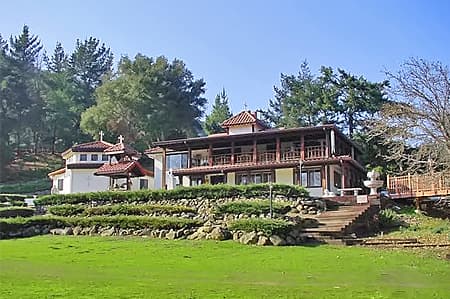
Holy Cross Orthodox Monastery
Holy Cross Orthodox Monastery is an Orthodox Church in America (OCA) monastic institution located in Castro Valley, California. Founded in 1979 by Archimandrite Theodor, it was established with the intention of building a monastery dedicated to the Appearance of the Holy Cross over Jerusalem. The monastery serves a diverse community of Orthodox Christians, offering services in various languages and acting as a center for spiritual life and sacraments.