
Baia de Aramă Monastery
Baia de Aramă Monastery is a significant religious site in Romania, established in the late 17th century. It is renowned for its well-preserved fresco decorations, characteristic of the Romanian artistic period between the Carpathians and the Danube. Following a period of disuse, the monastery was re-established as a nunnery in 2008 and continues to be an active spiritual center and a valuable monument of medieval art.
Key Facts
- ›The church was built between 1699 and 1703, with consecration on May 7, 1703.
- ›The interior features entirely conserved fresco decorations from the late 17th and early 18th centuries.
- ›The monastery was initially a monk monastery but was re-established as a nun monastery in 2008.
- ›Its architecture blends the Matei Basarab age style with Brâncovenesc elements.
- ›Notable figures associated with its founding include Milco Baiasul and Cornea Brailoiu.
- ›The painters of the interior frescoes were Neagoe and Partenie of Tismana.

Matei Basarab Style, BrâNcovenesc Style
Preserved 17th-18th Century Frescoes, Carved Linden Wood Iconostasis, Strategic and Defensive Construction
- MăNăStirea SfințIi Voievozi of the Baia De Aramă Town
Saint Nicodim of Tismana, Matei Basarab, Constantin BrâNcoveanu, Milco Baiasul, Cornea Brailoiu, Vasile, Neagoe, Partenie of Tismana, Ivan, Mihaela PăIuș, Isidora Rusu
- Construction of the Church Between 1699-1703
- Consecration of the Church On May 7, 1703
- Restoration and Re-Establishment As A Nun Monastery In 2008
About Baia de Aramă Monastery
Baia de Aramă Monastery is a significant religious and historical site located in Baia de Aramă, in the northwestern region of Oltenia, Romania. Situated on the Mehedinți Plateau and nestled amidst surrounding hills, the monastery has a rich history dating back to the late 17th century. Its church, constructed between 1699 and 1703, is a notable example of Romanian ecclesiastical architecture, blending elements of the Matei Basarab period with the emerging Brâncovenesc style.
History and Artistic Significance
The monastery's significance is largely attributed to its well-preserved interior wall paintings. Executed in fresco technique by renowned painters Neagoe and Partenie of Tismana, these artworks are characteristic of the artistic trends prevalent in the Romanian territory between the Southern Carpathians and the Danube during the late 17th and early 18th centuries. The frescoes, which are entirely conserved in their original form, depict various religious scenes and figures, including unique portraits of Serbian saints and rulers.
The monastery's history also reflects periods of cultural exchange, having been under Greek and Serbian abbots and fostering connections with neighboring Serbian communities. Although it functioned as a hermitage and was dedicated to the Hilandar Monastery of Mount Athos, parts of the original construction were lost over time.
Modern Revival
After a long period of disuse, Baia de Aramă Monastery was revitalized in 2008 when it was re-established as a nun monastery under the jurisdiction of the Diocese of Severin and Strehaia. Today, it serves as an active spiritual center, striving to preserve its rich artistic heritage while continuing its monastic life, attracting both devotees and tourists interested in its historical and artistic value.
Source: Wikipedia ↗
Frequently Asked Questions
When was Baia de Aramă Monastery founded?
While local tradition suggests an earlier monastic settlement from the 15th century, the current church building was constructed between 1699 and 1703, with its consecration taking place on May 7, 1703. The monastery began its activity in 1703.
What is significant about the art at Baia de Aramă Monastery?
The monastery is particularly noted for its interior wall paintings, executed in fresco technique. These decorations are entirely conserved in their original form and are specific to the artistic trends of the late 17th and early 18th centuries in Romania.
What is the architectural style of Baia de Aramă Monastery?
The church's architecture blends the style of the Matei Basarab age from the 17th century with the Brâncovenesc style of the 18th century. Key features include a bell tower on the nave, brick columns, and a carved iconostasis.
Is Baia de Aramă Monastery still active?
Yes, the monastery was re-established as a nun monastery in 2008 and is under the jurisdiction of the Diocese of Severin and Strehaia. It currently houses an active monastic community.
Who were the founders of Baia de Aramă Monastery?
The true founders are considered to be Milco Baiasul, a foreman of local miners, and Cornea Brailoiu, the Great Ban of Craiova and a relative of Constantin Brâncoveanu. Constantin Brâncoveanu himself supported the building with a donation.
Related Monasteries

Donskoy Monastery
The Donskoy Monastery in Moscow was founded in 1591 to commemorate the city's defense against an invasion by the Crimean Khan Kazy-Girey. It served as a strategic defense point for the Moscow Kremlin along a key highway. Over centuries, it evolved from a humble cloister to a significant religious and architectural complex, becoming a burial site for nobility and a repository for relics and artifacts from destroyed churches during the Soviet era.
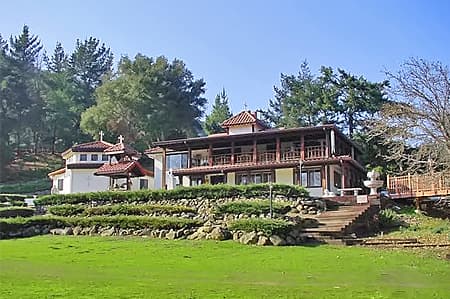
Holy Cross Orthodox Monastery
Holy Cross Orthodox Monastery is an Orthodox Church in America (OCA) monastic institution located in Castro Valley, California. Founded in 1979 by Archimandrite Theodor, it was established with the intention of building a monastery dedicated to the Appearance of the Holy Cross over Jerusalem. The monastery serves a diverse community of Orthodox Christians, offering services in various languages and acting as a center for spiritual life and sacraments.

Ipatiev Monastery
The Ipatiev Monastery, also known as the Hypatian Monastery, is a male monastery located on the bank of the Kostroma River in Russia. Founded around 1330, it is dedicated to St. Hypatios of Gangra and has played a significant role in Russian history, particularly during the Time of Troubles and the early Romanov dynasty. The monastery is a notable center of learning and has been the site of important historical discoveries and events.