
Dobrilovina Monastery
Dobrilovina Monastery is a Serbian Orthodox monastery situated in Donja Dobrilovina, Mojkovac, northern Montenegro, located at the entrance to the Tara River Canyon. While the village of Dobrihnina was first mentioned in 1253, the oldest preserved record of the monastery dates to 1592, with its current church dedicated to Saint George completed in 1609. The monastery has a history marked by destruction, rebuilding, and a significant role in the region's spiritual and national awakening.
Key Facts
- ›The monastery is located on the left bank of the Tara River, at the start of Europe's deepest canyon.
- ›The oldest mention of the monastery dates to 1592, though the village of Dobrihnina existed in 1253.
- ›The current church, dedicated to Saint George, was finished in 1609 and its frescoes completed by 1613.
- ›It was built in the Raška architectural school style.
- ›Archimandrite Mihailo DožIć-Medenica established a secret school at the monastery in the 19th century.
- ›The monastery played a role in organizing an insurgent battalion during the Montenegrin–Ottoman War.

RašKa Architectural School
- Location At the Beginning of the Tara River Canyon
- Frescoes Completed By 1613
- Secret School Established In the 19th Century
Manastir Dobrilovina, Little MoračA
Hegumen JanićIje, Duhovnik Zarija, Hegumen Joakim, Vojvoda Radič MilošEvić, Knezovi, Hieromonk Makarije of VraćEvšNica, Jovan Savić, Priest Vid, Archimandrite Mihailo DožIć-Medenica, Stefan Uroš I
- Ottoman Authorities Allowed Rebuilding of the Monastery
- Construction of the Current Church
- Painting of Frescoes
- Potarje Revolt Against the Ottoman Empire
- Relics of Archbishop Arsenije I Moved To the Monastery
- Ravaged By Ottomans
- Church Destroyed By Omer Akn
- Restored By Hieromonk Makarije
- Attacked By Turks From KolašIn
- Church Renovated
- Secret School Operated
- Organized Insurgent Battalion
- Ottomans Emptied and Burned Quarters
- Renovated
- Battle of Mojkovac
About Dobrilovina Monastery
Dobrilovina Monastery is a significant Serbian Orthodox monastic complex located in Donja Dobrilovina, near Mojkovac in northern Montenegro. Situated on the left bank of the Tara River, it stands at the entrance to the Tara River Canyon, renowned as the deepest canyon in Europe. The monastery's history is deeply intertwined with the local community and the broader historical context of the region, marked by periods of construction, destruction, and revival.
History and Significance
The earliest mention of the settlement of Dobrihnina, later known as Dobrilovina, appears in a Nemanjić charter from 1253. While the exact date of the monastery's original foundation is not precisely recorded, the oldest preserved mention of its existence dates to 1592. In that year, Ottoman authorities granted permission for locals to rebuild their monastery. The current church, dedicated to Saint George, was completed in 1609, with its interior frescoes finished by 1613. Throughout its existence, the church has endured multiple instances of being pillaged, abandoned, and destroyed, necessitating various renovations.
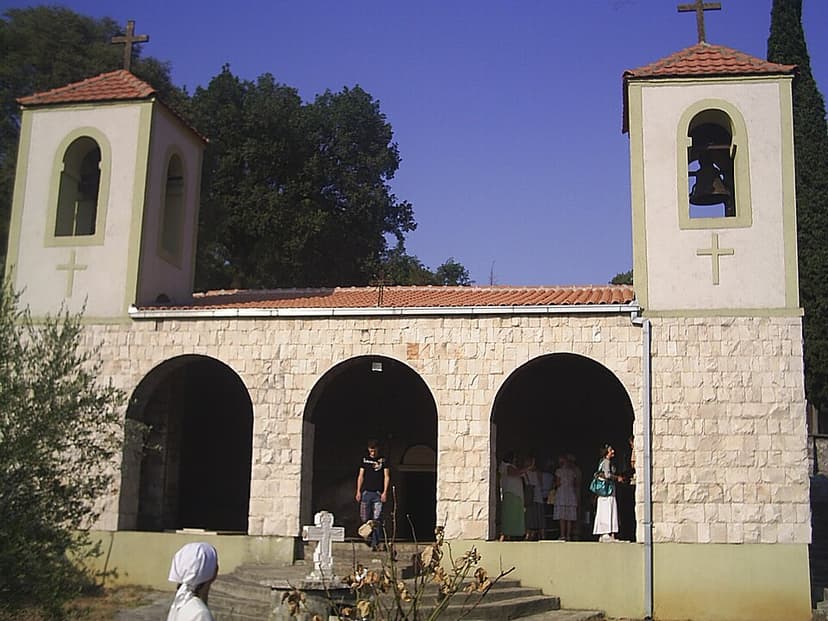
Architecturally, Dobrilovina Monastery adheres to the Raška architectural school. Its design is characterized by a single nave and a rectangular apse, with low choir chapels that appear as transepts on the ground plan. This style shares resemblances with other monasteries from the same school, such as Uvac Monastery and Majstorovina Monastery.
In the 19th century, under the administration of archimandrite Mihailo Dožić-Medenica, Dobrilovina Monastery evolved into a vital center for spiritual and political aspirations in the Potarje region. Dožić established a school within the monastery, operating in secret due to Ottoman rule, which is considered the first school in the Tara valley and a crucial element in the national awakening of the area. He also organized a local insurgent battalion that was active during the Montenegrin–Ottoman War.
The monastery's history includes the transfer of valuables from the Ravna Reka monastery in 1673 and the relocation of relics of Archbishop Arsenije I at a later date. Despite facing destruction and abandonment on several occasions, including a notable incident around 1813 when the church was reportedly destroyed, it was restored in 1833 and later renovated in 1866. The monastery was again renovated in 1905. Its historical role as a spiritual and cultural hub, particularly its contribution to education and local resistance, underscores its importance in the history of Montenegro.
Source: Wikipedia ↗
Frequently Asked Questions
When was Dobrilovina Monastery founded?
While the village of Dobrihnina was mentioned in 1253, the oldest existing sources mentioning the monastery date from 1592. The current church dedicated to Saint George was finished in 1609.
What is the architectural style of Dobrilovina Monastery?
The monastery was built in the Raška architectural school. It features a single-naved design with a rectangular apse and low choir chapels at the sides.
What is the significance of Dobrilovina Monastery?
In the 19th century, under archimandrite Mihailo Dožić-Medenica, it became a center for spiritual and political life, hosting a secret school that was crucial for national awakening in the region.
Has the monastery always been in its current state?
No, the church dedicated to Saint George has been pillaged, abandoned, destroyed, and renovated several times since its founding. It has faced multiple ravages by Ottoman forces throughout its history.
Where is Dobrilovina Monastery located?
The monastery is located in Donja Dobrilovina, Mojkovac, in northern Montenegro, on the left banks of the Tara River, at the beginning of the Tara River Canyon.
Related Monasteries

Cetinje Monastery
Cetinje Monastery is a significant Serbian Orthodox monastery located in Cetinje, Montenegro, serving as the seat of the Metropolitanate of Montenegro and the Littoral. Founded around 1484 by Prince Ivan Crnojević, it was initially the cathedral monastery of the Eparchy of Zeta. Although devastated multiple times, notably in 1692, it was rebuilt and has remained a vital center of spiritual, cultural, and political life throughout Montenegro's history.
Dajbabe Monastery
The Dajbabe Monastery is a Serbian Orthodox monastery located in a cave on Dajbabe Hill near Podgorica, Montenegro. Founded in 1897 and dedicated to the Assumption of the Theotokos, it initially utilized the cave as a sanctuary before plans for expansion. A notable feature is its reliquary containing the relics of St. Simeon Dajbabe.

Dovolja Monastery
The Dovolja Monastery is a Serbian Orthodox monastery situated on the right bank of the Tara River near Pljevlja, Montenegro. Believed to have been founded by King Stefan Milutin at the end of the 13th century, it was first documented in 1513 and is dedicated to the Assumption of the Holy Mother of God. The monastery is ecclesiastically administered by the Eparchy of Mileševa, and at some point after 1699, the relics of Archbishop Arsenije I were transferred from Dovolja to Dobrilovina Monastery.