
Pentemont Abbey
Cistercian·France·Mixed use (Ministry of Defence, Protestant church)·13th century
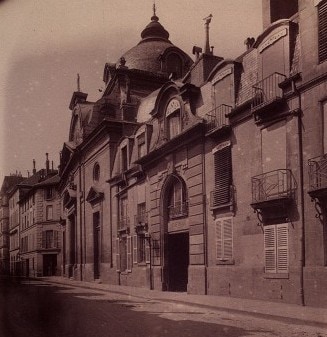
Pentemont Abbey, originally a Cistercian nunnery founded near Beauvais in 1217, was relocated to Paris in 1672. It became a prestigious educational institution for elite daughters and a refuge for highborn women. Disestablished during the French Revolution, its buildings were repurposed for military use, with the former chapel becoming a Protestant church in 1844.
Key Facts
- ›Founded near Beauvais in 1217 and moved to Paris in 1672.
- ›Was a prominent educational institution for daughters of the elite in the late 18th century.
- ›Housed notable figures like Thomas Jefferson's daughters and Joséphine de Beauharnais.
- ›Disestablished during the French Revolution and buildings converted to military use.
- ›The former chapel has served as the Protestant Temple de Pentemont since 1844.
- ›The complex consists of 18th and 19th-century buildings.
18th-Century, 19th-Century
Former Chapel, Aristide Cavaillé-Coll Organ, War Memorial In the Courtyard, Bunker Constructed During the 20th Century
Abbaye De Penthemont, Pentemont, Panthemont, Pantemont
Philip of Dreux, Milo of Nanteuil, HéLèNe De Tourville, Marie-Catherine BéThisy De MéZièRes, FrançOis Ii Franque, Pierre Contant D'Ivry, Denis Diderot, Louise AdéLaïDe De Bourbon, Louise D'EsparbèS De Lussan, Thomas Jefferson, Martha Jefferson Randolph, Mary Jefferson, Marquis De Lafayette, Abigail Adams, JoséPhine De Beauharnais, Alexandre De Beauharnais, James Smithson, Duke of Northumberland, Napoleon Iii, André Maginot, Henri Frenay, Victor Baltard, Aristide Cavaillé-Coll, Benjamin Mouton
- Founded Near Beauvais
- Sanctioned By Pope Gregory Ix
- Provided Refuge To Charlotte I De Monceaux
- Moved To Paris
- Reconstruction Initiated By Abbess Marie-Catherine BéThisy De MéZièRes
- Reconstruction Completed
- Disestablished During the French Revolution
- Buildings Turned Over To Military Use
- Expanded To Rue De Bellechasse
- Former Chapel Converted To Protestant Church
- Bunker Constructed
- Sale To Real Estate Investment Trust
About Pentemont Abbey
Pentemont Abbey: A Historical Overview
Pentemont Abbey, located in the 7th arrondissement of Paris, is a complex of 18th and 19th-century buildings with a history rooted in the Cistercian Order. Originally founded near Beauvais in 1217, the abbey was relocated to its present Parisian site in 1672 at the request of King Louis XIV. Under Abbess Marie-Catherine Béthisy de Mézières, a significant reconstruction project was undertaken from 1745 to 1783, transforming the abbey into one of Paris's most prestigious educational institutions for the daughters of the elite.
During its active period, Pentemont Abbey was renowned for its educational rigor and also served as a sanctuary for highborn women seeking respite or independence, including notable figures like Joséphine de Beauharnais. The abbey's distinguished reputation and considerable revenues reflected its prominence in Parisian society.
History and Transformation
The abbey's trajectory shifted dramatically with the French Revolution. Disestablished and its properties confiscated, the buildings were subsequently repurposed for military functions, first housing the National Guard and later the Imperial Guard. Further expansion occurred in 1835, altering some of the original structure. The former chapel, after being used for storage during the Revolution, was eventually dedicated as a Protestant church, the Temple de Pentemont, in 1844, following extensive conversion work by architect Victor Baltard.
Legacy and Modern Use
In the 20th century, Pentemont Abbey continued its association with governmental functions, housing the Ministry of War Pensions. A notable feature from this era is a bunker constructed in 1937. In 2014, the Ministry of Defence initiated plans to vacate the historic complex, with the buildings slated for sale to a real estate investment trust, marking another significant transition in the long history of Pentemont Abbey. The Temple de Pentemont, however, continues to serve its congregation.
Source: Wikipedia ↗
Frequently Asked Questions
When was Pentemont Abbey founded?
The abbey was originally founded near Beauvais in 1217. It was later moved to its current site in Paris in 1672.
What was the primary purpose of Pentemont Abbey in Paris?
In Paris, Pentemont Abbey served as a prestigious educational institution for young women of elite families. It also provided accommodations for highborn women seeking rest or temporary independence.
What happened to Pentemont Abbey after the French Revolution?
Following the French Revolution, the abbey was disestablished and its properties confiscated. The buildings were then repurposed for military use, serving as the home for various military units.
Is the former chapel of Pentemont Abbey still in use?
Yes, the former chapel of Pentemont Abbey has been a Protestant church, known as the Temple de Pentemont, since 1844. It was converted for Protestant worship with significant architectural modifications.
Were any famous historical figures educated at Pentemont Abbey?
Yes, Pentemont Abbey educated daughters of the elite, including Martha and Mary, daughters of Thomas Jefferson. It also provided refuge to Joséphine de Beauharnais during her separation from her first husband.
What is the current status of the Pentemont Abbey buildings?
The buildings of Pentemont Abbey are currently occupied by the Ministère de la Défense, although plans were in place for them to be sold to a real estate investment trust. The former chapel functions as a Protestant church.
Related Monasteries

La Clarté-Dieu
The Abbey of La Clarté-Dieu was a Cistercian monastery founded in 1239 in Saint-Paterne-Racan, France. Conceived by Peter des Roches, Bishop of Winchester, it was established as part of a pair with Netley Abbey in England. Despite suffering damage during the Hundred Years' War and facing financial strain, it survived until the French Revolution, after which it was secularized and partially used as a farm. Today, much of the medieval and post-medieval structures remain in excellent condition and are preserved as a monument historique, open to the public.

Maubuisson Abbey
Maubuisson Abbey, also known as Notre-Dame-la-Royale, is a former Cistercian nunnery founded in 1236 by Blanche of Castile, Queen of France. It served as a royal residence and necropolis, and despite periods of decline and conflict, it played an important role in the local economy. Today, the surviving buildings are listed as a monument historique and the site houses a Centre of Contemporary Arts.
Port-Royal-des-Champs
Port-Royal-des-Champs was a Cistercian abbey that gained significant cultural and theological influence in the 17th century, particularly through its association with Jansenism and the prominent Arnauld family. It established renowned schools and became a center for intellectual and religious reform, attracting figures like Blaise Pascal. Despite its influence, it faced persecution and was eventually suppressed by papal bull, with most of its buildings razed.