
Paris
Paris, originally Lutetia Parisiorum, has a history stretching back to the 3rd century BC, evolving from a Gallic settlement to the capital of France. It has been a major European center for finance, diplomacy, commerce, culture, fashion, and gastronomy since the 17th century. The city is renowned for its iconic landmarks, extensive museums, and significant role in major historical events, including the French Revolution and World Wars.
Key Facts
- ›The city was founded by the Parisii tribe around the middle of the 3rd century BC.
- ›It became a Roman settlement named Lutetia Parisiorum in 52 BC.
- ›Paris served as the capital of Clovis the Frank from 508 AD.
- ›The city was the most populous in Europe by the 14th century, with an estimated 200,000 inhabitants.
- ›Parts of the city along the Seine have been designated a UNESCO World Heritage Site since 1991.
- ›Paris is a major transportation hub, with Charles de Gaulle Airport being the EU's busiest.

Gothic, Baroque, Art Nouveau, Haussmannian
Notre Dame Cathedral, Louvre Fortress, Pont Neuf, Palais-Cardinal, Versailles, Champs-éLyséEs, Arc De Triomphe, Eiffel Tower, Grand Palais, Petit Palais, Paris MéTro, Centre Georges Pompidou, MuséE D'Orsay, Louvre Pyramid, Promenade Des Berges De La Seine, îLe De La Cité
Lutetia Parisiorum, Lutetia
Julius Caesar, Saint Denis, Clovis the Frank, Odo of France, Hugh Capet, Maurice De Sully, Philip Augustus, Henry V of England, Joan of Arc, Henry Iv, Cardinal Richelieu, Louis Xiii, Louis Xiv, Jean Sylvain Bailly, Louis Xvi, Napoleon Bonaparte, Louis-Philippe I, Napoleon Iii, Georges-EugèNe Haussmann, éMile Zola, Charles Baudelaire, Paul Verlaine, Courbet, Manet, Monet, Renoir, Pablo Picasso, Modigliani, Henri Matisse, Marcel Proust, Ernest Hemingway, Igor Stravinsky, James Joyce, Josephine Baker, Eva Kotchever, Henry Miller, AnaïS Nin, Sidney Bechet, Salvador Dalí, Ho Chi Minh, Zhou Enlai, LéOpold SéDar Senghor, Charles De Gaulle, Jacques Chirac, Georges Pompidou, ValéRy Giscard D'Estaing, FrançOis Mitterrand, Bertrand Delanoë, Nicolas Sarkozy
Roman Conquest of the Paris Basin, Christianity Introduced By Saint Denis, Sacking By Vikings, Siege of Paris, Construction of Notre Dame Cathedral Started, University of Paris Founded, English Occupation During Hundred Years' War, St. Bartholomew's Day Massacre, Henry Iv Enters Paris, Fronde Civil War, French Revolution, Napoleon Bonaparte Seizes Power, July Revolution, Revolution of 1848, Franco-Prussian War and Siege of Paris, Paris Commune, 1889 Universal Exposition, 1900 Universal Exposition, First World War, German Occupation, Liberation of Paris, Algerian War, May 1968 Protests and General Strike, January 2015 Attacks, November 2015 Attacks, Paris Agreement Signing
About Paris
Paris, originally known as Lutetia Parisiorum, traces its origins to a Gallic settlement of the Parisii tribe around the mid-3rd century BC. It was conquered by Julius Caesar for the Roman Republic in 52 BC, becoming a prosperous Roman city. Christianity was introduced in the 3rd century AD by Saint Denis, the first Bishop of Paris. The city's strategic importance was established through defenses against Viking raids and sieges, and it gradually became the largest and most prosperous city in France from the Capetian dynasty onwards.
By the end of the 12th century, Paris had solidified its position as the political, economic, religious, and cultural capital of France. Significant constructions like Notre Dame Cathedral began, and the city's marketplace and trade organizations developed. The University of Paris was established, attracting scholars from across Europe. Paris was the most populous city in Europe by the 14th century, though it faced periods of occupation during the Hundred Years' War and internal religious conflicts.
The city underwent significant transformations during the reigns of Henry IV and Louis XIV, with the construction of new bridges, palaces, and public squares, and the demolition of city walls to create boulevards. Paris became a major global center for finance, diplomacy, commerce, culture, fashion, and gastronomy from the 17th century onward. The 18th century saw its rise as the "City of Light" during the Age of Enlightenment and the epicentre of the French Revolution.
The 19th century brought further urban development under Napoleon III and Baron Haussmann, characterized by wide boulevards, parks, and improved infrastructure, though it also saw sieges and the tumultuous Paris Commune. The late 19th and early 20th centuries hosted major international expositions and saw Paris become a hub for artistic and literary movements. The city endured the impacts of both World Wars, including German occupation, and played a role in post-war decolonization conflicts and social movements like May 1968.
In contemporary times, Paris continues to be a global city, a hub for international organizations, and a center for arts and culture. Parts of the city along the Seine are recognized as a UNESCO World Heritage Site. Modern developments include extensive transportation networks and ongoing urban renewal projects, while the city has also faced challenges such as terrorist attacks and efforts to address climate change, exemplified by the signing of the Paris Agreement.
Source: Wikipedia ↗
Frequently Asked Questions
What was Paris called before it was Paris?
Before being known as Paris, the city was referred to as Lutetia Parisiorum, or Lutetia, during the Roman period. This name is believed to derive from the Celtic root *lukot- ('mouse') or *luto- ('marsh, swamp').
When did Paris become the capital of France?
Clovis the Frank made the city his capital from 508 AD. Subsequently, with the rise of the Capetian dynasty in 987, Paris gradually grew to become the largest and most prosperous city in France, solidifying its status as the nation's capital.
What is Paris known for historically?
Paris is historically known as a major center of finance, diplomacy, commerce, culture, fashion, and gastronomy. It was also a focal point of significant events, including the French Revolution, and has been a mecca for artists and writers.
Is Paris a UNESCO World Heritage Site?
Yes, parts of the city along the Seine have been designated as a UNESCO World Heritage Site since 1991. This designation recognizes the unique cultural and historical significance of these areas.
What is Paris's nickname?
Paris is famously nicknamed the "City of Light." This moniker is partly attributed to its significant role during the Age of Enlightenment and its status as a major center of education and science.
Related Monasteries

Avignon
Avignon, also known as 'La Cité des Papes' (The City of the Popes), is a historic city in southern France renowned for its papal history and well-preserved medieval architecture. Between 1309 and 1377, it served as the residence for seven successive popes, significantly shaping its urban development and cultural landscape. The city's historic center, including the Palais des Papes and its ramparts, is a UNESCO World Heritage Site, drawing millions of visitors annually for its architectural grandeur and vibrant arts scene, particularly the annual Festival d'Avignon.
Bourges
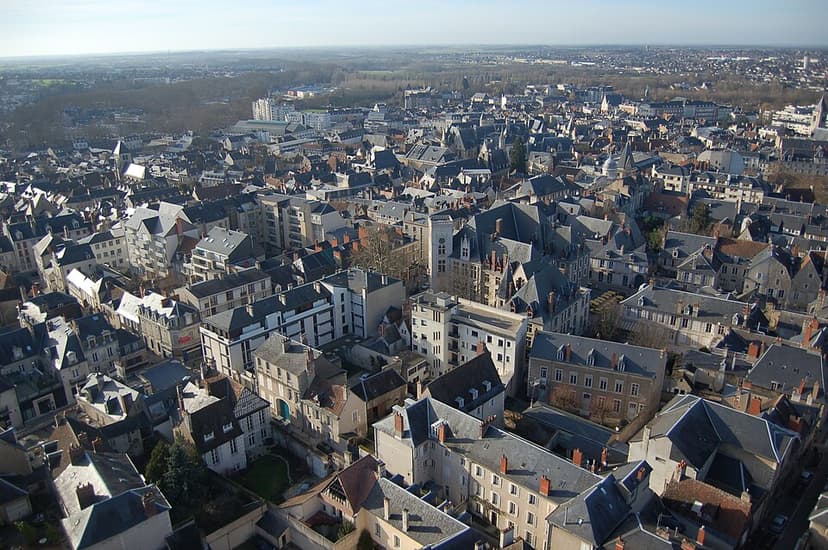
Bourges is a historic commune in central France, serving as the capital of the Cher department and the former province of Berry. Its origins trace back to the Gallic confederacy, enduring sieges and reconstructions by Romans and Franks. Throughout the Middle Ages and Renaissance, it served as a significant administrative and cultural center, notably as a refuge for Charles VII and a hub for alchemy. Today, Bourges is recognized for its stunning Gothic cathedral, a UNESCO World Heritage site, and its rich architectural heritage.

Châlons-sur-Marne
Châlons-en-Champagne, formerly known as Châlons-sur-Marne, is a city in the Grand Est region of France with a rich historical background, dating back to Gallic and Gallo-Roman settlements. It is historically significant as a conjectured site for major battles, including those involving Roman emperors and Attila the Hun. The city boasts notable architectural landmarks, including cathedrals and churches, with some parts recognized as UNESCO World Heritage.