
Pavlo-Obnorsky Monastery
The Pavlo-Obnorsky Monastery is a Russian Orthodox monastery founded in 1414 by Pavel of Obnora. Situated on the Nurma River in Vologda Oblast, Russia, it gained considerable influence in the 17th century. After being abolished in 1924 and repurposed, it was reestablished in 1994 and regained its independence in 2003, becoming an active monastic community once more.
Key Facts
- ›Founded in 1414 by Pavel of Obnora, a disciple of Sergius of Radonezh.
- ›Was one of the most influential monasteries in Russia during the 17th century.
- ›Suffered destruction by Tatars in 1538 and was rebuilt, with its current ensemble largely formed between the 16th and 18th centuries.
- ›Reestablished in 1994 after being abolished in 1924 and used for secular purposes.
- ›Its architectural ensemble includes the Assumption Church (1867) and Resurrection Church (1862), among other structures.
- ›Some icons by the renowned Russian icon painter Dionisius were created at the monastery.

Russian Revival
Assumption Church, Resurrection Church, Chapel of St. Pavel of Obnora, Artificial Hills Symbolizing New Jerusalem
Pavel of Obnora, Alexios, Dionisius
Founded By Pavel of Obnora In 1414, Destroyed By Tatars In 1538, Abolished In 1924, Reestablished In 1994, Became Independent Entity In 2003
About Pavlo-Obnorsky Monastery
The Pavlo-Obnorsky Monastery is a significant Russian Orthodox monastic complex located in the Vologda Oblast of Russia. Founded in 1414 by Saint Pavel of Obnora, the monastery was established in a remote forest setting and quickly developed a reputation for its strict monastic rules.
History and Significance
Founded by Pavel of Obnora, the monastery's early years saw the establishment of rigorous spiritual practices. Pavel himself did not hold a formal position within the monastery, but his disciple Alexios served as the first hegumen. The monastery rose to prominence, becoming one of the most influential religious centers in Russia by the 17th century. Its significance is further highlighted by the fact that some icons by the renowned Russian icon painter Dionisius were created there.
In 1538, the monastery suffered destruction at the hands of Tatar raiders. It was subsequently rebuilt, and the ensemble of buildings that largely defines its present appearance was constructed between the 16th and 18th centuries. A notable architectural ambition during this period was to create a symbolic representation of New Jerusalem, which involved the construction of two artificial hills topped with a church and a chapel.
The monastery faced a period of disruption when it was abolished in 1924. During the Soviet era, its buildings were repurposed for secular uses, including a school, orphanage, and sanatorium. However, the monastic tradition was revived when the monastery was reestablished in 1994, initially as a metochion of the Spaso-Prilutsky Monastery. It regained its independent status in 2003 and continues to function as an active monastic community, being recognized as one of the four active monasteries in the Vologda Oblast as of 2011.
Architecture
The architectural ensemble of the Pavlo-Obnorsky Monastery, though neglected after its abolition, has undergone restoration efforts since the 1990s. Key structures within the complex include the Assumption Church, built in 1867, and the Resurrection Church, constructed in 1862 as a skete approximately 300 meters from the main monastery. Contemporary wooden chapels dedicated to St. Pavel of Obnora are also present, including one located at a spring associated with the saint. The Trinity Church, a significant earlier structure built between 1505 and 1516, has unfortunately been demolished. The monastery's ensemble and individual buildings are protected and recognized as cultural monuments of local significance.
Source: Wikipedia ↗
Frequently Asked Questions
When was the Pavlo-Obnorsky Monastery founded?
The Pavlo-Obnorsky Monastery was founded in 1414. Its founder was Pavel of Obnora, who sought a remote location in the dense forests of the time.
Where is the Pavlo-Obnorsky Monastery located?
The monastery is located in the selo of Yunosheskoye, on the bank of the Nurma River, a tributary of the Obnora River. This is in the Gryazovetsky District in the southern part of Vologda Oblast, Russia.
What is the history of the Pavlo-Obnorsky Monastery after its founding?
The monastery was rebuilt after being destroyed by Tatars in 1538, with its ensemble taking shape from the 16th to 18th centuries. It was abolished in 1924 and its buildings were used for various secular institutions before its reestablishment in 1994.
Is the Pavlo-Obnorsky Monastery still active?
Yes, the Pavlo-Obnorsky Monastery was reestablished in 1994 and became an independent entity in 2003. As of 2011, it was one of the four active monasteries in Vologda Oblast.
What notable artists are associated with the monastery?
The famous Russian icon painter Dionisius created some of his icons at the Pavlo-Obnorsky Monastery. These works have since been preserved in the Tretyakov Gallery in Moscow.
Related Monasteries
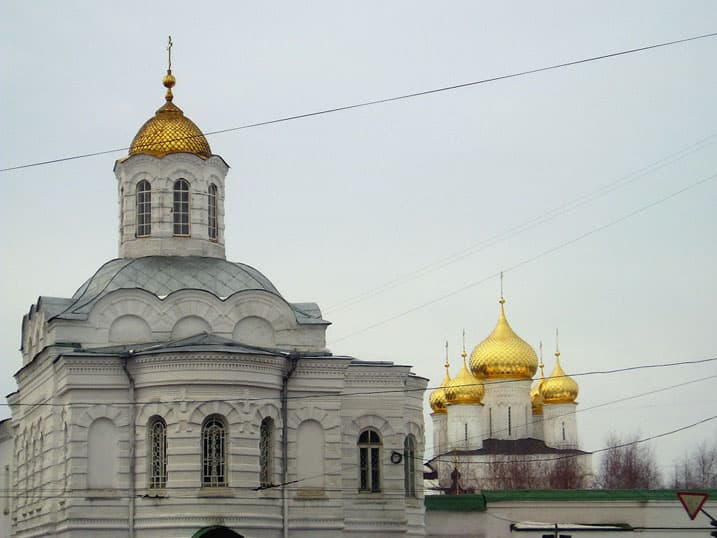
Bogoyavlensky Monastery (Kostroma)
Bogoyavlensky Convent, located in Kostroma, is a prominent Russian Orthodox convent renowned for housing the ancient Feodorovskaya Icon of the Mother of God. Originally founded as a monastery in the 15th century, it underwent significant construction and stylistic changes throughout its history, including a major rebuilding in the Russian Revival style in the late 19th century, after which it became a convent. Despite abolishment after the October Revolution, it was revived in the 1990s.

Krypetsky Monastery
Krypetsky Monastery is a Russian Orthodox monastery located near Pskov, founded in 1485 by Saint Savva Krypetsky. Initially established in a difficult marshland, it received support from the Pskov veche and later saw expansion and improvements. Despite periods of disrepair and closure by the Bolsheviks in 1918, the monastery was revived and restituted to the Russian Orthodox Church in 1991.

Makaryev Monastery
The Zheltovodsky Makaryev Convent, historically a men's monastery, is a significant Russian Orthodox site known for its legendary foundation by Saint Macarius in the early 15th century. It played a crucial role in the economy due to the famous Makaryev Fair held outside its walls for over two centuries. After facing destruction, relocation of the fair, and dissolution, it was resurrected as a women's convent in the late 19th century and continues to operate today.