
Makaryev Monastery
The Zheltovodsky Makaryev Convent, historically a men's monastery, is a significant Russian Orthodox site known for its legendary foundation by Saint Macarius in the early 15th century. It played a crucial role in the economy due to the famous Makaryev Fair held outside its walls for over two centuries. After facing destruction, relocation of the fair, and dissolution, it was resurrected as a women's convent in the late 19th century and continues to operate today.
Key Facts
- ›Legendary foundation by Saint Macarius in the early 15th century.
- ›Site of the famous Makaryev Fair, a major economic event in Eastern Europe.
- ›Rebuilt in stone between 1651 and 1667, featuring fortress-like walls.
- ›Captured by Stenka Razin's rebel forces in 1670.
- ›Dissolved in 1869, then resurrected as a women's convent in 1882.
- ›Restored to the Nizhny Novgorod Orthodox Diocese in 1992.

Classical
Fortress-Like Stone Walls With Towers, Cathedral of Holy Trinity, Church of the Dormition of Our Lady, Refectory, Bell Tower, Church of St. Michael the Archangel, Monastic Cells, Well Said To Be Dug By Saint Macarius
- Zheltovodsky Makaryev Convent of the Holy Trinity
- Svyato-Troitsye-Makaryevo-Zheltovodsky Zhensky Monastyr
Saint Macarius, Ulu Mukhammed, Avramy, Stenka Razin, Sister Mikhaila
- Burned By Tatar Khan Ulu Mukhammed In 1439
- Rebuilt Starting In 1620
- Major Stone Construction Between 1651 and 1667
- Captured By Stenka Razin's Rebel Forces In 1670
- Site of the Makaryev Fair For Over Two Centuries
- Massive Fire In 1816 Destroyed Fair Buildings
- Fair Moved To Nizhny Novgorod In 1817
- Monastic Community Dissolved In 1869
- Resurrected As A Women's Convent In 1882
- Nuns Expelled After the October Revolution In 1927
- Buildings Used For Orphanage, Then Rented Out
- Used As A Military Hospital During World War Ii
- Transferred To Lyskovo College of Animal Husbandry and Veterinary Medicine In 1943
- Restored To Nizhny Novgorod Orthodox Diocese In 1992
- Saint's Head Transferred To the Monastery In 2007
About Makaryev Monastery
The Zheltovodsky Makaryev Convent of the Holy Trinity, historically a men's monastery and now a convent of the Russian Orthodox Church, holds significant historical and legendary importance in the Nizhny Novgorod Oblast of Russia. Its origins are traced to the early 15th century, with legend attributing its founding to the missionary Saint Macarius (Makary) near the Yellow Lake (Zhyoltoye Ozero), which gives it the appellation "Zheltovodsky."
History and Significance
The monastery's early history was marked by destruction; in 1439, it was burned by Tatar Khan Ulu Mukhammed, and Saint Macarius was taken prisoner. After being released, Macarius was forbidden to rebuild the site and instead founded another monastery in the Kostroma forests.
The monastery was later re-established in 1620 by the monk Avramy, and major stone structures, including a fortress-like wall, were erected between 1651 and 1667. These buildings encompassed the Cathedral of the Holy Trinity, the Church of the Dormition of Our Lady with a refectory, and a bell tower. For over two centuries, the Makaryev Monastery was the focal point of the famous Makaryev Fair, one of Eastern Europe's most important merchant gatherings, significantly contributing to the Russian economy.
Challenges and Revival
Despite its prosperity, the monastery faced considerable challenges. In 1670, it was captured by Stenka Razin's rebel forces. A devastating fire in 1816 destroyed many of the fair's buildings, and the subsequent relocation of the fair to Nizhny Novgorod in 1817 led to a decline in the monastery's income. Furthermore, shifts in the Volga River's course threatened the monastery with erosion and flooding, leading to its dissolution in 1869.
However, the monastery was resurrected in 1882, this time as a women's convent. After the October Revolution, its properties were nationalized, and the nuns were expelled in 1927. The buildings were repurposed for various institutions, including an orphanage and a military hospital, before being transferred to an agricultural college. The Zheltovodsky Makaryev Convent was finally restored to the Nizhny Novgorod Orthodox Diocese in 1992 and continues to serve as an active monastic community.
Source: Wikipedia ↗
Frequently Asked Questions
When was the Makaryev Monastery founded?
According to legend, the Makaryev Monastery was founded by Saint Macarius in the early 15th century. Some sources suggest 1435, while others indicate 1415.
What was the significance of the Makaryev Fair?
The Makaryev Fair, held annually outside the monastery's walls for over two centuries, was one of the most important merchant fairs in Eastern Europe. It was essential to the Russian economy, attracting merchants from across Europe and Asia.
What happened to the monastery after the fair moved?
After the Makaryev Fair moved to Nizhny Novgorod in 1817, the monastery lost its main source of income. The Volga River also shifted, threatening the buildings with floods. Consequently, the monastic community was dissolved in 1869.
When did the Makaryev Monastery become a women's convent?
The old monastery was resurrected as a women's convent in 1882, after the Volga River shifted its course away from the buildings and the immediate threat of flooding subsided.
What is the current status of the Makaryev Monastery?
The Zheltovodsky Makaryev Convent of Holy Trinity was restored to the Nizhny Novgorod Orthodox Diocese in January 1992. As of 2006, it housed twenty-two nuns and continues to operate as an active convent.
Is Saint Macarius associated with the monastery?
Yes, the monastery is legendarily founded by Saint Macarius, and his remains were venerated there. A well on the monastery grounds is said to have been dug by Saint Macarius himself.
Related Monasteries
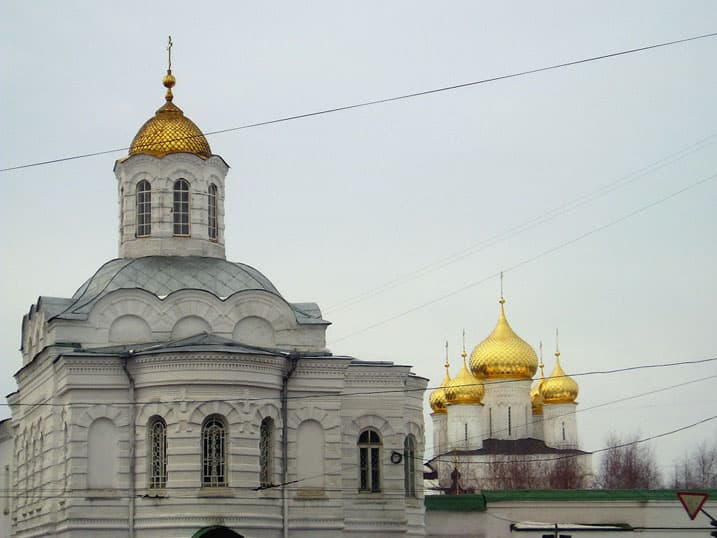
Bogoyavlensky Monastery (Kostroma)
Bogoyavlensky Convent, located in Kostroma, is a prominent Russian Orthodox convent renowned for housing the ancient Feodorovskaya Icon of the Mother of God. Originally founded as a monastery in the 15th century, it underwent significant construction and stylistic changes throughout its history, including a major rebuilding in the Russian Revival style in the late 19th century, after which it became a convent. Despite abolishment after the October Revolution, it was revived in the 1990s.

Krypetsky Monastery
Krypetsky Monastery is a Russian Orthodox monastery located near Pskov, founded in 1485 by Saint Savva Krypetsky. Initially established in a difficult marshland, it received support from the Pskov veche and later saw expansion and improvements. Despite periods of disrepair and closure by the Bolsheviks in 1918, the monastery was revived and restituted to the Russian Orthodox Church in 1991.
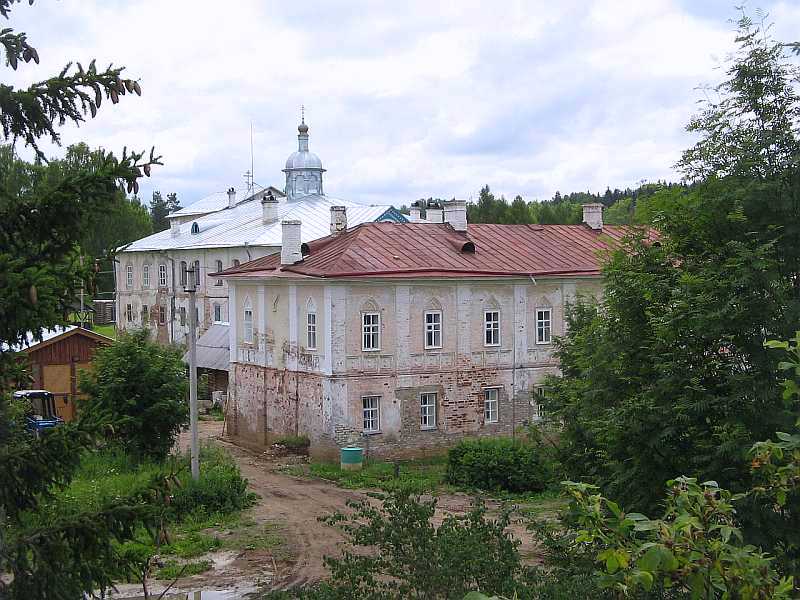
Pavlo-Obnorsky Monastery
The Pavlo-Obnorsky Monastery is a Russian Orthodox monastery founded in 1414 by Pavel of Obnora. Situated on the Nurma River in Vologda Oblast, Russia, it gained considerable influence in the 17th century. After being abolished in 1924 and repurposed, it was reestablished in 1994 and regained its independence in 2003, becoming an active monastic community once more.