
Oronsay Priory
Oronsay Priory was a monastery of canons regular situated on the island of Oronsay in the Inner Hebrides, Scotland. Established in the 14th century under the patronage of John of Islay, Lord of the Isles, it was dedicated to St. Columba and may have been a continuation of an earlier foundation. Despite its remoteness and a general lack of detailed records, the priory operated until at least 1560, with significant restoration work occurring in the late 19th and early 20th centuries.
Key Facts
- ›Founded in the 14th century.
- ›Established under the patronage of John of Islay, Lord of the Isles.
- ›Dedicated to St. Columba.
- ›Continued in operation until at least the Scottish Reformation in 1560.
- ›Restoration and excavation were carried out in 1883 and 1927.
- ›Features a notable High Cross, possibly dating to 1510.
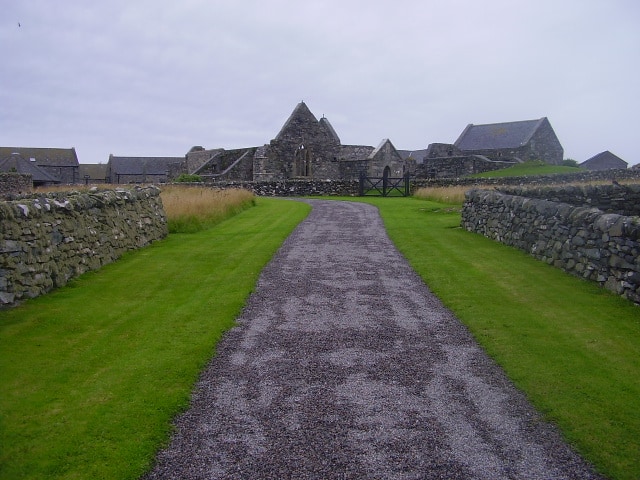
High Cross, Remnants of Monastery Church
John of Islay, Lord of the Isles, Robert Lamont, Maol Choluim Macdubhthaich, Colin, William De B M Galloway
Scottish Reformation
About Oronsay Priory
Oronsay Priory was a monastic institution of canons regular situated on the remote island of Oronsay, within the Inner Hebrides of Argyll, Scotland. Its establishment is placed in the 14th century, benefiting from the patronage of John of Islay, the Lord of the Isles. The priory was dedicated to St. Columba, and historical conjecture suggests it may have represented a revival or continuation of an earlier monastic settlement on the island.
Due to its isolated location and the scarcity of surviving records, detailed information about Oronsay Priory's daily life and history is limited. However, occasional mentions of its priors appear in historical documents. The priory remained in operation until at least 1560, the year of the Scottish Reformation, after which its assets were secularized. The last known prior, Robert Lamont, was elected in 1555.
Following the Reformation, the priory's lands and property underwent changes in ownership, being transferred to Maol Choluim MacDubhthaich in 1561 and later to the Bishop of the Isles under King James VI. Significant restoration efforts and archaeological work were undertaken in the late 19th and early 20th centuries, led by architects such as William de B M Galloway and the Ministry of Works. These efforts have preserved and made visible the priory's ruins today, including its notable High Cross.
The High Cross
A prominent feature near the priory ruins is the High Cross, standing approximately four meters east of the monastery church. This cross rises from a four-tiered foundation and is believed to date from around 1510, commemorating the death of Prior Colin. The westward face of the cross displays scenes of the crucifixion of Jesus, while the eastward side is adorned with intricate foliage motifs.
Source: Wikipedia ↗
Frequently Asked Questions
When was Oronsay Priory founded?
Oronsay Priory was established in the 14th century. The exact year is not precisely recorded, but its foundation is linked to the patronage of John of Islay, Lord of the Isles.
What religious order did Oronsay Priory belong to?
Oronsay Priory was a monastery of canons regular. These canons followed a monastic rule, similar to monks, but often engaged in clerical duties.
What happened to Oronsay Priory after the Reformation?
Following the Scottish Reformation in 1560, the priory's lands and property were transferred. They were given in commendam in 1561 and later granted to the Bishop of the Isles by King James VI.
What is the significance of the High Cross at Oronsay Priory?
The High Cross stands near the priory ruins and is inscribed to commemorate the death of Prior Colin, who died around 1510. It features depictions of the crucifixion of Jesus on its westward side and foliage motifs on the east side.
Is Oronsay Priory still an active monastery?
Oronsay Priory is no longer an active monastery. The site today consists of ruins that are a scheduled monument, with visible remnants from restoration work.
Related Monasteries

St Fillan's Priory
St Fillan's Priory was a small Augustinian priory located in Strath Fillan, Argyll. Founded around 1318 by Robert I, King of Scots, it was dedicated to the popular 14th-century saint, St. Fillan. The priory benefited from royal patronage, even after the Scottish Reformation, but by 1607 it had become a Campbell possession.

South Queensferry Whitefriars
The Priory Church of St Mary of Mount Carmel, commonly known as the Priory Church or St Mary's Episcopal Church, is a historic Carmelite church in South Queensferry, Scotland. Founded in 1330, it was built for the Carmelite Order and later served as a parish church before falling into disrepair. Following extensive restoration in the late 19th century, it was reopened by the Scottish Episcopal Church and stands today as the only medieval Carmelite church still in use in the British Isles.
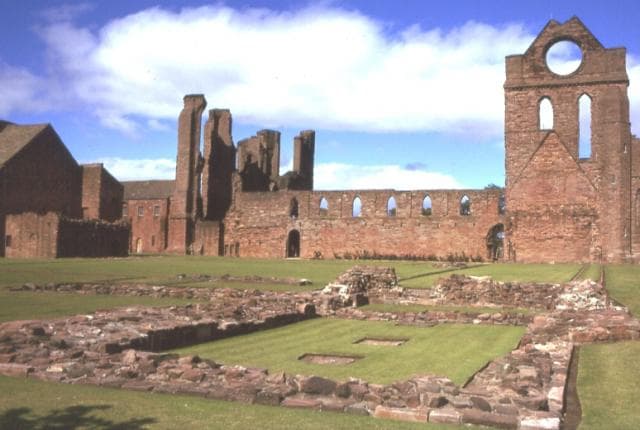
Arbroath Abbey
Arbroath Abbey, a ruined Cistercian monastery located in Arbroath, Scotland, was founded in 1178 by King William the Lion. It is renowned as the site where the Declaration of Scottish Independence was likely drafted in 1320. The Abbey, once the wealthiest in Scotland, is now managed by Historic Environment Scotland and is a popular tourist attraction, notable for its distinctive red sandstone ruins.