
North Berwick Priory
North Berwick Priory was a significant medieval monastery for nuns located in East Lothian, Scotland. Founded around 1150 by Donnchad I, Earl of Fife, it endured for over four centuries before declining and eventually disappearing after the Scottish Reformation. Initially supported by various Earls, it later came under the control of the Home family, who eventually acquired its lands.
Key Facts
- ›Founded by Donnchad I, Earl of Fife, likely between 1147 and 1153, possibly around 1150.
- ›Endowed by the Earls of Fife and the Earls of Carrick.
- ›Appears to have been a Cistercian house, though possibly originally Benedictine.
- ›Suffered damage from war, with its church burned down by 1384.
- ›Had 21 sisters and a prioress in 1544, a larger number than typical Cistercian nunneries.
- ›Its lands were leased to Alexander Home of North Berwick in 1565 and later became a free barony.

- Hospitals of Ardross and North Berwick Were Dependent On the Priory.
North Berwick Nunnery, Priory of St Mary, North Berwick
Donnchad I, Earl of Fife, MáEl Coluim I, Earl of Fife, Donnchad, Earl of Carrick, Sir Roger De Skelbrooke, Pope Clement Vii, Margaret Home, Alexander Home of North Berwick, King James Vi
Church Burned Down By 1384 Due To War.
About North Berwick Priory
North Berwick Priory, also known as the Priory of St Mary, North Berwick, was a medieval monastery for nuns situated in East Lothian, Scotland. Its origins trace back to around 1150, with Donnchad I, Earl of Fife, identified as its founder. The priory served its religious purpose for over four centuries, its existence concluding with the religious and political shifts of the Scottish Reformation.
History and Significance
While some later historical accounts, such as Walter Bower's Scotichronicon, attributed the founding to Máel Coluim I, Earl of Fife, charter evidence points to his grandfather, Donnchad I, as the true founder. Donnchad I's son and successor, Earl Donnchad II, confirmed land grants made by his father to the priory. Máel Coluim I himself reaffirmed the priory's possessions in a charter dated 1199. The precise year of foundation remains elusive, but a period between 1147 and 1153 is considered probable, with 1150 being a commonly cited estimate.
The priory also benefited from the patronage of Donnchad, Earl of Carrick, a kinsman of the Fife family. Between 1189 and 1250, he granted the priory the Rectorship of the Church of St Cuthbert of Maybole, likely not long after his earldom was established in 1225. Additionally, Donnchad of Carrick confirmed a donation by Sir Roger de Skelbrooke, which included the Church of St Brigit at Kirkbride and a grant from a place called Barrebeth.
North Berwick Priory is understood to have been a Cistercian house. However, the relationship between the Cistercian Order and communities of nuns could be complex, and it is possible that the priory began as a simple Benedictine foundation. Gervase of Canterbury, writing around 1207, described it as such. A shift to Cistercian affiliation was not uncommon in England, where nuns found the order's privileges appealing.
By February 18, 1384, a papal bull issued by Pope Clement VII noted that the monastery, described as not using the Cistercian habit, had suffered from war, with its church being burned down. While Cistercian women's monasteries typically housed thirteen nuns (a prioress and twelve sisters), North Berwick had a larger community, with 21 sisters and a prioress recorded in 1544, a number that remained similar on the eve of the Scottish Reformation. The hospitals of Ardross and North Berwick were historically dependent on the priory.
In the later years of its existence, the priory came under the influence of the locally prominent Home family. In 1565, the priory lands were leased to Alexander Home of North Berwick by his sister, Margaret Home, who was the last prioress. By March 20, 1588, King James VI formally converted these lands into a free barony for the Home family. Reports from 1587 indicated that the priory's buildings were in a state of ruin, marking the physical decline of the institution.
Source: Wikipedia ↗
Frequently Asked Questions
When was North Berwick Priory founded?
The exact date of North Berwick Priory's foundation is unclear, but it is believed to have been established between 1147 and 1153, with around 1150 being a probable year. It was founded by Donnchad I, Earl of Fife.
What religious order did North Berwick Priory belong to?
North Berwick Priory appears to have been a Cistercian house. However, historical accounts suggest it may have originally been founded as a simple Benedictine house, with a later adoption of Cistercian practices, a common occurrence for nunneries seeking the order's privileges.
What caused damage to the priory in the past?
A papal bull from Pope Clement VII in 1384 indicates that the monastery had been a victim of war, resulting in its church being burned down. This event likely contributed to its decline over time.
How many nuns were at North Berwick Priory?
Typically, Cistercian women's monasteries had thirteen nuns: a prioress and twelve sisters. However, North Berwick Priory had a larger community, with 21 sisters and a prioress recorded in 1544, and a similar number on the eve of the Scottish Reformation.
What happened to the priory lands after its decline?
In 1565, the priory lands were leased to Alexander Home of North Berwick by his sister, the last prioress. Subsequently, in 1588, King James VI converted these lands into a free barony for the Home family.
Related Monasteries
Arbroath Abbey
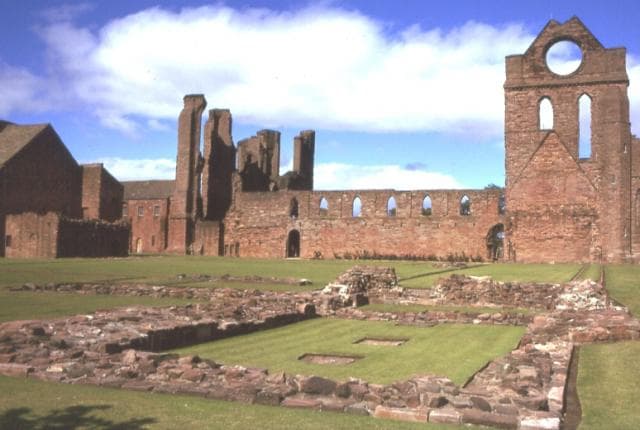
Arbroath Abbey, a ruined Cistercian monastery located in Arbroath, Scotland, was founded in 1178 by King William the Lion. It is renowned as the site where the Declaration of Scottish Independence was likely drafted in 1320. The Abbey, once the wealthiest in Scotland, is now managed by Historic Environment Scotland and is a popular tourist attraction, notable for its distinctive red sandstone ruins.

Dundrennan Abbey
Dundrennan Abbey was a Cistercian monastery established in 1142 in Dundrennan, Scotland. Known for its Romanesque architecture, the abbey reflects the austere Cistercian ideal and is noted for the preservation of its original forms due to its hard-weathering grey sandstone construction. Although extensively ruined, it holds historical significance as the site where Mary, Queen of Scots, spent her final night in Scotland in 1568 before fleeing.

Eynhallow Monastery
Eynhallow Church, a ruined medieval structure on the uninhabited Orkney island of Eynhallow, is believed to have originated as a monastery, possibly Benedictine, dating back to the 12th century. Its name, derived from Old Norse for "Holy Isle," suggests its former religious significance. The site, which also includes remains of a post-medieval settlement, is a scheduled monument and holds a place in Norse folklore.