
Münchenbuchsee Commandery
The Münchenbuchsee Commandery was a medieval commandery of the Knights Hospitaller, established in the 12th century in what is now the Swiss municipality of Münchenbuchsee. It grew to encompass several villages and vineyards, serving as a center for pastoral care, a hospital for pilgrims, and care for the poor. Following the Protestant Reformation in 1528, the commandery was secularized, and its buildings were repurposed for administrative and residential use.
Key Facts
- ›Founded in the late 12th century when Cuno of Buhse granted his lands to the Order of St. John.
- ›Confirmed by the Pope in 1192 and subsequently converted into a commandery.
- ›Received additional lands and rights from neighboring nobility and the city of Bern.
- ›Its church choir was built between 1260-1280, featuring 13th-century stained glass.
- ›The monastic community was consistently small, with only eight members recorded in 1480.
- ›Secularized in 1528 during the Swiss Protestant Reformation.

Gothic
- 13th-Century Stained Glass In the Church Choir
- Commander's House
- Monastery Buildings
- Guesthouse and Workshops
Order of St. John, Knights Hospitaller
Cuno of Buhse, Peter Englisberg
- Secularization During the Protestant Reformation In 1528
About Münchenbuchsee Commandery
The Münchenbuchsee Commandery was a significant medieval establishment of the Knights Hospitaller, situated in the municipality of Münchenbuchsee within the Swiss Canton of Bern. Its origins trace back to the late 12th century when Cuno of Buhse, or Buchsee, granted his extensive lands, including villages and vineyards, to the Order of St. John in 1180.
History and Development
The land grant was officially confirmed by the Pope in 1192, marking the formal establishment of the commandery. Over time, the commandery's holdings expanded significantly through grants from neighboring nobility and the citizens of Bern, incorporating properties such as the church at Twann and the castle, court, and village of Moosseedorf. By 1264, the commandery possessed its own seal, signifying its administrative autonomy.
The architectural complex of the commandery featured a walled enclosure. At its heart were the courtyard of the oldest part of Cuno's castle, the monastery serving as housing for the knights, the commander's residence, and a church. The church's choir was constructed between 1260 and 1280 and is notable for its 13th-century stained glass. The northern section of the complex housed a summer house, a guesthouse, and various workshops.
Role and Decline
The monastic community at Münchenbuchsee was consistently small, with records from 1480 indicating only the commander, the prior, and six knights resided there. In accordance with the Order's Rule of Life, these knights were tasked with providing crucial pastoral care to the surrounding populace, operating a hospital for pilgrims, and offering aid to the poor. The commander of Münchenbuchsee often held leadership of the Thunstetten Commandery concurrently.
The trajectory of the commandery dramatically shifted with the onset of the Protestant Reformation in Switzerland. In 1528, Commander Peter Englisberg, who led both Münchenbuchsee and Thunstetten commanderies, supported their secularization. As a reward for his compliance, he received Bremgarten Castle. Following this, the commandery's buildings were repurposed: the commander's house became a rectory, the monastery and outbuildings were converted into a granary, and the remaining structures were utilized for the administration of the bailiwick of Münchenbuchsee. A bailiff's castle and tithe barn were later added on the northern side between 1600 and 1620.
Source: Wikipedia ↗
Frequently Asked Questions
When was the Münchenbuchsee Commandery founded?
The Münchenbuchsee Commandery was founded in the late 12th century. The initial land grant to the Order of St. John occurred in 1180, and the Pope confirmed this gift in 1192, shortly before it was converted into a commandery.
What was the purpose of the Münchenbuchsee Commandery?
The knights at the commandery were responsible for providing pastoral care to the local population, operating a hospital for pilgrims, and caring for the poor. It also served as a center for the administration of various lands and rights granted to the order.
What happened to the commandery after the Reformation?
In 1528, during the Protestant Reformation, the commandery was secularized. The commander's house was converted into a rectory, and the monastery and outbuildings were repurposed as a granary and administrative center for the bailiwick of Münchenbuchsee.
What notable architectural features does the commandery have?
The church's choir was constructed between 1260 and 1280 and contains stained glass from the 13th century. The current church tower was built much later, in 1891. The grounds also included a commander's house and a monastery, with guesthouses and workshops on the north side.
Related Monasteries
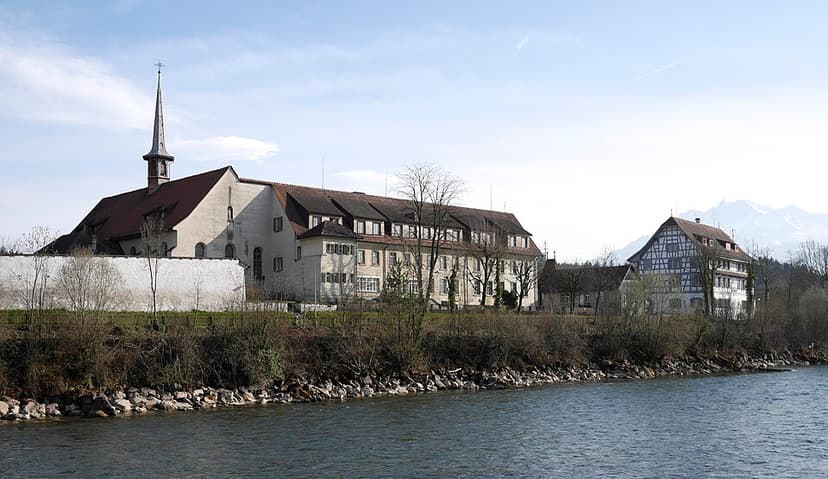
Rathausen Abbey
Rathausen Abbey was a Cistercian convent for women in Ebikon, Switzerland, founded in 1245 and dedicated to the Virgin Mary and Saint George. It faced periods of financial difficulty and reorganization, eventually gaining exemption from the Cistercian Order in 1649. After its suppression in 1848, the convent buildings were repurposed for educational and welfare institutions.

Bonmont Abbey
Bonmont Abbey, a former Cistercian monastery in Vaud, Switzerland, was founded between 1110 and 1120. Initially adhering to strict Benedictine and Cistercian rules, it grew wealthy through donations, leading to architectural and decorative changes. Secularized in 1536 during the Reformation, its buildings were repurposed for agricultural and administrative uses, though the church was preserved and later restored as a national monument.

Bubikon Commandery
Bubikon Commandery, also known as Bubikon Castle, was a medieval monastery of the Knights Hospitaller. Founded between 1191 and 1198, it grew to own significant lands across the present-day Canton of Zürich. The commandery was secularized during the Reformation, and its buildings now house a museum dedicated to its history and the Order.