
Rathausen Abbey
Rathausen Abbey was a Cistercian convent for women in Ebikon, Switzerland, founded in 1245 and dedicated to the Virgin Mary and Saint George. It faced periods of financial difficulty and reorganization, eventually gaining exemption from the Cistercian Order in 1649. After its suppression in 1848, the convent buildings were repurposed for educational and welfare institutions.
Key Facts
- ›Founded in 1245 as a female religious community that moved from Horw to Riedholz near Ebikon.
- ›Admitted into the Cistercian Order in 1260 or 1261.
- ›The superior held the title of abbess, with nuns primarily from prominent bourgeois families.
- ›In 1588, it was reorganized and left as one of two surviving female convents in Lucerne.
- ›Granted exemption from the Cistercian Order, submitting directly to the Holy See in 1649.
- ›Suppressed in 1848, with the buildings later housing a teachers' college and an orphanage.
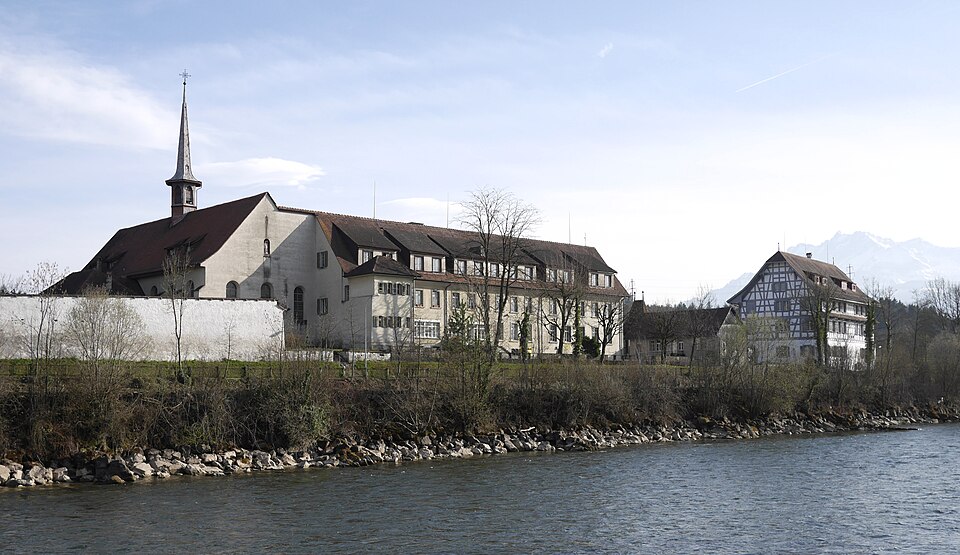
- Convent Buildings Repurposed For Educational and Welfare Institutions After Suppression.
- Reconstruction of Church Due To Ruin By Mid-14th Century.
- Placed Under Supervision of the City of Lucerne In 1528.
- Reorganization of Female Convents In 1588, Leaving Rathausen and Eschenbach Surviving.
- Conflict Leading To Exemption In 1649.
- Suppression In 1848.
About Rathausen Abbey
Rathausen Abbey was a significant Cistercian convent for women situated in Ebikon, within the Canton of Lucerne, Switzerland. Its foundation traces back to 1245 when a female religious community relocated to Riedholz near Ebikon. The convent was formally authorized by the bishop in 1251 and subsequently admitted into the Cistercian Order in 1260 or 1261, with its superior holding the title of abbess.
History and Development
The early years of Rathausen Abbey saw it drawing nuns primarily from prominent bourgeois families in Lucerne and the surrounding regions. By the mid-14th century, the abbey faced financial challenges, necessitating the sale of land and organization of collections to fund the reconstruction of its church, which had fallen into disrepair. A pivotal moment occurred in 1528 when the city of Lucerne placed the convent under its supervision.
A significant reorganization in 1588, spearheaded by nuncio Ottavio Paravicini, aimed to preserve the existence of Lucerne's female convents, ultimately leaving only Rathausen and Eschenbach to survive. Due to Saint-Urbain's diminished capacity for spiritual direction, Jesuits were appointed as confessors, leading to a conflict known as the 'Beichtigerhandel'. This dispute culminated in 1649 when Pope Innocent X detached Rathausen Abbey from the Cistercian Order, placing it directly under the Holy See's authority.
Suppression and Later Use
Rathausen Abbey was suppressed in 1848. Following this, the sisters dispersed, eventually emigrating to locations in Lorraine and Bavaria. The former convent buildings were subsequently repurposed by the canton, serving as a teachers' college from 1849 to 1867 and later as an orphanage, known as the Rathausen children's home, from 1883 to 1988. In 1990, the buildings were assigned to a foundation dedicated to caring for individuals with severe disabilities.
Source: Wikipedia ↗
Frequently Asked Questions
When was Rathausen Abbey founded?
The female religious community that would become Rathausen Abbey moved to Riedholz near Ebikon in 1245. The convent received authorization from the bishop in 1251 and was admitted into the Cistercian Order in 1260 or 1261.
What is the religious tradition of Rathausen Abbey?
Rathausen Abbey was a Cistercian convent for women. It was part of the Cistercian Order until 1649 when it was detached to submit directly to the Holy See.
What happened to Rathausen Abbey after its suppression?
Following its suppression in 1848, the sisters emigrated to various locations. The convent buildings were passed to the canton and subsequently housed a teachers' college and an orphanage before being assigned to a foundation for people with severe disabilities.
Who were the nuns at Rathausen Abbey primarily from?
The nuns at Rathausen Abbey primarily came from prominent bourgeois families of Lucerne and the surrounding area.
What significant event occurred in 1649 regarding Rathausen Abbey?
In 1649, Rathausen Abbey was detached from the Cistercian Order and granted exemption, submitting directly to the Holy See due to conflicts regarding spiritual direction.
Related Monasteries

Münchenbuchsee Commandery
The Münchenbuchsee Commandery was a medieval commandery of the Knights Hospitaller, established in the 12th century in what is now the Swiss municipality of Münchenbuchsee. It grew to encompass several villages and vineyards, serving as a center for pastoral care, a hospital for pilgrims, and care for the poor. Following the Protestant Reformation in 1528, the commandery was secularized, and its buildings were repurposed for administrative and residential use.

Augustinerkloster Zürich
The Augustinerkloster was a prominent monastery of the Augustinian Order within medieval Zurich, Switzerland. Founded around 1270, it played a role in the city's fortifications and religious life until its abolition during the Reformation in 1524. The Augustinian church, now known as the Augustinerkirche, remains on the site and is a parish church.

Barfüsserkloster Zürich
The Barfüsserkloster Zürich was a former Franciscan friary located in the old town of Zurich, first documented in the 1240s. It was dissolved during the Reformation in 1524. Following its dissolution, the buildings underwent significant transformations, serving as a grain depot, casino, and eventually housing the cantonal court of law, with portions lost to construction and a fire over the centuries.