
Barfüsserkloster Zürich
Christian·Switzerland·Partially repurposed, former monastery buildings now house court of law·13th century
The Barfüsserkloster Zürich was a former Franciscan friary located in the old town of Zurich, first documented in the 1240s. It was dissolved during the Reformation in 1524. Following its dissolution, the buildings underwent significant transformations, serving as a grain depot, casino, and eventually housing the cantonal court of law, with portions lost to construction and a fire over the centuries.
Key Facts
- ›First attested in the 1240s as a Franciscan friary.
- ›Dissolved during the Reformation in 1524.
- ›Located in the southeastern corner of the medieval city of Zurich.
- ›Buildings were repurposed for various uses after dissolution, including a grain depot and casino.
- ›Most of the original structure was lost due to 19th-century construction and a fire in 1890.
- ›Currently houses the cantonal court of law.

Former Franciscan Friary, Buildings Now House Cantonal Court of Law
- Dissolution During the Reformation
- Significant Construction Work In the 19th Century
- Fire In 1890
About Barfüsserkloster Zürich
The Barfüsserkloster Zürich, a former Franciscan friary, is a significant historical site located in the old town of Zurich, Switzerland. First documented in the 1240s, it played a role in the city's religious landscape until its dissolution during the Reformation in 1524.
Historical Context and Transformation
The friary was strategically situated in the southeastern part of the medieval city. After its closure, the buildings underwent substantial changes in use and form. Initially, they served as a grain depot, and by the early 19th century, they were repurposed as a casino. The 19th century marked a period of extensive alteration, with significant construction work leading to the loss of much of the original friary structure.
Current Status and Legacy
From the 1870s onwards, the complex has been predominantly occupied by the cantonal court of law (Obergericht), alongside communal wine cellars and a theater at various times. A fire in 1890 resulted in the demolition of a part of the structure, which is now a parking lot. Today, the cantonal court remains the sole occupant of the estate, representing a continuation of the site's administrative and public function, albeit detached from its original monastic purpose.
Source: Wikipedia ↗
Frequently Asked Questions
When was the Barfüsserkloster Zürich founded?
Historical records first attest to the Barfüsserkloster Zürich in the 1240s. This indicates its establishment sometime around or before that period.
What happened to the Barfüsserkloster Zürich after the Reformation?
Following its dissolution during the Reformation in 1524, the buildings of the Barfüsserkloster Zürich were repurposed. They were used as a grain depot and later as a casino in the early 19th century.
What is the current use of the Barfüsserkloster Zürich buildings?
Since the 1870s, the buildings have primarily housed the cantonal court of law (Obergericht). They also previously accommodated communal wine cellars and a theater.
Has the original structure of the Barfüsserkloster Zürich been preserved?
Much of the original structure has been lost due to significant construction work during the 19th century and a fire in 1890. A portion of the site is now a parking lot.
Related Monasteries
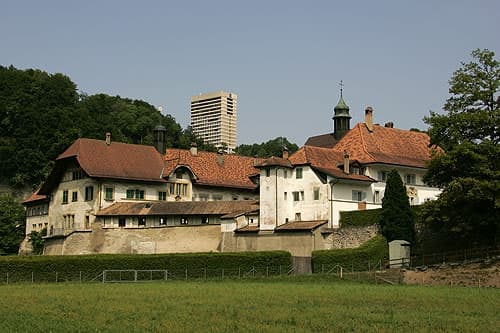
La Maigrauge Abbey
La Maigrauge Abbey, also known as Magerau Abbey, is a Cistercian monastery for nuns located in Fribourg, Switzerland. Founded in 1255, it was the first and only monastery for nuns in Fribourg until the 17th century. Despite periods of poverty and decline, particularly during the Reformation and Swiss civil war, the abbey has persevered, rebuilding after a fire in the 17th century and adapting to changing political landscapes. Today, it houses a small community of nuns who support themselves through various enterprises, including a bakery, guesthouse, and liqueur shop.

Eschenbach Abbey
Eschenbach Abbey is a Cistercian community of nuns located in Eschenbach, Switzerland. Originally founded around 1290 as an Augustinian convent, it transitioned to the Cistercian Order in 1588. The abbey has undergone several significant architectural expansions and renovations throughout its history, including the construction of its abbey church in 1910.

Augustinerkloster Zürich
The Augustinerkloster was a prominent monastery of the Augustinian Order within medieval Zurich, Switzerland. Founded around 1270, it played a role in the city's fortifications and religious life until its abolition during the Reformation in 1524. The Augustinian church, now known as the Augustinerkirche, remains on the site and is a parish church.