
Eschenbach Abbey
Eschenbach Abbey is a Cistercian community of nuns located in Eschenbach, Switzerland. Originally founded around 1290 as an Augustinian convent, it transitioned to the Cistercian Order in 1588. The abbey has undergone several significant architectural expansions and renovations throughout its history, including the construction of its abbey church in 1910.
Key Facts
- ›Founded circa 1290 for Augustinian nuns.
- ›Became a Cistercian monastery in 1588.
- ›Moved to its current location in Obereschenbach in 1309.
- ›The largest sundial in Switzerland was installed in 1683.
- ›A new abbey church was built in Baroque revival style and dedicated in 1910.
- ›The abbey is dedicated to the Blessed Virgin Mary and Saint Catherine.

Baroque Revival
Largest Sundial In Switzerland
Kloster Eschenbach, Abbatia B. M. V. Et Sanctae Catharinae
Baron Walther Iii Von Eschenbach
Foundation of the Augustinian Convent, Move To Obereschenbach, Nuns Joined the Cistercian Order, Construction of New Abbey Church
About Eschenbach Abbey
Eschenbach Abbey, known in Latin as Abbatia B. M. V. et Sanctae Catharinae, is a community of Cistercian nuns situated in Eschenbach, within the canton of Lucerne, Switzerland. The abbey's origins trace back to approximately 1290 when Baron Walther III von Eschenbach established it as a convent for Augustinian nuns in Niedereschenbach. The site of this original nunnery is still marked by the chapel of St. Catherine. In 1309, the community relocated to its present location in Obereschenbach.
A significant transition occurred in 1588 when the nuns formally joined the Cistercian Order, adopting the Rule of St Benedict. The abbey has seen considerable architectural development over the centuries. The guest house was constructed in 1612, followed by the laying of the foundation stone in 1625 for a new abbey church, along with 24 cells, the cloister, and the chapter house. Further renovations and extensions to the guest house in 1683 included the installation of the largest sundial in Switzerland. In 1910, a new abbey church, designed in the Baroque revival style by architect August Hardegger, was dedicated, coinciding with the local parish building its own separate church.
Eschenbach Abbey remains an active monastic community. Its history is marked by its founding by a local baron, its transition between monastic orders, and its continuous development as a place of religious life and architectural interest in Switzerland.
Source: Wikipedia ↗
Frequently Asked Questions
When was Eschenbach Abbey founded?
Eschenbach Abbey was founded around 1290. It was initially established as a community of Augustinian nuns before becoming Cistercian in 1588.
What is the religious order of Eschenbach Abbey?
Eschenbach Abbey is a community of Cistercian nuns. They live according to the Rule of St Benedict.
Where is Eschenbach Abbey located?
The abbey is situated in Eschenbach, in the canton of Lucerne, Switzerland. Its current site in Obereschenbach was established in 1309.
What are some notable architectural features of Eschenbach Abbey?
Notable features include a guest house refurbished and extended in 1683, which saw the installation of the largest sundial in Switzerland. The abbey church, designed in Baroque revival style by August Hardegger, was dedicated in 1910.
Did Eschenbach Abbey always belong to the Cistercian Order?
No, Eschenbach Abbey was originally founded in about 1290 as a convent for Augustinian nuns. The nuns joined the Cistercian Order in 1588.
Related Monasteries
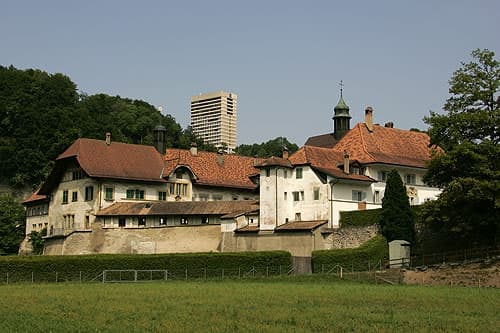
La Maigrauge Abbey
La Maigrauge Abbey, also known as Magerau Abbey, is a Cistercian monastery for nuns located in Fribourg, Switzerland. Founded in 1255, it was the first and only monastery for nuns in Fribourg until the 17th century. Despite periods of poverty and decline, particularly during the Reformation and Swiss civil war, the abbey has persevered, rebuilding after a fire in the 17th century and adapting to changing political landscapes. Today, it houses a small community of nuns who support themselves through various enterprises, including a bakery, guesthouse, and liqueur shop.

Abbaye de la Fille-Dieu
The Abbaye de la Fille-Dieu is a Cistercian monastery near Romont in Switzerland, continuously occupied by nuns since its founding in 1268. Initially a Benedictine priory, it later affiliated with the Trappists and has undergone significant restorations, including a notable 1990s modernization and the preservation of medieval murals. The abbey is recognized as a Swiss heritage site of national significance.

La Valsainte Charterhouse
La Valsainte Charterhouse is the sole surviving Carthusian monastery in Switzerland, located in the Canton of Fribourg. Founded in 1295, it has a complex history marked by destruction, suppression, and revival, notably serving as a refuge for French Trappists and becoming a center for the Cistercian Reform. The monastery has been a significant spiritual and intellectual hub throughout the 20th century, attracting scholars and artists.