
Abbaye de la Fille-Dieu
Cistercian / Trappist·Switzerland·active·13th century
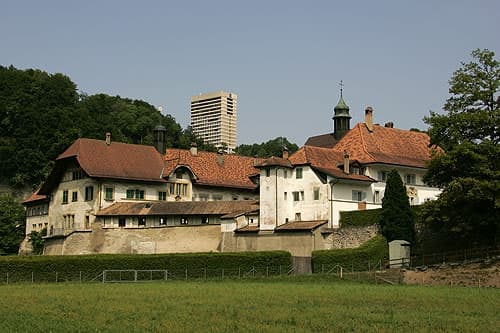
The Abbaye de la Fille-Dieu is a Cistercian monastery near Romont in Switzerland, continuously occupied by nuns since its founding in 1268. Initially a Benedictine priory, it later affiliated with the Trappists and has undergone significant restorations, including a notable 1990s modernization and the preservation of medieval murals. The abbey is recognized as a Swiss heritage site of national significance.
Key Facts
- ›Founded as a Benedictine priory in 1268.
- ›Continuously occupied by a community of nuns since its establishment.
- ›Affiliated with the Trappists (Cistercian Order of Strict Observance) in 1906.
- ›Underwent a significant restoration between 1990 and 1996.
- ›Features rediscovered medieval murals and contemporary stained glass windows by Brian Clarke.
- ›Designated a Swiss heritage site of national significance.

- Rediscovered Medieval Murals
- Contemporary Stained Glass Windows By Brian Clarke
- Swiss Heritage Site of National Significance
Fille-Dieu
Juliette De Villa, Pernette De Villa, CéCile De Villa, Jean De Cossonay, Brian Clarke
- Foundation of the Priory In 1268.
- Affiliation With the Trappists In 1906.
- Major Restoration Between 1990 and 1996.
- Destruction and Replacement of the Oculus Window In 2009-2010.
About Abbaye de la Fille-Dieu
The Abbaye de la Fille-Dieu is a significant Cistercian monastery situated near Romont in the Swiss Canton of Fribourg. Its history dates back to 1268 when it was established as a Benedictine priory, and it has been continuously inhabited by a community of nuns since its inception. This long-standing presence and its designation as a Swiss heritage site of national significance underscore its importance.
History and Development
The monastery's origins lie with a small community of women who founded a house of prayer near Romont in 1265. By 1268, Bishop Jean de Cossonay authorized Juliette, Pernette, and Cécile de Villa to establish a monastery on the site, naming it 'Fille-Dieu'. Throughout its existence, the abbey has faced numerous challenges, including economic hardship, fires, and alterations to its structure, some of which proved unsympathetic to its original design. In 1906, the community transitioned to the Cistercian Order of Strict Observance, colloquially known as the Trappists.
Architectural and Artistic Significance
The Abbaye de la Fille-Dieu has undergone substantial transformations over the centuries. A major restoration project undertaken between 1990 and 1996 modernized the monastic buildings and meticulously restored the abbey church to its original volume. This period also saw the preservation of rediscovered medieval murals. More recently, the abbey gained international notice for its contemporary stained glass windows, particularly a suite commissioned from the British artist Brian Clarke. The oculus window, destroyed by a hailstorm in 2009, was replaced in 2010 with a new design by Clarke, further enhancing the abbey's artistic heritage. Restoration efforts at the abbey continue to the present day.
Source: Wikipedia ↗
Frequently Asked Questions
When was the Abbaye de la Fille-Dieu founded?
The Abbaye de la Fille-Dieu was founded in 1268. It began as a Benedictine priory, authorized by the Bishop of Lausanne.
What is the current religious affiliation of the Abbaye de la Fille-Dieu?
The Abbaye de la Fille-Dieu became affiliated with the Cistercian Order of Strict Observance, commonly known as the Trappists, in 1906. It remains a Cistercian monastery.
Has the monastery undergone significant renovations?
Yes, the Abbaye de la Fille-Dieu has been heavily altered throughout its history due to various factors. A particularly notable restoration was undertaken between 1990 and 1996, which modernized buildings and preserved medieval murals.
Are there any notable artistic features at the Abbaye de la Fille-Dieu?
The monastery is known for its rediscovered medieval murals. Additionally, it features contemporary stained glass windows, including a significant oculus window designed by artist Brian Clarke, whose work has been presented at the Swiss National Museum of Stained Glass.
What is the significance of the Abbaye de la Fille-Dieu?
The Abbaye de la Fille-Dieu is a Swiss heritage site of national significance. It is distinguished by its continuous occupation by a community of nuns since its founding and its historical and artistic restorations.
Related Monasteries

Eschenbach Abbey
Eschenbach Abbey is a Cistercian community of nuns located in Eschenbach, Switzerland. Originally founded around 1290 as an Augustinian convent, it transitioned to the Cistercian Order in 1588. The abbey has undergone several significant architectural expansions and renovations throughout its history, including the construction of its abbey church in 1910.
La Maigrauge Abbey
La Maigrauge Abbey, also known as Magerau Abbey, is a Cistercian monastery for nuns located in Fribourg, Switzerland. Founded in 1255, it was the first and only monastery for nuns in Fribourg until the 17th century. Despite periods of poverty and decline, particularly during the Reformation and Swiss civil war, the abbey has persevered, rebuilding after a fire in the 17th century and adapting to changing political landscapes. Today, it houses a small community of nuns who support themselves through various enterprises, including a bakery, guesthouse, and liqueur shop.

La Valsainte Charterhouse
La Valsainte Charterhouse is the sole surviving Carthusian monastery in Switzerland, located in the Canton of Fribourg. Founded in 1295, it has a complex history marked by destruction, suppression, and revival, notably serving as a refuge for French Trappists and becoming a center for the Cistercian Reform. The monastery has been a significant spiritual and intellectual hub throughout the 20th century, attracting scholars and artists.