
Morača Monastery
Serbian Orthodox·Montenegro·Active (implied by historical significance and ongoing mentions)·13th century
Morača Monastery is a significant Serbian Orthodox monastery located in central Montenegro, founded in 1252 by Stefan Vukanović of the Nemanjić dynasty. Recognized as one of Montenegro's finest medieval monuments, it features Rascian-style architecture with Romanesque portals and important frescoes dating from the 13th and 16th centuries, including depictions of the life of Prophet Elias and the Last Judgment. Despite suffering damage from Ottoman incursions, it has undergone reconstructions and remains a vital historical and religious site.
Key Facts
- ›Founded in 1252 by Stefan Vukanović, a member of the Serbian Nemanjić dynasty.
- ›Features Rascian architectural style, characteristic of medieval Serbian art.
- ›Contains important frescoes from the 13th century depicting the life of Prophet Elias.
- ›Suffered damage from Ottoman raids, notably in 1505, but was rebuilt.
- ›The main sanctuary is dedicated to the Assumption of Mary, with a chapel for Saint Nicholas.
- ›Hosted a significant session of the Yugoslav land assembly during World War II in 1944.

Rascian, Romanesque
Frescoes Depicting the Life of Prophet Elias, Last Judgment Frescoes, Rascian-Style Architecture, Romanesque Portals
Manastir MoračA
Stefan Vukanović, Vukan Nemanjić, Stefan Nemanja, Sokollu Mehmed Pasha, Tomo, Mojsije, Vukić VučEtić, Vuk Stefanović KaradžIć, Novica Cerović, Serdar Milan
- Founded In 1252.
- Burnt Down By Ottomans In 1505.
- Rebuilt Between 1574 and 1580.
- Third Session of the Yugoslav Land Assembly Held In July 1944.
About Morača Monastery
Morača Monastery is a distinguished Serbian Orthodox monastery situated in the scenic valley of the Morača River in Kolašin, central Montenegro. Its foundation in 1252 by Stefan Vukanović, a descendant of the prominent Nemanjić dynasty, marks it as a cornerstone of medieval Montenegrin heritage and one of the country's most celebrated medieval monuments.
History and Significance
The monastery's founding history is recorded above its western portal, highlighting its connection to the ruling Nemanjić dynasty, which was instrumental in establishing Serbian statehood. The region was under the dynasty's dominion, and Stefan Vukanović himself was the grandson of Stefan Nemanja. The monastery has endured significant historical challenges, notably being burnt down by the Ottomans in 1505, which led to its abandonment for seven decades. A period of relative political calm under Sokollu Mehmed Pasha facilitated its rebuilding between 1574 and 1580. This reconstruction was a community effort, led by monks Tomo and Mojsije and financially supported by local leaders and the populace, including knez Vukić Vučetić. The monastery also played a role in more recent history, hosting a session of the Yugoslav land assembly in July 1944 during World War II.
Architecture and Art
The architectural design of Morača Monastery is a significant example of the Rascian style, which flourished in medieval Serbia from 1170. This style is characterized by its integration of Byzantine and Western European influences. The main sanctuary, or katholikon, is a large, single-nave church. The monastery's two principal portals are crafted in the Romanesque style, adding a distinct European flair to its structure. The church is dedicated to the Assumption of Mary, while a smaller adjacent chapel honors Saint Nicholas.
The frescoes within Morača Monastery are of particular importance, offering invaluable insights into medieval Serbian art. The oldest surviving compositions, dating from the 13th century, feature eleven scenes from the life of Prophet Elias. These works exhibit conservative artistic traits, drawing inspiration from late-Comnenian figure styles and architectural motifs characterized by solid, heavy forms, similar to those found in frescoes at Sopoćani Monastery in Serbia. Later frescoes, though less preserved, date to the 16th century and include significant depictions of the Last Judgment, Paradise, the Bosom of Abraham, and Satan on the Two-Headed Beast, all completed around 1577-1578. Sadly, the Ottoman occupation in the early 16th century resulted in damage and loss to parts of the original fresco cycle.
Source: Wikipedia ↗
Frequently Asked Questions
When was Morača Monastery founded?
Morača Monastery was founded in 1252. The founding date is explicitly engraved above the western portal of the main church.
Who founded Morača Monastery?
The monastery was founded by Stefan Vukanović, who was the son of Vukan Nemanjić, the Grand Prince of Zeta, and a grandson of Stefan Nemanja. He was a member of the influential Nemanjić dynasty.
What architectural style is Morača Monastery?
The main sanctuary, or katholikon, is built in the Rascian style, a significant school of medieval Serbian art and architecture. The two main portals of the church exhibit Romanesque style elements.
Has Morača Monastery been damaged historically?
Yes, the monastery was burnt down by the Ottomans for the first time in 1505 and was abandoned for approximately seventy years. Part of the original fresco cycle was also damaged or lost during this period.
What are the notable frescoes at Morača Monastery?
The monastery is renowned for its frescoes, with the oldest dating back to the 13th century and depicting the life of Prophet Elias. Later frescoes from the 16th century include notable depictions of the Last Judgment, Paradise, the Bosom of Abraham, and Satan on the Two-Headed Beast.
Is Morača Monastery still active?
The text does not explicitly state if Morača Monastery is currently an active monastic community but describes it as a medieval monument and mentions its historical reconstructions and significant events held there, implying continued religious or historical importance.
Related Monasteries

Dovolja Monastery
The Dovolja Monastery is a Serbian Orthodox monastery situated on the right bank of the Tara River near Pljevlja, Montenegro. Believed to have been founded by King Stefan Milutin at the end of the 13th century, it was first documented in 1513 and is dedicated to the Assumption of the Holy Mother of God. The monastery is ecclesiastically administered by the Eparchy of Mileševa, and at some point after 1699, the relics of Archbishop Arsenije I were transferred from Dovolja to Dobrilovina Monastery.
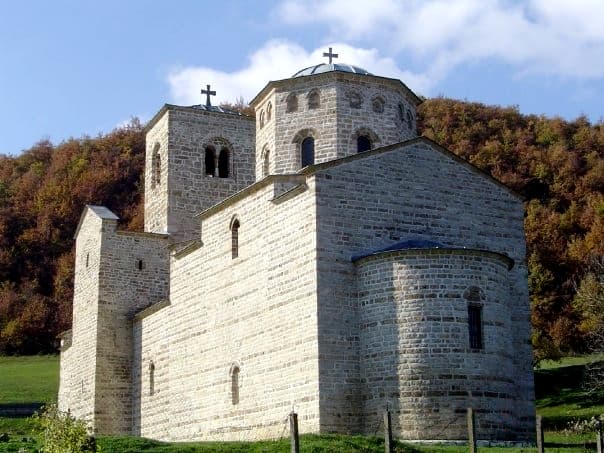
Đurđevi Stupovi Monastery
Đurđevi Stupovi Monastery is a Serbian Orthodox monastery located in Berane, Montenegro. Founded in 1213 by Stefan Prvoslav, it served as the episcopal seat for the Eparchy of Budimlja for centuries and continues to be a significant religious center today. The monastery is characterized by its historical importance as a spiritual and administrative hub for the region.

Podmalinsko Monastery
The Podmalinsko Monastery, also known as the Tušinski Monastery, is a Serbian Orthodox monastery located near Šavnik in modern-day Montenegro. Believed to have been built around 1252 by Stephen Uroš I of Serbia, it holds historical significance as a traditional gathering place for the Drobnjaci tribe. Although destroyed and rebuilt numerous times, its ruins and graveyard remain, with one grave belonging to Mirko Aleksić, who famously killed Smail-aga Čengić.