
Podmalinsko Monastery
The Podmalinsko Monastery, also known as the Tušinski Monastery, is a Serbian Orthodox monastery located near Šavnik in modern-day Montenegro. Believed to have been built around 1252 by Stephen Uroš I of Serbia, it holds historical significance as a traditional gathering place for the Drobnjaci tribe. Although destroyed and rebuilt numerous times, its ruins and graveyard remain, with one grave belonging to Mirko Aleksić, who famously killed Smail-aga Čengić.
Key Facts
- ›The monastery is dedicated to St. Michael.
- ›It is believed to have been founded by Stephen Uroš I of Serbia around 1252.
- ›The name "Podmalinsko" means "beneath Malinsko."
- ›It was also known by the name Tušinski Monastery.
- ›The monastery served as a traditional meeting place for the Drobnjaci tribe.
- ›Its ruins include remnants of various buildings and a small graveyard.

Church Dedicated To St. Michael, Ruins of Monastic Buildings, Small Graveyard, Grave of Mirko Aleksić
TušInski Monastery
Stephen Uroš I of Serbia, Mirko Aleksić, Smail-Aga čEngić
- Construction Around 1252
- Gathering Place For the Drobnjaci Tribe
- Meeting In 1840 To Plan the Killing of Smail-Aga čEngić
- Plundering and Destruction By Ottomans After 1840
About Podmalinsko Monastery
The Podmalinsko Monastery, also known as the Tušinski Monastery, is a significant historical site of the Serbian Orthodox tradition, located near Šavnik in modern-day Montenegro. Its origins are traditionally traced to the mid-13th century, with many believing it was built around 1252 by Stephen Uroš I of Serbia. The monastery's name, "Podmalinsko," derives from its location beneath the village of Malinsko, and it was also referred to as Tušinski Monastery after the nearby village of Tušina.
History and Significance
The monastery is situated in the scenic valley of the Bukovica River. Historically, it played a crucial role as a meeting point for the Drobnjaci tribe. These gatherings were often for important tribal decisions; notably, a meeting held in 1840 at the monastery led to the decision to inform Njegoš about the tribe's intent to kill Smail-aga Čengić. Following this event, the monastery, along with the Drobnjaci region, suffered plunder and destruction by Ottoman forces.
The church at Podmalinsko is dedicated to St. Michael, a figure of importance to the Nemanjić dynasty. While the monastery has been destroyed and rebuilt numerous times throughout its history, only ruins of its various buildings and a small graveyard remain today. Among the graves is that of Mirko Aleksić, a prominent voivode of Malinsko, known for his role in the death of Smail-aga Čengić.
Source: Wikipedia ↗
Frequently Asked Questions
What is the origin of the name Podmalinsko Monastery?
The name "Podmalinsko" is derived from the village of Malinsko, situated on the hill Kravica. It translates to "beneath Malinsko" in Serbian, indicating its geographical position relative to the village.
What is the religious affiliation of Podmalinsko Monastery?
Podmalinsko Monastery is a Serbian Orthodox monastery.
Where is Podmalinsko Monastery located?
The monastery is situated in the valley of the Bukovica River, near its right bank, between the villages of Malinsko and Tušina. It is located near Šavnik in modern-day Montenegro.
Who is believed to have founded Podmalinsko Monastery?
It is believed that Stephen Uroš I of Serbia founded the monastery around the year 1252. Legend suggests its construction utilized leftover stones from the building of Morača Monastery.
What historical significance does Podmalinsko Monastery hold?
Historically, the monastery was a gathering place for members of the Drobnjaci tribe, who held important meetings there. One such meeting in 1840 led to the decision to inform Njegoš about their intention to kill Smail-aga Čengić.
What can be seen at the Podmalinsko Monastery site today?
Today, the site features the church dedicated to St. Michael, along with the ruins of various other monastic buildings. There is also a small graveyard, which includes the grave of Mirko Aleksić.
Related Monasteries

Dovolja Monastery
The Dovolja Monastery is a Serbian Orthodox monastery situated on the right bank of the Tara River near Pljevlja, Montenegro. Believed to have been founded by King Stefan Milutin at the end of the 13th century, it was first documented in 1513 and is dedicated to the Assumption of the Holy Mother of God. The monastery is ecclesiastically administered by the Eparchy of Mileševa, and at some point after 1699, the relics of Archbishop Arsenije I were transferred from Dovolja to Dobrilovina Monastery.
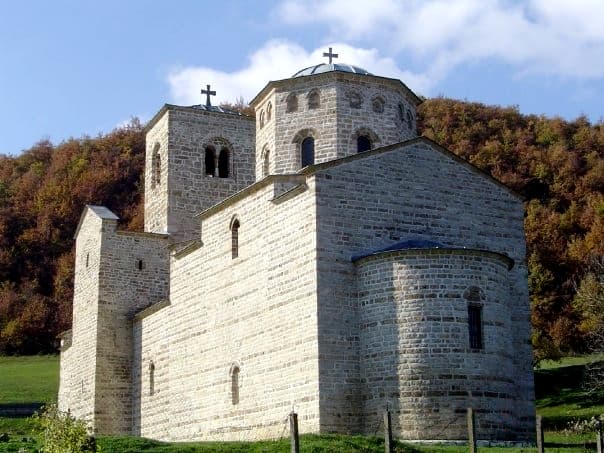
Đurđevi Stupovi Monastery
Đurđevi Stupovi Monastery is a Serbian Orthodox monastery located in Berane, Montenegro. Founded in 1213 by Stefan Prvoslav, it served as the episcopal seat for the Eparchy of Budimlja for centuries and continues to be a significant religious center today. The monastery is characterized by its historical importance as a spiritual and administrative hub for the region.

Morača Monastery
Morača Monastery is a significant Serbian Orthodox monastery located in central Montenegro, founded in 1252 by Stefan Vukanović of the Nemanjić dynasty. Recognized as one of Montenegro's finest medieval monuments, it features Rascian-style architecture with Romanesque portals and important frescoes dating from the 13th and 16th centuries, including depictions of the life of Prophet Elias and the Last Judgment. Despite suffering damage from Ottoman incursions, it has undergone reconstructions and remains a vital historical and religious site.