
Monastery of Saint Nicholas
Serbian Orthodox·Serbia·reconstructed monument·12th century
The Monastery of Saint Nicholas is a Serbian Orthodox monastery built by Grand Prince Stefan Nemanja between 1159 and 1166, making it potentially the oldest monastery founded by him. Situated in the historical region of Toplica near Kuršumlija, Serbia, it served as a significant religious and administrative center, becoming the seat of the Eparchy of Toplica after the Serbian Church's autocephaly. Despite destruction and repurposing of its materials, the monastery has undergone reconstruction and is now a cultural monument of exceptional importance.
Key Facts
- ›Founded by Grand Prince Stefan Nemanja between 1159 and 1166.
- ›Potentially the oldest monastery established by Stefan Nemanja.
- ›Served as the seat of the Serbian Orthodox Eparchy of Toplica from 1219.
- ›Its name is linked to the city of Kuršumlija, meaning 'lead church'.
- ›Underwent significant reconstruction, with initial steps in 1910 and continued efforts until 2003.
- ›Considered a cultural monument of exceptional importance in Serbia.

RašKa School, Byzantine
Three-Part Altar, Segmented Dome, Narthex With Two Towers, Chapel On the North Side, Characteristic Brick Facade, Original Frescoes From the 14th Century
манастир светог николе
Stefan Nemanja, Saint Sava, Stefan the First-Crowned, King Milutin
- Founded By Stefan Nemanja Before He Became Ruler of Serbia.
- Became the Seat of the Eparchy of Toplica In 1219.
- Left Empty After the Great Serb Migrations of 1690.
- Torn Down In the 19th Century.
- Reconstruction Efforts Began In 1910 and Continued Until 2003.
About Monastery of Saint Nicholas
The Monastery of Saint Nicholas is a Serbian Orthodox monastery located in the historical region of Toplica, near modern-day Kuršumlija, Serbia. It was built by Grand Prince Stefan Nemanja between 1159 and 1166, and is considered by some to be the oldest monastery he founded. The monastery holds significant historical importance as it served as a key religious and administrative center during the Middle Ages.
History and Significance
Before becoming the Grand Prince of Serbia, Stefan Nemanja governed the eastern regions, and it was during this time he constructed the Monastery of Saint Nicholas. There is some historical debate regarding the exact order of construction among his early foundations, with differing accounts from Domentijan and Saint Sava. Despite disputes with his brothers, Nemanja rose to power, and Kuršumlija, then known as Bela Crkva, became his capital. Following the establishment of the autocephalous Serbian Archbishopric in 1219, the church became the seat of the Eparchy of Toplica, a status it maintained until the first half of the 18th century.
The monastery faced significant decline, particularly after the Great Serb Migrations of 1690. During Ottoman occupation, the lead from its roof was reportedly taken for bullet production, contributing to the city's name, Kuršumlija, which derives from the Turkish for 'lead church.' The church was eventually torn down in the 19th century, with its materials used in the construction of other buildings. Recognizing its historical value, the National Museum in Belgrade initiated repair efforts in 1910, and a comprehensive reconstruction project continued intermittently until 2003. Today, the Monastery of Saint Nicholas is under state protection and is recognized as a cultural monument of exceptional importance.
Architecture
The Monastery of Saint Nicholas is noted as a beautiful monument of Serbian culture and a prototype of the Raška school of architecture. It exhibits Byzantine influences and bears similarities to structures like Hagia Sophia in Nicaea. The construction occurred in three distinct phases. The original building featured a single nave, a three-part altar, and a segmented dome. Later, Stefan the First-Crowned added a narthex with two towers on the west side, and in the 14th century, King Milutin constructed a chapel on the north side.
The interior is characterized by its grand scale and multiple rooms. The altar space is separated from the nave, and the church does not feature an iconostasis. The altar itself contains two niches, and the communion table is a tripartite structure. The floor of the altar is laid with brick tiles. A distinctive feature of the church is its brick facade, where every second row of bricks is indented and covered with mortar. The single and double doors are crafted from oak wood and rotate on metal axles.
While the interior was originally plastered and frescoed, only a small number of original 14th-century frescoes survive, primarily found on the window dome and within the chapel of the south tower. These preserved fragments depict figures such as a bishop and the Virgin. The church is not extensively frescoed today.
Source: Wikipedia ↗
Frequently Asked Questions
Who built the Monastery of Saint Nicholas?
The Monastery of Saint Nicholas was built by Grand Prince Stefan Nemanja. He began construction between 1159 and 1166, during a period when he governed the eastern regions of Serbia centered around Toplica.
When was the Monastery of Saint Nicholas founded?
The monastery was built by Stefan Nemanja between 1159 and 1166. There is some historical debate regarding the exact order in which he established his monasteries in Kuršumlija, but this period is consistently cited for the construction of St. Nicholas Church.
What was the significance of the Monastery of Saint Nicholas?
The monastery was one of the most important founded by the Nemanjić dynasty and may be the oldest one established by Stefan Nemanja. After the Serbian Church became an autocephalous archbishopric in 1219, it became the seat of the Eparchy of Toplica.
What happened to the monastery over time?
The church was left empty after the Great Serb Migrations of 1690 and its lead roof was taken for making bullets, leading to the city's name 'Kuršumlija' (lead church). It was torn down in the 19th century, with its materials used for other buildings. Reconstruction efforts began in 1910 and continued until 2003.
What architectural styles are present at the Monastery of Saint Nicholas?
The monastery is considered a prototype of the Raška school, showing Byzantine influence and similarities to Hagia Sophia in Nicaea. It was built in three phases, with additions including a narthex with towers and a chapel.
Related Monasteries
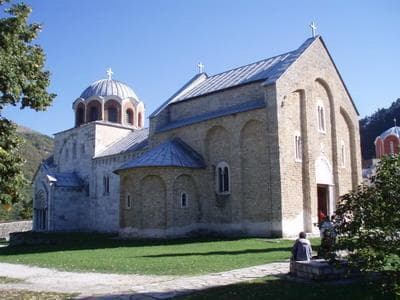
Studenica Monastery
Studenica Monastery is a 12th-century Serbian Orthodox monastery renowned as the mother-church of all Serbian temples. Founded by Stefan Nemanja, it became a significant political, cultural, and spiritual center of medieval Serbia, housing priceless collections of Byzantine art. Protected by the state and recognized as a UNESCO World Heritage Site, it continues to be a vital religious and historical monument.
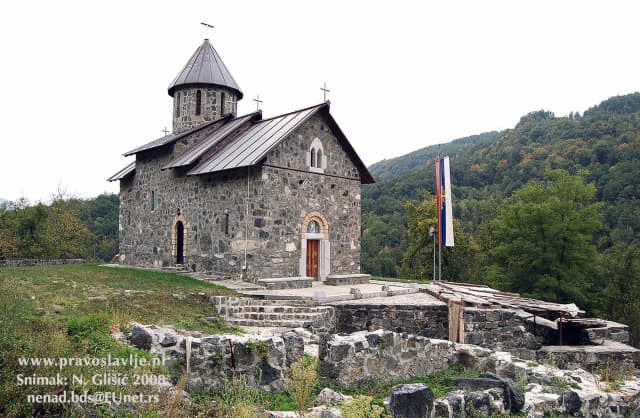
Mažići Monastery
Mažići Monastery, also known as Orahović, is a Serbian Orthodox monastery located near the village of Mažići in Serbia. Founded in the 12th century, it has a long history of destruction and rebuilding, with significant archaeological finds revealing its ancient origins as a cult site. Though abandoned in the early 18th century, the monastery complex, including its church and hospital, has undergone renovation and is protected as a cultural monument of great importance.

Pridvorica Monastery
Pridvorica Monastery is a 12th-century Serbian Orthodox monastery located in Ivanjica, Serbia, renowned for its architecture exemplifying the medieval Raška school. Originally founded as a nunnery around 1195 by a court servant of the Nemanjić dynasty, it later transitioned to a male monastery in 2007. The monastery is dedicated to the Transfiguration and is recognized as a cultural monument of great importance.