
Studenica Monastery
Studenica Monastery is a 12th-century Serbian Orthodox monastery renowned as the mother-church of all Serbian temples. Founded by Stefan Nemanja, it became a significant political, cultural, and spiritual center of medieval Serbia, housing priceless collections of Byzantine art. Protected by the state and recognized as a UNESCO World Heritage Site, it continues to be a vital religious and historical monument.
Key Facts
- ›Established in the late 12th century by Stefan Nemanja, founder of the medieval Serb state.
- ›It is the largest and richest of Serbia's Orthodox monasteries.
- ›Features two principal monuments: the Church of the Virgin and the Church of the King, both built of white marble.
- ›Houses priceless collections of 13th- and 14th-century Byzantine painting.
- ›Declared a Monument of Culture of Exceptional Importance in 1979.
- ›Included on the UNESCO list of World Heritage Sites in 1986.
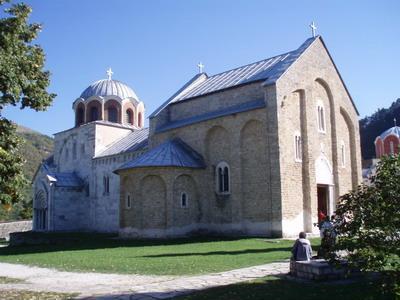
Romanesque, Byzantine, RašKa School
- Church of the Virgin
- Church of the King
- Priceless Collections of 13th- and 14th-Century Byzantine Painting
- White Marble Construction
- Frescoes, Including A 1209 Crucifixion and the 'Founders' Composition'
- Sculptural Elements On Portals
- Monastic Residence Housing A Museum
манастир студеница, Manastir Studenica
Stefan Nemanja, Stefan the First Crowned, King Radoslav, King Milutin, Saint Sava, Saint Sava Ii, Archbishop Arsenije
- Stefan Nemanja's Abdication and Monastic Vows
- Stefan Nemanja's Death and Relics Moved To Studenica
- King Radoslav Adding A Narthex
- King Milutin Building the King's Church
- Assaults By Turks After 1459
- Restoration of Frescoes
- Damage From Earthquake and Fire In the Early 17th Century
About Studenica Monastery
Studenica Monastery is a significant 12th-century Serbian Orthodox monastery located in central Serbia, southwest of Kraljevo. Founded by Stefan Nemanja, the progenitor of the medieval Serb state, it quickly evolved into a pivotal center for religion, culture, and politics in medieval Serbia. The monastery is celebrated for its architectural grandeur and its exceptional collection of Byzantine art, particularly the frescoes housed within its main churches.
History and Significance
The monastery, dedicated to the Presentation of the Holy Virgin, was established by Stefan Nemanja shortly after his abdication in 1196. It played a crucial role in the spiritual and political life of the Nemanjić dynasty. Following Stefan Nemanja's death, his son Saint Sava oversaw Studenica, solidifying its status as a major cultural and spiritual hub. Royal patronage continued with additions by King Radoslav and King Milutin, further enhancing its artistic and architectural richness. Despite facing numerous assaults and damage from natural disasters over the centuries, Studenica has undergone significant restorations, preserving its invaluable heritage.
Architecture and Art
The monastery complex is dominated by two primary structures built of white marble: the Church of the Virgin and the Church of the King. The Church of the Virgin, a domed single-nave basilica, is a prime example of the Raška School of architecture, harmoniously blending Romanesque and Byzantine styles. Its facades of white marble and interior artworks, including the renowned 1209 Crucifixion fresco, showcase the peak of Serbian medieval art. The Church of the King, built in 1314, is noted for its compressed cross form and octagonal dome. The monastery also features other churches, a bell tower, and a monastic residence that now serves as a museum displaying artifacts from the Studenica treasury.
Recognition and Current Status
Studenica Monastery's outstanding universal value was recognized when it was declared a Monument of Culture of Exceptional Importance in 1979 and subsequently inscribed on the UNESCO list of World Heritage Sites in 1986. It remains an active Serbian Orthodox monastery, drawing visitors and pilgrims who come to admire its historical significance, architectural beauty, and profound spiritual atmosphere.
Source: Wikipedia ↗
Frequently Asked Questions
When was Studenica Monastery founded?
Studenica Monastery was founded in the late 12th century by Stefan Nemanja. The first stage of construction was completed by the spring of 1196, around the time of Nemanja's abdication and monastic vows.
What is the significance of Studenica Monastery?
Studenica Monastery is considered the mother-church of all Serbian temples and served as a crucial political, cultural, and spiritual center of medieval Serbia. It is also recognized for its exceptional artistic heritage, particularly its 13th- and 14th-century Byzantine paintings.
What are the main architectural features of Studenica Monastery?
The monastery's main monuments, the Church of the Virgin and the Church of the King, are built of white marble. The Virgin's Church is a domed single-nave basilica that harmoniously blends Romanesque and Byzantine architectural styles, giving rise to the Raška School. The King's Church, built in 1314, has an octagonal dome and a compressed cross form.
What notable artworks are found at Studenica Monastery?
The monastery is renowned for its priceless collections of 13th- and 14th-century Byzantine paintings. The frescoes in the Church of the Virgin, dating from the first decade of the 13th century, include a celebrated Crucifixion from 1209. The King's Church also contains frescoes considered supreme achievements of Byzantine art in the region.
Is Studenica Monastery a UNESCO World Heritage Site?
Yes, Studenica Monastery was included on the list of World Heritage Sites by UNESCO in 1986. It is recognized for its outstanding universal value as a testament to medieval Serbian architecture and art.
Who is buried at Studenica Monastery?
Stefan Nemanja, the founder of the monastery, is buried at Studenica. His son, Stefan Radoslav of Serbia, is also interred there, with his relics having been moved to the monastery by Saint Sava.
Related Monasteries

Sopoćani Monastery
Sopoćani Monastery, an endowment of King Stefan Uroš I, was constructed between 1259 and 1270 in the Ras region of Serbia. It is renowned for its remarkable frescoes, considered among the most beautiful of the Serbian medieval period, which depict theological narratives and portraits of the Nemanjić dynasty. Although damaged and deserted for centuries after Ottoman raids in the late 17th century, the monastery was restored in the 20th century and now houses an active monastic community.

Pridvorica Monastery
Pridvorica Monastery is a 12th-century Serbian Orthodox monastery located in Ivanjica, Serbia, renowned for its architecture exemplifying the medieval Raška school. Originally founded as a nunnery around 1195 by a court servant of the Nemanjić dynasty, it later transitioned to a male monastery in 2007. The monastery is dedicated to the Transfiguration and is recognized as a cultural monument of great importance.

Patriarchate of Peć Monastery
The Patriarchate of Peć Monastery is a significant medieval Serbian Orthodox monastic complex located near Peja, Kosovo. Established in the 13th century, it rose to prominence as the permanent seat of Serbian Archbishops and later, in 1346, became the center of the Serbian Patriarchate. The complex is notable for its four interconnected churches, serving as a vital spiritual and cultural hub and the mausoleum for Serbian church leaders.