
Mogiła Abbey
Mogiła Abbey is a significant Cistercian monastery located in Kraków, Poland, founded in 1222 by Bishop Iwo Odrowąż. It was once the largest and most impressive church in medieval Poland after Wawel Cathedral and served as the burial place for the Odrowąż family. The complex features a Gothic abbey church, a Renaissance abbot's palace, and a red-brick monastery, having endured significant historical events including Mongol invasions and Swedish ravages.
Key Facts
- ›Founded in 1222 by Bishop Iwo Odrowąż.
- ›Was the second largest and most impressive church in medieval Poland.
- ›Served as the Odrowąż family's burial site until the 16th century.
- ›The abbey church was promoted to minor basilica status in 1970.
- ›Visited by Pope John Paul II in 1979.
- ›Features frescoes by Polish Renaissance painter Stanisław Samostrzelnik.

Gothic, Renaissance, Baroque
- Abbey Church of the Assumption of the Blessed Virgin Mary and St. Wenceslaus
- Abbot's Palace
- Frescoes By StanisłAw Samostrzelnik
- Wanda Mound
Opactwo CystersóW W Mogile, Abbatia B.M.V. De Clara Tumba
Iwo Odrowąż, Erazm CiołEk, StanisłAw Samostrzelnik
Founded In 1222, Ransacked During Mongol Invasion, Abbey Church Consecrated, Consumed By Fire, Ravaged By Swedish Army, Baroque Facade Added, Elevated To Minor Basilica, Visited By Pope John Paul Ii
About Mogiła Abbey
Mogiła Abbey, known in Latin as Abbatia B.M.V. de Clara Tumba, is a Cistercian monastery situated in the Nowa Huta District of Kraków, Poland. Its foundation in 1222 by Bishop Iwo Odrowąż marked the establishment of a significant religious and architectural complex. Originally conceived for religious devotion and to bolster the prestige of the Odrowąż family, it grew to become the most impressive church in medieval Poland after Wawel Cathedral and served as the family's burial site until the 16th century.
History and Architecture
The monastery's construction commenced around 1219 when a community of monks from Lubiąż Abbey was brought to the site. The monastic community, comprising the necessary thirteen professed monks for an independent establishment, took up residence around 1225, though expansion continued for many years. The abbey's status was officially confirmed by Pope Gregory IX in 1228.
The architectural ensemble is notable for its Polish Gothic church dedicated to the Assumption of the Blessed Virgin Mary and St. Wenceslaus, which also functions as the local parish church. Accompanying the church are a Polish Renaissance abbot's palace, constructed around 1569, and the main red-brick monastery buildings. These structures, set around a broad inner courtyard, are complemented by outbuildings, a vegetable garden, and a greenhouse.
Mogiła Abbey has faced considerable adversity throughout its history. In 1241, it was plundered during the Mongol invasion of Poland. Following its rebuilding, the abbey church was consecrated in 1266. The complex suffered further damage from a fire in 1447 and was severely ravaged in the 17th century by the invading Swedish army, an event that resulted in the death of nearly all its inhabitants, with only two monks surviving. The monastery church's facade was updated with Baroque elements between 1779 and 1780, based on a design by Franz Moser.
The abbey's spiritual significance was acknowledged in 1970 when Pope Paul VI elevated the church to the rank of a minor basilica. A testament to its enduring importance, the site was visited by Pope John Paul II in 1979, who celebrated Mass for approximately 200,000 people in a nearby open field.
Notable Individuals and Contributions
Under the abbacy of Erazm Ciołek, who was elected in 1522, Mogiła Abbey experienced a period of restoration and an expansion of its collection of rare books. Ciołek, a relative of the scholar Bishop Erazm Ciołek of Płock, also served as Vicar General of the Archdiocese of Kraków before his death, and was interred in the abbey cemetery.
The abbey also employed the talents of Stanisław Samostrzelnik, a Polish Renaissance painter also known as Stanisław z Mogiły (c. 1490–1541). He spent his final years working at Mogiła, where he died. His artistic contributions are visible in the monastery church, with frescoes adorning the right-hand transept and one of its chapels, including a significant painting on the forward wall of the chancel dating to around 1530.
Source: Wikipedia ↗
Frequently Asked Questions
When was Mogiła Abbey founded?
Mogiła Abbey was founded in 1222 by Bishop Iwo Odrowąż of Kraków. A community of monks from Lubiąż Abbey was brought in around 1219 to commence construction.
What is the architectural style of Mogiła Abbey?
The complex includes a Polish Gothic church of the Assumption of the Blessed Virgin Mary and St. Wenceslaus. The abbot's palace is in the Polish Renaissance style, and the monastery itself is red-brick. The church's facade was later updated in the Baroque style in 1779–80.
What significant historical events have affected Mogiła Abbey?
The abbey was ransacked during the Mongol invasion of Poland in 1241 and rebuilt. It was consumed by fire in 1447 and ravaged again by the Swedish army in the 17th century, an event during which most of the resident population was killed.
Who are some notable individuals associated with Mogiła Abbey?
Abbot Erazm Ciołek, elected in 1522, is noted for restoring the abbey and expanding its book collection. The Polish Renaissance painter Stanisław Samostrzelnik spent his final years working at the abbey and created frescoes within the church.
What is the significance of the name 'Clara Tumba'?
The Latin name for the monastery, Clara Tumba, translates to 'Bright Tomb'. This name is derived from local toponyms, possibly referencing the nearby Wanda Mound and the Polish word for 'tomb' in the original village name of Mogiła.
Has Mogiła Abbey been visited by Popes?
Yes, the abbey church was elevated to the rank of a minor basilica by Pope Paul VI in 1970. Pope John Paul II also visited in 1979, celebrating Mass for a large congregation in a nearby field.
Related Monasteries
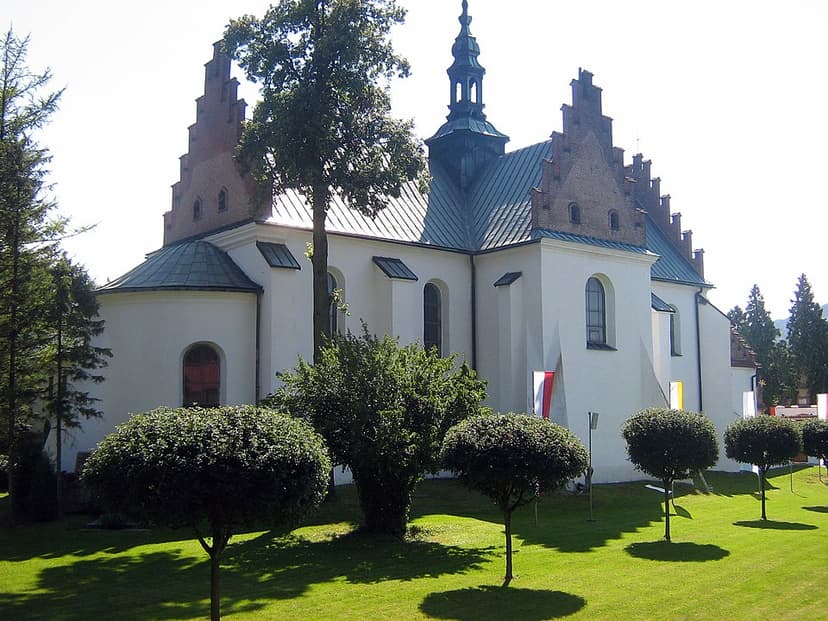
Szczyrzyc Abbey
Szczyrzyc Abbey is a functioning Cistercian monastery located in Szczyrzyc, Poland, established in 1234. It holds significance as one of the Polish Shrines to the Virgin Mary and also houses the Museum of the Cistercian Abbey, showcasing its religious and historical heritage.

Rügenwalde
Rügenwalde, also known as Darłowo, is a historic seaside town in northwestern Poland with a rich past as a trading center and ducal seat. Its strategic location at the mouth of the River Wieprza led to its development as a Hanseatic League member and a royal residence. The town's medieval layout, Ducal Castle, and Gothic churches contribute to its significance as a historical and tourist destination.
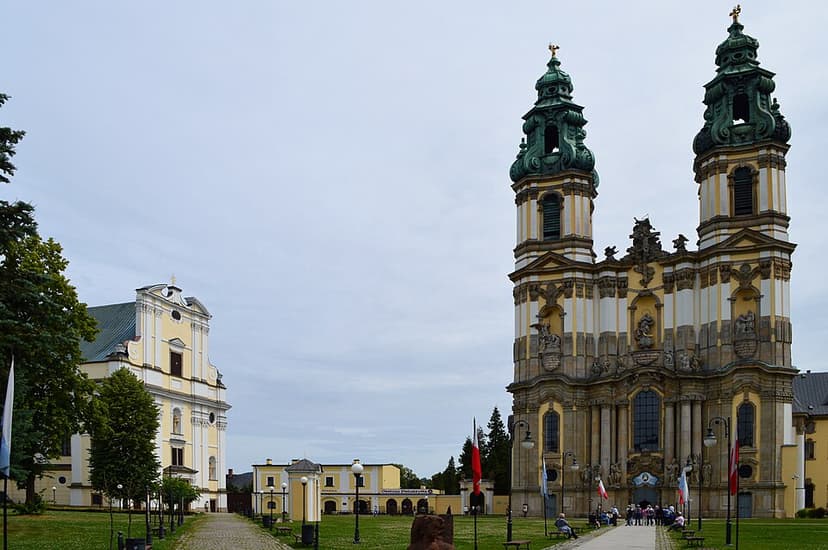
Krzeszów Abbey
Krzeszów Abbey is a historic Baroque Cistercian monastery located in Lower Silesia, Poland. Founded in 1242 as a Benedictine house, it was later managed by Cistercians from 1289 until its secularization by the Prussian state in 1810. The abbey complex, particularly its Basilica of the Assumption, features a mausoleum for dukes of the Piast dynasty and has undergone significant rebuilding, notably in a Baroque style. Following World War II, the site was resettled by Polish Benedictine nuns.