
Rügenwalde
Rügenwalde, also known as Darłowo, is a historic seaside town in northwestern Poland with a rich past as a trading center and ducal seat. Its strategic location at the mouth of the River Wieprza led to its development as a Hanseatic League member and a royal residence. The town's medieval layout, Ducal Castle, and Gothic churches contribute to its significance as a historical and tourist destination.
Key Facts
- ›The town's origins trace back to a 10th-century fortress named Dirlow.
- ›It was granted Lübeck law in 1312 and became a member of the Hanseatic League in 1412.
- ›Rügenwalde was the birthplace and burial site of Eric of Pomerania, King of Denmark, Sweden, and Norway.
- ›The Castle of Pomeranian Dukes, built in the MID-14th century, is a significant Gothic structure and now houses a museum.
- ›The town's lighthouse is unique in Poland for its rectangular plan.
- ›Rügenwalde is a popular summer resort with an aquapark featuring desalinated seawater.

Gothic, Renaissance, Baroque, Neo-Gothic
Ducal Castle, Our Lady of CzęStochowa Church, St. Gertrude's Church, St. George's Church, High Gate, Lighthouse of DarłOwo, Fountain – Fisherman Memorial, Old Town With Medieval Urban Planning, Aquapark With Desalinated Seawater
DarłOwo, Rugium, Dirlow, Dirlovo, RüGenwaldermüNde
Eric of Pomerania, Vitslav Ii of RüGen, Mestwin Ii, Bogislaw V, Elizabeth of Poland, Bogislaw X, Duke of Pomerania, MatthäUs Merian, Cecilia, Princess Sophia, John of Maszewo, Karl Rosenow, Wilhelm Groß, August Koberstein, StanisłAw Flejterski
- Settlement By the Rugii Tribe Around 100 Ad.
- Fortress Dirlow Existed By the 11th Century.
- Granted LüBeck Law In 1312.
- Became A Member of the Hanseatic League In 1412.
- Eric of Pomerania Returned and Expanded His Duchy Here After Losing His Thrones.
- Suffered Damage From Storms In 1497 and 1552, and Fires In 1589, 1624, 1648, 1679, and 1722.
- Capital of A Small Eponymous Duchy From 1569 To 1622.
- Harbour Destroyed During the Thirty Years' War and Reconstructed In 1772.
- Received A Railway Connection In 1878.
- Site of the German Army Firing Test Range RüGenwalde-Bad During Wwii, Testing Large Artillery Pieces Like Schwerer Gustav.
- Operated A Forced Labor Subcamp During Wwii.
- Population Expelled After Wwii, and the Town Was Repopulated With Poles and Lemkos.
- Renamed DarłOwo After Wwii.
About Rügenwalde
Rügenwalde, modernly known as Darłowo, is a significant historical seaside town situated on the Slovincian Coast of northwestern Poland. Its strategic location at the mouth of the River Wieprza into the Baltic Sea made it a crucial trading point as early as the 11th century. The town's history is marked by its ducal past, its affiliation with the Hanseatic League, and its connection to royalty, particularly Eric of Pomerania, who was born and later resided there.
History and Development
The area's settlement traces back to the Stone Age, with evidence of Roman merchants traveling along the Amber Road. By the 11th century, it was a significant trading location. The town was likely founded around 1270 by Vitslav II of Rügen and was granted Lübeck law in 1312. It officially became a member of the Hanseatic League in 1412, boasting its own trade fleet that sailed as far as Normandy and Spain. The town experienced periods of prosperity under rulers like Bogislaw X, but also suffered from natural disasters such as storms and fires.
During World War II, Rügenwalde served a different purpose as the site of the German Army Firing Test Range, where massive artillery pieces like the Schwerer Gustav were tested. It also housed a forced labor subcamp. Following the war, the town's German population was expelled, and it was repopulated by Poles and Lemkos, eventually taking its current Polish name, Darłowo.
Notable Structures and Features
Darłowo retains much of its medieval character, with a preserved Old Town featuring a central market square and remnants of its fortifications, including the surviving High Gate (Brama Wysoka). The Castle of Pomeranian Dukes, a Gothic structure dating from the second half of the 14th century, now functions as a museum and is notable for its unique architecture on the Polish coast. The town is also home to several medieval churches, including the Gothic Our Lady of Częstochowa Church, the burial site of Eric of Pomerania, and St. Gertrude's Church, known for its Scandinavian-style Gothic architecture.
Modern Significance
Today, Darłowo is a popular summer resort, attracting visitors with its beaches and a unique aquapark. The lighthouse in Darłówko, the easternmost on the West Coast, is notable for being the only one in Poland built on a rectangular plan. Rügenwalde's historical legacy is preserved through its well-maintained architecture and its continued role as a vibrant coastal town.
Source: Wikipedia ↗
Frequently Asked Questions
What is the historical significance of Rügenwalde?
Rügenwalde was a vital trading point since the 11th century, becoming a member of the Hanseatic League and a ducal seat. It is famously known as the birthplace and burial site of Eric of Pomerania, a significant monarch of the Kalmar Union.
What are the main historical attractions in Rügenwalde?
The primary attractions include the well-preserved Old Town with its medieval urban planning, the Castle of Pomeranian Dukes, and several Gothic churches like Our Lady of Częstochowa Church and St. Gertrude's Church.
When was Rügenwalde founded?
The town was likely founded in 1270 by Vitslav II of the Danish Principality of Rügen and was first mentioned in a document on February 5, 1271.
What notable figures are associated with Rügenwalde?
Key figures include Eric of Pomerania, who was born and later resided in the town, and Bogislaw X, Duke of Pomerania, under whom sea and land trade flourished.
What is the architectural style of the Castle of Pomeranian Dukes?
The castle is primarily built in the Gothic style, with its base plan resembling a square and a tower reaching 24 meters in height. Its initial appearance is said to have inspired Kronborg Castle in Denmark.
Is Rügenwalde still an active settlement?
Yes, Rügenwalde is an active seaside town and a popular summer resort in modern-day Poland, with a population of over 13,000 inhabitants.
Related Monasteries

Mogiła Abbey
Mogiła Abbey is a significant Cistercian monastery located in Kraków, Poland, founded in 1222 by Bishop Iwo Odrowąż. It was once the largest and most impressive church in medieval Poland after Wawel Cathedral and served as the burial place for the Odrowąż family. The complex features a Gothic abbey church, a Renaissance abbot's palace, and a red-brick monastery, having endured significant historical events including Mongol invasions and Swedish ravages.
Szczyrzyc Abbey
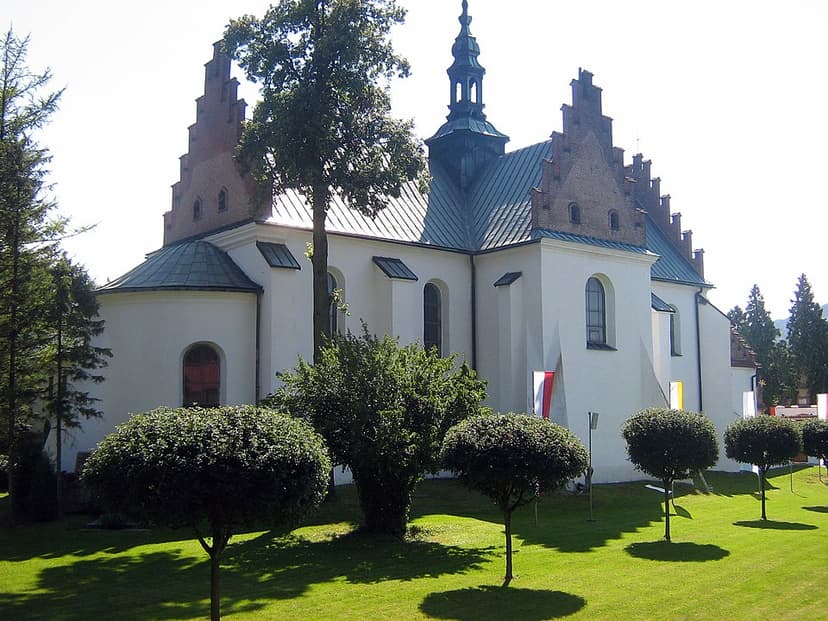
Szczyrzyc Abbey is a functioning Cistercian monastery located in Szczyrzyc, Poland, established in 1234. It holds significance as one of the Polish Shrines to the Virgin Mary and also houses the Museum of the Cistercian Abbey, showcasing its religious and historical heritage.
Krzeszów Abbey
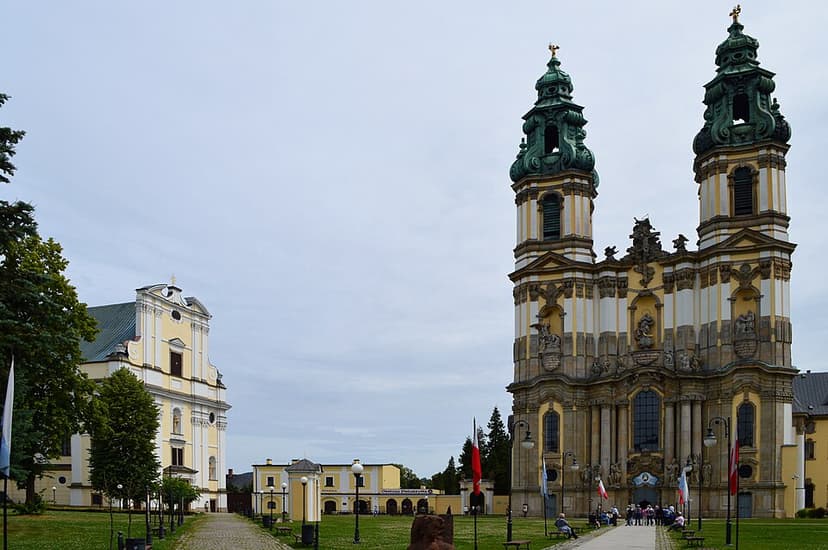
Krzeszów Abbey is a historic Baroque Cistercian monastery located in Lower Silesia, Poland. Founded in 1242 as a Benedictine house, it was later managed by Cistercians from 1289 until its secularization by the Prussian state in 1810. The abbey complex, particularly its Basilica of the Assumption, features a mausoleum for dukes of the Piast dynasty and has undergone significant rebuilding, notably in a Baroque style. Following World War II, the site was resettled by Polish Benedictine nuns.