
Merevale Abbey
Merevale Abbey was a medieval Cistercian monastery founded in 1148 by Robert de Ferrers. Though dissolved in 1538 and falling into ruin, significant remnants survive, most notably the gate chapel, now St. Mary The Church of Our Lady Merevale. This church is recognized for its exceptional Cistercian stained glass, including a significant Jesse window, and is unique for being the only Cistercian gate chapel to hold regular services year-round.
Key Facts
- ›Founded in 1148 by Robert de Ferrers.
- ›A relatively small Cistercian abbey with approximately 10 monks.
- ›Dissolved in October 1538 during the reign of Henry VIII.
- ›The gate chapel, now St. Mary the Church of our Lady Merevale, is a surviving significant part.
- ›Features important Cistercian stained glass, including a notable Jesse window.
- ›It is the only Cistercian gate chapel open for regular weekly services.

Cistercian
Cistercian Stained Glass, Jesse Window, Gate Chapel Used As A Church
Robert De Ferrers, William De Ferrers
Dissolution of the Monasteries
About Merevale Abbey
Merevale Abbey was a medieval Cistercian monastery established in 1148 by Robert de Ferrers. Situated in the village of Merevale, North Warwickshire, England, it was a relatively modest institution, housing around ten monks during its operational period. The abbey's existence came to an end in October 1538 when it was dissolved under the reign of King Henry VIII, leading to its decline into ruin.
Despite its dissolution, significant portions of Merevale Abbey have endured to the present day. The most notable surviving structure is its gate chapel, which has been repurposed as St. Mary The Church of Our Lady Merevale. This church holds particular importance for its preserved Cistercian stained glass, including a highly significant Jesse window, considered one of the most important in the British Isles. Furthermore, it holds the distinction of being the sole Cistercian gate chapel that remains open for regular weekly services throughout the year. William de Ferrers is among the notable figures interred at the site.
Source: Wikipedia ↗
Frequently Asked Questions
When was Merevale Abbey founded?
Merevale Abbey was founded in 1148 by Robert de Ferrers.
What religious order was Merevale Abbey part of?
Merevale Abbey was a medieval Cistercian monastery.
What happened to Merevale Abbey?
The abbey was dissolved in October 1538 during the reign of Henry VIII and subsequently fell into ruin.
What significant parts of Merevale Abbey remain today?
The most significant surviving part is the gate chapel, which is now used as St. Mary The Church of Our Lady Merevale. This church is notable for its Cistercian stained glass.
Is the surviving church at Merevale Abbey still used for services?
Yes, St. Mary The Church of Our Lady Merevale is unique as it is the only Cistercian gate chapel to be open for regular weekly services throughout the year.
Who is buried at Merevale Abbey?
William de Ferrers is buried at Merevale Abbey.
Related Monasteries

Ankerwycke Priory
Ankerwycke Priory was a small and relatively poor Benedictine nunnery established around 1160 in Buckinghamshire, England. Dedicated to St. Mary Magdalene, it held lands across several counties. Dissolved in 1536, its revenues were transferred to Bisham Abbey, and the priory site later saw the construction of a manor house. Today, only a small section of ruins remains, situated in Berkshire.
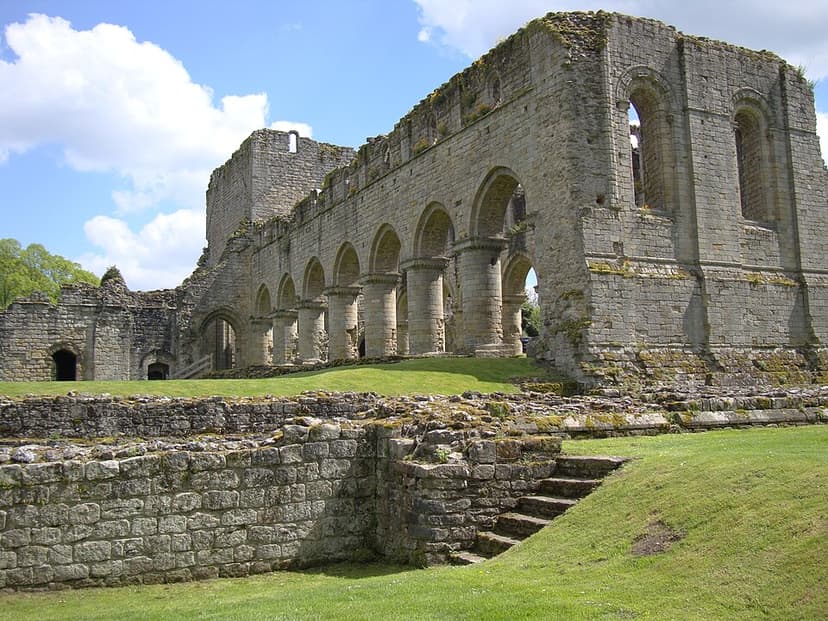
Buildwas Abbey
Buildwas Abbey was a significant Cistercian monastery in Shropshire, England, founded in 1135. It experienced periods of substantial growth and wealth, becoming a center of learning with a notable library. Despite facing challenges from economic crises and conflict, it played a role in royal administration, particularly concerning Ireland and Wales, before its suppression in 1536. Today, substantial remains of the abbey church and monastic buildings are maintained by English Heritage.

Byland Abbey
Byland Abbey was a Savigniac and later Cistercian monastic institution founded in 1135 in North Yorkshire, England. Despite an unstable early history with multiple relocations, it eventually settled at its final site near Coxwold. Once established, it became a significant religious and economic center, renowned for its sheep rearing and wool exports, and boasting a church described as one of the finest 12th-century structures in Europe. Though dissolved in 1538, extensive ruins remain, including the west front of the church with its notable rose window, and the site is maintained by English Heritage.