
Marienmünster
Marienmünster is a town in the Höxter district of North Rhine-Westphalia, Germany, established in 1970 through the merger of several independent municipalities. Located in the Weserbergland, it is notable for its well-developed tourism industry and its historical ties to the Corvey Monastery and the Marienmünster Abbey church. The town's administrative center is in Vörden, and it is recognized as a climatic spa, attracting visitors with its agreeable climate and recreational facilities.
Key Facts
- ›Marienmünster is North Rhine-Westphalia's smallest municipality by land area.
- ›The town was formed on January 1, 1970, from the merger of 13 former municipalities.
- ›Its administrative center is located in the constituent community of Vörden.
- ›The town is known for the Abteikirche Marienmünster, the former abbey church.
- ›Vörden was designated a state-recognized climatic spa in 1999.
- ›The town's CIVIC coat of arms features a stylized representation of the Marienmünster abbey church.

Baroque
Organ In Abteikirche MarienmüNster, Schloss VöRden, Hungerbergkapelle, MüHlengrund In Hohehaus, Aussichts- Und Museumsturm
- Establishment of the Town Through Municipal Merger On January 1, 1970.
- Designation of VöRden As A State-Recognized Climatic Spa In 1999.
- Beginning of the Rock N Revel Festival In Altenbergen In 2019.
About Marienmünster
Marienmünster is a municipality located in the Höxter district within the state of North Rhine-Westphalia, Germany. It is recognized as the smallest municipality in North Rhine-Westphalia by land area and is situated in the Weserbergland region. The town was officially established on January 1, 1970, through the amalgamation of thirteen previously independent municipalities, with Vörden serving as its administrative center.
History and Development
The history of the area now comprising Marienmünster is intertwined with early settlements and monastic influences. Historical records indicate settlements like "Wendedhen" (first mentioned in 1188) and "Dungen" (dating back to around 825), which had holdings associated with the Corvey Monastery. The town's coat of arms, conferred in 1973, features a stylized representation of the west façade of the Marienmünster abbey church, established in 1128, underscoring its historical and unifying significance.
Culture and Tourism
Marienmünster is known for its well-developed tourism industry. The constituent community of Vörden received the designation of "State-recognized climatic spa" in 1999, highlighting the agreeable bioclimate of the area. Key attractions include the Abteikirche Marienmünster, noted for its organ, the Baroque stately home Schloss Vörden with its park, and the Hungerbergkapelle, which is part of a Way of the Cross. The town also hosts educational institutions, including primary schools and a Hauptschule, and participates in a joint Volkshochschule with the neighboring town of Höxter.
Source: Wikipedia ↗
Frequently Asked Questions
When was the town of Marienmünster established?
The town of Marienmünster was established on January 1, 1970. This was through the merger of previously independent municipalities.
What is the administrative center of Marienmünster?
The administrative center of Marienmünster is located in Vörden. Vörden is one of the constituent communities that form the town.
What is Marienmünster known for in terms of tourism?
Marienmünster has a well-developed tourism industry. The community of Vörden was recognized as a climatic spa in 1999, and the town is known for the Marienmünster Abbey church.
What historical entities are associated with the area that is now Marienmünster?
The area has historical ties to the Corvey Monastery, which is mentioned in connection with early settlements like "Wynithun" and "Dungen." The Marienmünster Abbey also played a role in the region's history.
What is the significance of the coat of arms of Marienmünster?
The coat of arms of Marienmünster features a stylized representation of the west façade of the Marienmünster abbey church, symbolizing the connection between the town, its people, and the church. The eight-pointed star on the arms is from the Schwalenberg family's insignia.
Related Monasteries

Herstelle Abbey
Herstelle Abbey, also known as the Abbey of the Holy Cross, is a Benedictine monastery for nuns located in Herstelle, North Rhine-Westphalia, Germany. Founded in 1899 on the grounds of a former Minorite convent, it was elevated to abbey status in 1924 and joined the Beuronese Congregation. The community is known for its traditional monastic duties, including hospitality, and its engagement in handicraft work.

Königsmünster Abbey
Königsmünster Abbey is a Benedictine monastery located in Meschede, Germany, founded in 1928 by monks from three Bavarian abbeys. The abbey's name, meaning "monastery of the King" (Christ), reflects its spiritual dedication. It played a role in continuing the traditions of the dissolved Grafschaft Abbey and experienced confiscation and expulsion of monks by the National Socialists in 1941, before its church was consecrated in 1964 and it became an independent priory.
Maria Hain Charterhouse
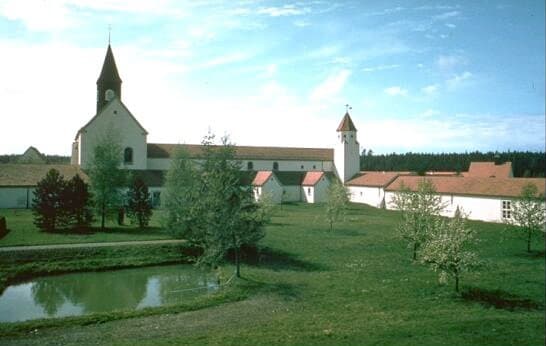
Marienau Charterhouse is the sole active Carthusian monastery in Germany, serving as the successor to the Maria Hain Charterhouse in Düsseldorf. Founded in 1964, it relocated from its original site due to airport expansion. The monastery is renowned for its modern, functional architecture designed by Emil Steffann and Gisberth M. Hülsmann, and its capacity to house 24 monks, double the usual number, reflecting its significant role in preserving the Carthusian way of life.