
Llantwit-Major Monastery
Christian·Wales·Active Parish Church and Museum/Exhibition Space·6th century
St Illtyd's Church in Llantwit Major is a significant ecclesiastical complex in Wales, built on the site of one of the UK's oldest educational institutions. Originally believed to be founded by Emperor Theodosius II around AD 395, it is now widely accepted as being established by St. Illtud circa AD 508. The current church structure, a Grade I listed building, began in the 11th century by the Normans and has undergone significant rebuilding and additions in the 13th and 15th centuries, earning it the moniker "Westminster Abbey of Wales" for its unique collection of carved stones and effigies.
Key Facts
- ›Believed to be the site of the oldest college in the United Kingdom.
- ›Founded by St. Illtud around AD 508, though an earlier founding by Emperor Theodosius II is now largely discredited.
- ›The current church building dates from the 11th century Norman conquest, with later additions.
- ›Known for its exceptional collection of Celtic carved stones and effigies.
- ›Referred to as the "Westminster Abbey of Wales" and "the most beautiful church in Wales."
- ›The Galilee Chapel was reconstructed as a contemporary visitor and exhibition center for the Celtic crosses.

Romanesque, Gothic
Collection of Celtic Carved Stones, Houelt Cross, Sampson Cross, Sampson Pillar, Galilee Chapel, Medieval Wall Paintings, Norman Parish Church, 13th-Century Monastery Church
St Illtyd's Church, CôR Tewdws, College of Theodosius, Bangor Illtyd, Llanilltud Fawr
St. Illtud, St. Germanus, St. Dubricius, Saint David, Saint Samson, Saint Paul Aurelian, Gildas the Historian, Saint Tudwal, Saint Baglan, Maelgwn Gwynedd, Robert Fitzhamon, Sir Hugh Raglan, Iolo Morganwg
- Attack By Irish Pirates
- Attack By Danes In 987
- Norman Conquest and Rebuilding In the 11th Century
- Restoration of Sanctuary Rights In 1150
- 13th-Century Rebuilding and Establishment of A Grange
- 15th-Century Rebuilding and Extension
- Dissolution of the Monasteries In the 16th Century
- Galilee Chapel Chantry Abolished During Reign of Edward Vi
- Restoration of West Chapel In Early 20th Century
- Reconstruction of the Galilee Chapel
About Llantwit-Major Monastery
St. Illtyd's Church, Llantwit Major
St. Illtyd's Church, situated in Llantwit Major, Vale of Glamorgan, Wales, stands as a significant ecclesiastical complex with deep historical roots. It is recognized as the site of one of the United Kingdom's oldest educational institutions, historically known as Côr Tewdws. While an 18th-century account attributed its founding to Emperor Theodosius II around AD 395, modern scholarship generally accepts its establishment by Saint Illtud circa AD 508, from whom it derives its name, Llanilltud Fawr, meaning "Illtud's Great Church."
History and Development
The college is believed to have been a vital center of learning, with tradition holding that numerous Celtic saints, including Saint David and Saint Samson, studied there. The original structures were likely constructed from wood or wattle and daub. The Norman conquest in the 11th century brought significant changes; the wooden college and church were destroyed, and the endowments were transferred to Tewkesbury Abbey. The Normans subsequently rebuilt a parish church on the site around 1100, though the college's importance diminished. The church underwent substantial rebuilding and expansion in the 13th and 15th centuries, resulting in the complex structure seen today, which is divided into distinct East and West Chapels. The East Chapel served as the monastery church, while the West Chapel functioned as the parish church. Following the Dissolution of the Monasteries in the 16th century, the monastic community disbanded, and the East Chapel was adopted as the parish church, with parts of the complex falling into disrepair.
Architectural Significance and Notable Features
The church is a Grade I listed building, celebrated for its unique collection of carved stones and effigies, earning it the appellation "Westminster Abbey of Wales." The architectural styles present include Romanesque in the 12th-century West Chapel, with later Gothic elements incorporated through 13th and 15th-century modifications. Among its most important features are the 9th and 10th-century Celtic carved stones, including the Houelt Cross, Sampson Cross, and Sampson Pillar. The Galilee Chapel, a 13th-century addition, was extensively reconstructed and reopened in 2013 as a visitor and exhibition center dedicated to these ancient artifacts. The church grounds also contain a 13th-century gatehouse and a monks' dovecote, adding to the historical richness of the site.
Source: Wikipedia ↗
Frequently Asked Questions
When was Llantwit-Major Monastery founded?
The monastery, now known as St. Illtyd's Church, is widely accepted to have been founded by St. Illtud around AD 508. Earlier theories suggest a founding by Emperor Theodosius II around AD 395, but these are now generally considered fictional.
What is the historical significance of Llantwit-Major Monastery?
It is recognized as the site of one of the United Kingdom's oldest colleges, which attracted numerous prominent Celtic saints as students. The church complex itself is a Grade I listed building and is celebrated for its significant collection of medieval carved stones and effigies.
What architectural styles can be found at Llantwit-Major Monastery?
The church complex showcases Romanesque style in its 12th-century West Chapel, built by the Normans. Subsequent rebuilding and additions in the 13th and 15th centuries introduced elements that contribute to its unique, elongated structure.
What are the most notable features of Llantwit-Major Monastery?
Key features include its extensive collection of 9th and 10th-century Celtic carved stones, such as the Houelt Cross and the Sampson Cross. The Galilee Chapel, recently reconstructed, serves as an exhibition space for these stones, and the church itself is divided into distinct East and West Chapels.
What is the current status of Llantwit-Major Monastery?
The complex is an active parish church, part of the Rectorial Benefice of Llantwit Major in the Diocese of Llandaff. The Galilee Chapel has been restored and serves as a visitor and exhibition center.
Is Llantwit-Major Monastery open to the public?
Yes, St. Illtyd's Church is generally open to the public as an active parish church. The restored Galilee Chapel also functions as a visitor center, making the site accessible for exploration and learning.
Related Monasteries

Bangor Monastery
Bangor Cathedral, dedicated to its founder Saint Deiniol, stands on a site of Christian worship since the sixth century. Originally established as St Deiniol's Monastery, it has a long and tumultuous history marked by destruction and rebuilding, evolving from its Norman origins to its current Gothic Revival appearance. The cathedral is a significant religious and historical landmark in Gwynedd, Wales, known for its architectural evolution and notable features.
Caergybi Monastery
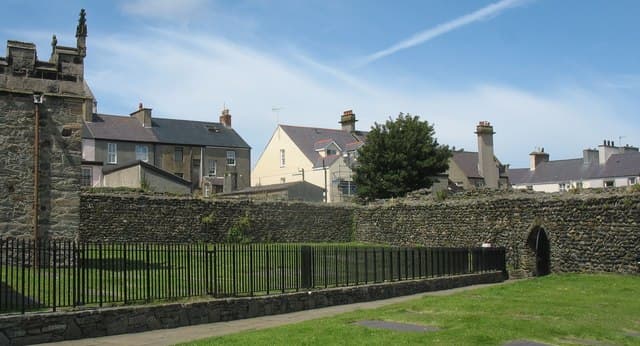
Caergybi Monastery, also known as the Church of St Cybi, is a historical religious site in Holyhead, Wales, with origins tracing back to a Roman fortlet. It was refounded as a monastery in the 6th century by Saint Cybi, and the church on the site today preserves elements of its long history, including its Roman foundations and a chapel reputedly over the saint's grave.

Llancarfan Monastery
Llancarfan Monastery was a significant 6th-century clas, a center of learning in the Vale of Glamorgan, Wales, founded by Saint Cadoc. It was renowned for its educational offerings, attracting many holy men who studied and taught there. Although the original monastic structures are not extant, the site is marked by its parish church, which still contains medieval wall paintings.