
Lesnes Abbey
Lesnes Abbey is a ruined Augustinian priory located in Abbey Wood, southeast London. Founded in 1178 by Richard de Luci, it was home to a small community of canons regular and faced financial difficulties due to land management costs. The abbey was suppressed in 1525 and its buildings largely demolished, with the site later becoming farmland before its ruins were excavated and opened as a public park in the 20th century.
Key Facts
- ›Founded in 1178 by Richard de Luci, Chief Justiciar of England.
- ›Initially housed canons regular associated with the Arroussian Order, a branch of Augustinian canons.
- ›Suffered chronic financial difficulties due to costs associated with draining marshland and maintaining river embankments.
- ›Closed in 1525 by Cardinal Wolsey due to having fewer than seven inmates.
- ›The ruins were excavated in the early 20th century and opened to the public as a park in 1931.
- ›Archaeological finds from the site are held by the Royal Greenwich Heritage Trust.

- Lesnes Abbey Woods
- Abbey Wood Sssi
- Lesnes Missal
- Abbott's Lodging
- Mulberry Tree Planted In the Late 18th Or Early 19th Century
- Restored Ruins Showing Abbey Outline and Walls
Loisnes
Richard De Luci, Henry Ii, Thomas Becket, Cardinal Wolsey, Abel Ker
- Norman Conquest
- Foundation of the Abbey
- Richard De Luci Retired To the Abbey and Died There
- Peasants' Revolt
- Suppression By Cardinal Wolsey
- Site Acquired By Henry Cooke
- Property Bequeathed To Christ's Hospital
- Excavation By Woolwich & District Antiquarian Society
- Site Purchased By London County Council and Opened As Park
- Became Property of London Borough of Bexley
About Lesnes Abbey
Lesnes Abbey is a former Augustinian priory located in Abbey Wood, within the London Borough of Bexley in southeast London. Now preserved as ruins and a scheduled monument, the site offers a glimpse into medieval monastic life and its subsequent transformation. The abbey's adjacent woodland, Lesnes Abbey Woods, is a recognized Local Nature Reserve and includes Abbey Wood SSSI, noted for its significant early Tertiary period fossils.
History and Foundation
The land where Lesnes Abbey stands was part of the Domesday Book entry for Loisnes. The Abbey of St Mary and St Thomas the Martyr at Lesnes was founded in 1178 by Richard de Luci, the Chief Justiciar of England. It is speculated that de Luci may have founded the abbey as an act of penance for his role in the conflict between King Henry II and Archbishop Thomas Becket, which led to Becket's murder. De Luci himself retired to the abbey after resigning his office in 1179 and was buried there.
The community at Lesnes Abbey consisted of canons regular associated with the Arroussian Order, a less stringent branch of Augustinian canons. Throughout its history, the abbey faced reports of irregularities and significant financial challenges stemming from the costly efforts to drain and maintain the surrounding marshland and river embankments.
Suppression and Later History
Due to its small size, with fewer than seven inmates, Lesnes Abbey was closed by Cardinal Wolsey in 1525 under a license to suppress such monasteries. Most of the monastic buildings were demolished, with only the Abbott's Lodging remaining largely intact at that time. The site passed through various private hands, with building materials being salvaged, and some stone is believed to have been used in the construction of Hall Place in nearby Bexley.
For a period, the area reverted to farmland, with the former abbot's house incorporated into a farmhouse. A notable feature from the late 18th or early 19th century is a large mulberry tree that still stands on what was the abbey's north side. The site underwent excavation between 1909 and 1910. Recognizing its historical and archaeological value, the London County Council purchased the ruins in 1930, opening the site to the public as a park in 1931. Since 1986, the London Borough of Bexley has managed the property. Today, the restored ruins clearly outline the abbey's former structure, providing a sense of its original scale and atmosphere, set within parkland and an ornamental garden. The site also includes visitor amenities such as a café and a small exhibition.
Source: Wikipedia ↗
Frequently Asked Questions
When was Lesnes Abbey founded?
Lesnes Abbey was founded in the year 1178. Its establishment was attributed to Richard de Luci, who held the significant position of Chief Justiciar of England.
What religious order was based at Lesnes Abbey?
Lesnes Abbey was home to a small community of canons regular. These canons were related to the Arroussian Order, which was a more relaxed form of the Augustinian canons.
Why was Lesnes Abbey closed?
The abbey was closed in 1525 by Cardinal Wolsey. This closure was part of a broader policy to suppress monasteries with fewer than seven inmates, as Lesnes Abbey fell into this category.
What is the current status of Lesnes Abbey?
Lesnes Abbey is now a ruined abbey and a scheduled monument. The ruins are listed at Grade II by Historic England and are part of a public park managed by the London Borough of Bexley.
What is notable about the surrounding area of Lesnes Abbey?
The Lesnes Abbey Woods adjacent to the ruins are a Local Nature Reserve. A portion of this woodland, Abbey Wood SSSI, is a geological Site of Special Scientific Interest known for its fossils from the early Tertiary period.
Is there any significant historical event associated with Lesnes Abbey?
During the Peasants' Revolt in 1381, a group from nearby Erith forced their way into Lesnes Abbey and made the abbot swear an oath to support their rebellion. The abbot was compelled to join them on their march to Maidstone.
Related Monasteries

Ankerwycke Priory
Ankerwycke Priory was a small and relatively poor Benedictine nunnery established around 1160 in Buckinghamshire, England. Dedicated to St. Mary Magdalene, it held lands across several counties. Dissolved in 1536, its revenues were transferred to Bisham Abbey, and the priory site later saw the construction of a manor house. Today, only a small section of ruins remains, situated in Berkshire.
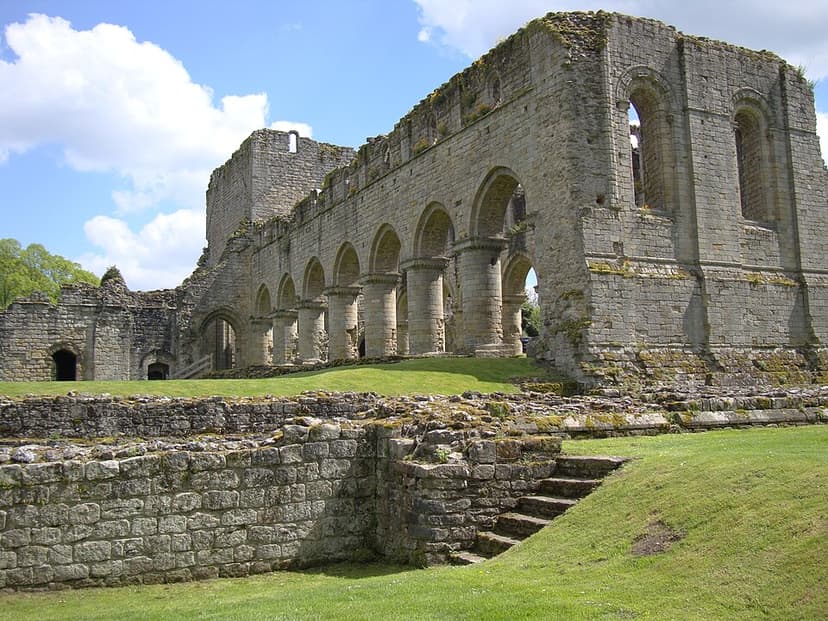
Buildwas Abbey
Buildwas Abbey was a significant Cistercian monastery in Shropshire, England, founded in 1135. It experienced periods of substantial growth and wealth, becoming a center of learning with a notable library. Despite facing challenges from economic crises and conflict, it played a role in royal administration, particularly concerning Ireland and Wales, before its suppression in 1536. Today, substantial remains of the abbey church and monastic buildings are maintained by English Heritage.

Byland Abbey
Byland Abbey was a Savigniac and later Cistercian monastic institution founded in 1135 in North Yorkshire, England. Despite an unstable early history with multiple relocations, it eventually settled at its final site near Coxwold. Once established, it became a significant religious and economic center, renowned for its sheep rearing and wool exports, and boasting a church described as one of the finest 12th-century structures in Europe. Though dissolved in 1538, extensive ruins remain, including the west front of the church with its notable rose window, and the site is maintained by English Heritage.