
Kirkstead Abbey
Kirkstead Abbey was a Cistercian monastery founded in 1139 in Lincolnshire, England. It moved to a new site in 1187 and operated until its dissolution in 1537. The last abbot and three monks were executed following accusations of involvement in the Lincolnshire Rising. Today, only a fragment of the south transept wall and earthworks remain, with the site being a listed monument.
Key Facts
- ›Founded in 1139 by Hugh Brito.
- ›Originally colonized by monks from Fountains Abbey.
- ›Moved to a new, larger site in 1187.
- ›Dissolved in 1537.
- ›The last abbot and three monks were executed.
- ›Remains are a Grade I listed monument.

Fragment of the South Transept Wall, Earthworks of the Vast Complex
Hugh Brito, Richard Harrison
Dissolution of the Monasteries, Implication In the Lincolnshire Rising
About Kirkstead Abbey
Kirkstead Abbey is a former Cistercian monastery situated in Kirkstead, Lincolnshire, England. Its establishment dates back to 1139, initiated by Hugh Brito, the lord of Tattershall. The original monastic community was formed by an abbot and twelve monks who migrated from Fountains Abbey in Yorkshire. However, the initial site proved insufficient, leading Robert, son of Hugh, to secure a more suitable location nearby in 1187. Architectural evidence suggests the abbey's construction was underway around 1175, with the 1187 date likely marking the completion of the abbey structures.
The monks of Kirkstead Abbey were granted significant rights, including the lordship of Wildmore and the right of common pasture for themselves and their tenants, by the lords of Bolingbroke, Scrivelsby, and Horncastle. The abbey maintained its monastic life for several centuries, existing until 1537.
Dissolution and Legacy
The dissolution of the monasteries under Henry VIII brought an end to Kirkstead Abbey. The final abbot, Richard Harrison, along with three of his monks, faced execution. This severe action followed their alleged, though likely unjust, implication in the Lincolnshire Rising of the preceding year. Following the abbey's dissolution, the lands passed through various noble hands, including the Duke of Suffolk and later the Clinton Earls of Lincoln, who constructed a substantial country house on the site.
By 1791, even the country house had disappeared, leaving behind only a striking fragment of masonry—specifically, a portion of the south transept wall of the original abbey church. The earthworks that delineate the extensive complex of buildings that once surrounded the abbey church are also preserved. These remnants are recognized for their historical importance, with the earthworks being Grade I listed and designated as an ancient scheduled monument. Historical records also suggest that the Monks Smithy House near Rotherham may have originated as a grange established by Kirkstead Abbey.
Source: Wikipedia ↗
Frequently Asked Questions
When was Kirkstead Abbey founded?
Kirkstead Abbey was founded in 1139 by Hugh Brito. The monastery later moved to a new site in 1187, with its architecture dating to around 1175.
What happened to Kirkstead Abbey?
The abbey remained in existence until 1537, when it was dissolved. The last abbot and three monks were executed by Henry VIII.
What remains of Kirkstead Abbey today?
Today, only a dramatic crag of masonry, a fragment of the south transept wall of the abbey church, and the earthworks of the former complex remain. The site is a Grade I listed monument.
Who founded Kirkstead Abbey?
Kirkstead Abbey was founded by Hugh Brito, also known as Hugh son of Eudo, who was the lord of Tattershall.
Related Monasteries

Ankerwycke Priory
Ankerwycke Priory was a small and relatively poor Benedictine nunnery established around 1160 in Buckinghamshire, England. Dedicated to St. Mary Magdalene, it held lands across several counties. Dissolved in 1536, its revenues were transferred to Bisham Abbey, and the priory site later saw the construction of a manor house. Today, only a small section of ruins remains, situated in Berkshire.
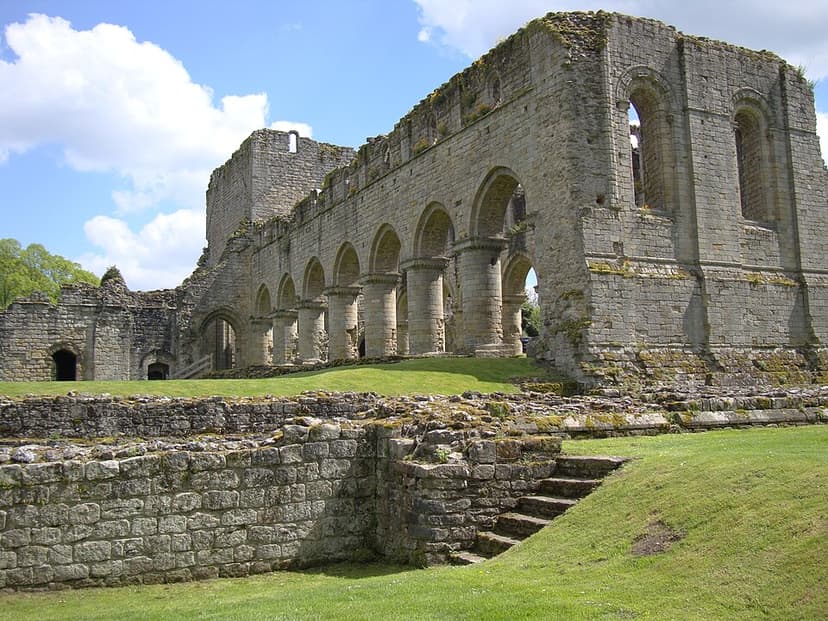
Buildwas Abbey
Buildwas Abbey was a significant Cistercian monastery in Shropshire, England, founded in 1135. It experienced periods of substantial growth and wealth, becoming a center of learning with a notable library. Despite facing challenges from economic crises and conflict, it played a role in royal administration, particularly concerning Ireland and Wales, before its suppression in 1536. Today, substantial remains of the abbey church and monastic buildings are maintained by English Heritage.

Byland Abbey
Byland Abbey was a Savigniac and later Cistercian monastic institution founded in 1135 in North Yorkshire, England. Despite an unstable early history with multiple relocations, it eventually settled at its final site near Coxwold. Once established, it became a significant religious and economic center, renowned for its sheep rearing and wool exports, and boasting a church described as one of the finest 12th-century structures in Europe. Though dissolved in 1538, extensive ruins remain, including the west front of the church with its notable rose window, and the site is maintained by English Heritage.