
Kirkstall Abbey
Kirkstall Abbey is a ruined Cistercian monastery located in West Yorkshire, England, on the north bank of the River Aire. Founded around 1152 by monks from Fountains Abbey, it flourished for centuries before being dissolved under Henry VIII. Today, its picturesque ruins are a popular visitor attraction and public park, with its gatehouse serving as the Abbey House Museum.
Key Facts
- ›Founded circa 1152 by Cistercian monks.
- ›Disestablished during the Dissolution of the Monasteries under Henry VIII.
- ›Acquired by Leeds Corporation in 1889 and opened to the public in 1895.
- ›The ruins have been a subject for artists like J. M. W. Turner.
- ›The grounds now form a public park with sports facilities and a visitor centre.
- ›The former gatehouse houses the Abbey House Museum.

Cistercian, Gothic
Picturesque Ruins, Public Park Setting, River Aire Location, Abbey House Museum, Visitor Centre With Interactive Exhibits
Henry De Lacy, Abbot Alexander, Thomas Cranmer, Sir Robert Savile, William Wells Brown, William St John Hope, W. V. Wade
Foundation C. 1152, Dissolution of the Monasteries, Acquisition By Leeds Corporation, Opening To the Public
About Kirkstall Abbey
Kirkstall Abbey is a significant ruined Cistercian monastery situated in Kirkstall, a suburb to the northwest of Leeds city centre in West Yorkshire, England. Nestled within a public park on the north bank of the River Aire, its picturesque remains attract visitors and have inspired artists for centuries.
Foundation and Early History
The abbey's origins trace back to a vow made by Henry de Lacy, Baron of Pontefract and Clitheroe, who promised to found an abbey if he recovered from an illness. He agreed to provide land at Barnoldswick for a daughter abbey of Fountains Abbey. In May 1147, Abbot Alexander led twelve Cistercian monks from Fountains to Barnoldswick. After six challenging years in what they found to be an inhospitable location, Abbot Alexander sought a more suitable site. He discovered a location in the Aire Valley inhabited by hermits and, with de Lacy's assistance in acquiring the land from William de Poitou, the monks relocated to Kirkstall, displacing the hermits. The majority of the abbey's buildings were constructed between the monks' arrival in 1152 and the conclusion of Abbot Alexander's abbacy in 1182, utilizing stone from Bramley Fall.
Architecture and Layout
Kirkstall Abbey's architecture exemplifies the plain style typical of English Cistercian houses. The church, one of the best-preserved examples, features a short chancel with three eastward chapels and transepts. Its windows and doorways are round-headed, while the vaulting arches are pointed, incorporating early Gothic elements. The nave notably lacks a triforium. The cloister, located to the south of the nave, was flanked by essential monastic buildings: a chapter house on the east side, a sacristy, a parlour, and the calefactory (day-room) below the monks' dormitory. The south side of the cloister housed the refectory, with a later, larger refectory superseding the original. Adjacent to these were the kitchen, pantry, and buttery. The western side of the cloister contained vaulted cellars supporting the lay brothers' dormitory. A secondary group of buildings to the southeast has been identified as potentially the hospitium or abbot's house.
Dissolution and Later History
The abbey was surrendered to Henry VIII's commissioners on November 22, 1539, marking its disestablishment. It was briefly granted to Thomas Cranmer before reverting to the Crown. The estate later passed through several private hands, with significant portions of its stone being repurposed for other constructions in the Leeds area. During the 18th century, the atmospheric ruins became a favored subject for Romantic artists, including J. M. W. Turner and John Sell Cotman. In 1889, Colonel John North purchased the abbey and gifted it to Leeds City Council. Following extensive restoration, Kirkstall Abbey was opened to the public in 1895. The gatehouse was converted into the Abbey House Museum, now part of Leeds Museums & Galleries.
The Abbey Today
Kirkstall Abbey is recognized as a Grade I listed building and a scheduled ancient monument. A recent £5.5 million renovation program has introduced a new visitor centre featuring interactive exhibits that detail the abbey's history and the monks' way of life. Entry to the Abbey ruins is managed through the visitor centre. The extensive grounds surrounding the abbey, covering 23.5 hectares (58 acres), are maintained as a public park offering various recreational amenities. The abbey site also serves as a venue for cultural events, including historical reenactments, concerts, and the annual Kirkstall Festival. It has also been utilized as a filming location for television series such as "Gunpowder" and hosted major concerts by bands like the Kaiser Chiefs.
Source: Wikipedia ↗
Frequently Asked Questions
When was Kirkstall Abbey founded?
Kirkstall Abbey was founded approximately in 1152. The monks arrived at the site and began construction of the buildings between this year and 1182, the end of Abbot Alexander's abbacy.
What is the architectural style of Kirkstall Abbey?
The church at Kirkstall Abbey is of the Cistercian type, characterized by plainness. While windows and doorways feature round heads, the vaulting arches are pointed, and moldings and capitals display early Gothic features. The nave lacks a triforium, and the chancel is short with eastward chapels.
What happened to Kirkstall Abbey after its dissolution?
Following its surrender in 1539, Kirkstall Abbey was granted to Thomas Cranmer, later reverting to the Crown. The estate was subsequently sold multiple times, with much of its stone being reused in other local buildings. The ruins gained popularity with Romantic artists before the site was acquired by Leeds Corporation.
Is Kirkstall Abbey still an active monastery?
No, Kirkstall Abbey is no longer an active monastery. It was dissolved under Henry VIII and is now a ruined historical site and a public park.
Can I visit Kirkstall Abbey?
Yes, Kirkstall Abbey is open to the public. Entry to the Abbey ruins is typically accessed via the visitor centre, and the surrounding grounds form a public park.
What is notable about the buildings of Kirkstall Abbey?
The buildings followed a typical Cistercian plan, with a church featuring a short chancel and transepts. The cloister area included a chapter house, sacristy, parlour, and calefactory, with the monks' dormitory above. A secondary group of buildings may have served as a hospitium or abbot's house.
Related Monasteries

Ankerwycke Priory
Ankerwycke Priory was a small and relatively poor Benedictine nunnery established around 1160 in Buckinghamshire, England. Dedicated to St. Mary Magdalene, it held lands across several counties. Dissolved in 1536, its revenues were transferred to Bisham Abbey, and the priory site later saw the construction of a manor house. Today, only a small section of ruins remains, situated in Berkshire.
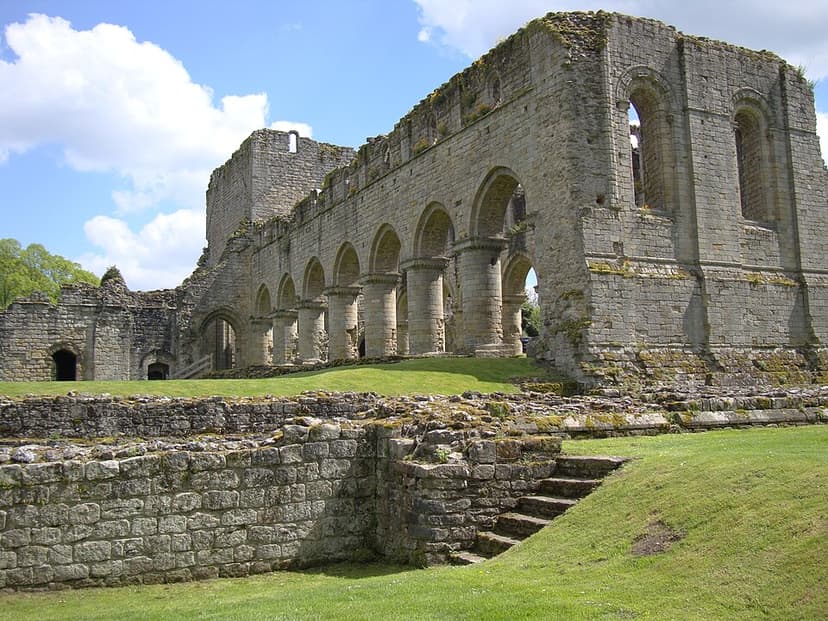
Buildwas Abbey
Buildwas Abbey was a significant Cistercian monastery in Shropshire, England, founded in 1135. It experienced periods of substantial growth and wealth, becoming a center of learning with a notable library. Despite facing challenges from economic crises and conflict, it played a role in royal administration, particularly concerning Ireland and Wales, before its suppression in 1536. Today, substantial remains of the abbey church and monastic buildings are maintained by English Heritage.

Byland Abbey
Byland Abbey was a Savigniac and later Cistercian monastic institution founded in 1135 in North Yorkshire, England. Despite an unstable early history with multiple relocations, it eventually settled at its final site near Coxwold. Once established, it became a significant religious and economic center, renowned for its sheep rearing and wool exports, and boasting a church described as one of the finest 12th-century structures in Europe. Though dissolved in 1538, extensive ruins remain, including the west front of the church with its notable rose window, and the site is maintained by English Heritage.