
Kinalehin Charterhouse
Kinalehin Charterhouse, also known as Kinaleghin Friary, holds the distinction of being Ireland's sole Carthusian monastery, founded around 1252. Over its history, it transitioned from a Carthusian charterhouse to a Franciscan friary, experiencing periods of dissolution and refounding before its final closure. The surviving remains primarily reflect its Franciscan period, though some Carthusian earthworks are still visible.
Key Facts
- ›Ireland's only Carthusian monastery.
- ›Founded circa 1252 by John de Cogan.
- ›Originally established for the Carthusian Order.
- ›Later served as a Franciscan friary.
- ›Surviving remains are predominantly from the Franciscan era.
- ›Designated as a National Monument in Ireland.

Cloister Remains, Choir Remains, Three Chapels
Kinaleghin Friary, Mainistir ChineáL FhéIchíN
John De Cogan, Richard Burke, 2nd Earl of Clanricarde
- Founded As Ireland's Only Carthusian Monastery .
- Purportedly Destroyed and Rebuilt .
- Dissolved By the General Chapter .
- Refounded With the Order of Friars Minor Conventual .
- Dissolved During the Dissolution of the Monasteries .
- Refounded For Observant Franciscan Friars .
- Friars Expelled After Cromwellian Conquest.
- Friars Returned During the Time of Charles Ii.
About Kinalehin Charterhouse
Kinalehin Charterhouse, also known by its Irish name Mainistir Chineál Fhéichín and the alternative spelling Kinaleghin Friary, stands as a significant monastic site in County Galway, Ireland. It holds the unique historical distinction of being Ireland's only Carthusian monastery. The site's history is complex, marked by its founding as a charterhouse, subsequent transitions to different religious orders, and periods of dissolution and refounding.
History and Significance
The monastery was established around 1252 by John de Cogan, who intended it for the Carthusian Order. The initial monks were brought from English houses in Somerset. Historical records suggest it may have been destroyed shortly after its founding in 1279, only to be rebuilt soon after. Its early history also includes a brief period where it was sold to the Knights Hospitaller in 1306, though this transaction appears not to have been fully realized. A significant shift occurred in 1321 when the Carthusian General Chapter dissolved Kinalehin, with the diocese of Clonfert taking possession in 1341.
Around 1371, Pope Gregory XI permitted the de Burgos family to refound the monastery, this time for the Order of Friars Minor Conventual. The site faced closure during the Dissolution of the Monasteries in 1540, with its lands later purchased by Richard Burke, 2nd Earl of Clanricarde, who allowed the friars to remain. It was dissolved again before 1609.
Kinalehin was refounded in 1611 for the Observant Franciscan Friars. During this period, in 1629, the monastery was noted as holding An Leabhar Breac, a significant 15th-century manuscript. The friars were expelled following the Cromwellian conquest but later returned during the reign of Charles II.
Architectural Remains
The surviving archaeological remains at Kinalehin Friary are primarily indicative of its Franciscan occupation. These include the remnants of a cloister, a choir area, and three chapels. While the main structures are Franciscan, some earthworks are believed to represent earlier Carthusian elements.
Location
Kinalehin Friary is situated in County Galway, Ireland. It is located approximately 6.7 kilometers (4.2 miles) west of Ballyshrule. The site lies to the northwest of Lough Derg and to the south of the Duniry River.
Source: Wikipedia ↗
Frequently Asked Questions
When was Kinalehin Charterhouse founded?
Kinalehin Charterhouse was founded around 1252 by John de Cogan for the Carthusian Order. The first monks arrived from England.
What is the religious tradition of Kinalehin Charterhouse?
Kinalehin Charterhouse began as a Carthusian monastery, a strict Catholic monastic order. Later in its history, it was refounded as a Franciscan friary, also part of the Catholic tradition.
What remains of Kinalehin Charterhouse today?
The surviving archaeological remains are mainly from the Franciscan period, consisting of a cloister, choir, and three chapels. Some earlier Carthusian elements may still exist as earthworks.
Has Kinalehin Charterhouse always been a monastery?
While founded as a Carthusian charterhouse, Kinalehin was later granted to the Knights Hospitaller, though this sale may not have been completed. It was then refounded with the Order of Friars Minor Conventual and later the Observant Franciscan Friars. The site experienced several dissolutions and refoundings throughout its existence.
Where is Kinalehin Charterhouse located?
Kinalehin Friary is situated in County Galway, Ireland. It is located west of Ballyshrule, northwest of Lough Derg, and south of the Duniry River.
Related Monasteries

Holy Cross
Holy Cross Abbey, originally known as Mainistir na Croise Naofa, is a historic Cistercian monastery located in County Tipperary, Ireland. Its significance stems from its possession of a relic of the True Cross, which made it a prominent medieval pilgrimage site and a symbol of Catholic resistance during the Reformation and subsequent periods of religious persecution. Though it fell into ruins after the Cromwellian conquest, it was exceptionally restored as a place of Catholic worship in the 20th century.

Abbey of Lerha
The Abbey of Lerha was a significant Cistercian monastery founded in 1205 by Risteárd de Tiúit. Although dissolved in 1539, its ruins remain visible and give the nearby village of Abbeylara its name. The monastery's historical presence is a defining characteristic of the region.
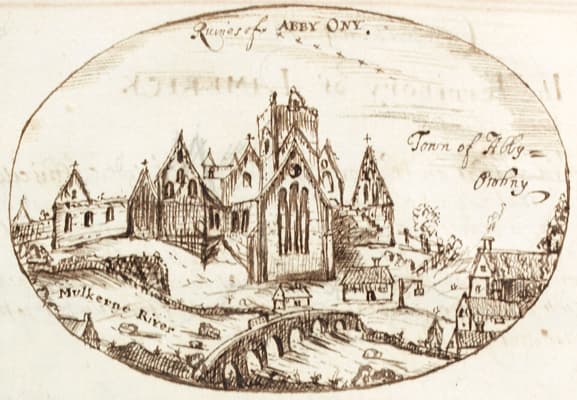
Abington Abbey
Abington Abbey, also known as the Cistercian Abbey of Woney, was founded in 1205 by Theobald Walter in County Limerick, Ireland. Situated on the banks of the Mulkear River, the abbey's charter granted extensive lands and judicial rights, establishing it as a significant religious and economic entity. Although the original buildings are now largely gone, traces of its architecture and layout can still be observed in the graveyard at Abington.