
Kilrimont Monastery
Kilrimont Monastery, also known as St Mary's Collegiate Church or St Mary of the Culdees, originated from an ancient association of clergy called the Culdees (Céli Dé). Established as a collegiate church in the 1240s, it served as Scotland's first and functioned as a secular college of priests. The institution played a role in ecclesiastical disputes and royal affairs until its decline following the Scottish Reformation, with little of its original structure surviving today.
Key Facts
- ›Originated from the ancient Culdees (CéLI Dé) association of clergy.
- ›Became Scotland's first collegiate church in the 1240s.
- ›Served as a secular college of priests based near St Andrews Cathedral.
- ›Was an official royal chapel between 1286 and 1501.
- ›Its original structure was largely destroyed in 1559 by reforming Protestants.

Gothic
- Extant Foundations Showing A Cross-Shaped Layout
- Site of Ancient Religious Community Pre-Dating Later Structures
St Mary On the Rock, St Mary's Collegiate Church, St Mary of the Culdees, Kirkheugh, Church of St Mary of Kilrymont, St Mary of Kilrymont
Gille CríSt, Robert, William De Malveisin, Master Adam De Malkarviston
- Foundation of the Augustinian Priory In 1140
- Disputes Between the CéLi Dé and the Augustinian Canons
- Establishment As Scotland's First Collegiate Church In the 1240s
- Served As A Royal Chapel
- Destruction By Reforming Protestants In June 1559
About Kilrimont Monastery
Kilrimont Monastery, also known by several other names including St Mary's Collegiate Church, St Mary on the Rock, and St Mary of the Culdees, was a significant religious institution in St Andrews, Scotland. Its origins trace back to an ancient association of clergy known as the Culdees or Céli Dé, meaning 'vassals of God'. While not formally founded as a collegiate church until the 1240s, it represented a continuation of this earlier clerical community.
History and Significance
The history of Kilrimont Monastery is intertwined with the development of religious life in St Andrews. The Culdees, headed by an abbot, were the primary clerics associated with the cathedral before the establishment of an Augustinian priory in 1140. Although attempts were made to integrate the Culdees into the new Augustinian order, they persisted, eventually being granted the status and rights of a secular college, becoming Scotland's first collegiate church. This transformation occurred around 1248 or 1249, with the church of St Mary becoming a distinct institution.
St Mary's Collegiate Church served as an official royal chapel from 1286 until 1501. Throughout its existence, it was involved in ecclesiastical politics, notably in disputes with the prior of St Andrews and in the process of episcopal elections. The collegiate church was endowed with numerous prebends over the centuries. However, its existence was relatively short-lived in its collegiate form, as it did not long survive the Scottish Reformation.
Location and Decline
The church was situated at Kirkheugh or Kirkhill, on the seaward side of St Andrews Cathedral. Archaeological evidence, including burials that pre-date later structures and tenth-century cross-slabs found in the grounds, suggests a religious presence on the site from as early as the sixth century. The church itself was described as cross-shaped, with the choir being longer than the nave. Tragically, the church is said to have been pulled down by reforming Protestants in June 1559, leading to the present state where little of the original structure remains.
Source: Wikipedia ↗
Frequently Asked Questions
What were the Culdees (Céli Dé)?
The Culdees, or Céli Dé, were an association of clergy in Scotland, meaning 'vassals of God'. They formed the earliest known clerical group associated with Kilrimont Monastery and later served as canons in St Mary's Collegiate Church.
When was Kilrimont Monastery established as a collegiate church?
Kilrimont Monastery was established as a collegiate church, specifically St Mary's Collegiate Church, in the 1240s. This made it the first of its kind in the Kingdom of Scotland.
What is the historical significance of Kilrimont Monastery?
Its significance lies in its role as Scotland's first collegiate church and its origins from the ancient Culdees. It also played a part in disputes between bishops and monastic chapters, and served as a royal chapel.
What remains of Kilrimont Monastery today?
Little of the original structure of Kilrimont Monastery has survived. The church was reportedly pulled down by reforming Protestants in 1559, and only extant foundations of its cross-shaped layout are noted.
What was the relationship between Kilrimont Monastery and St Andrews Cathedral?
Kilrimont Monastery, particularly as St Mary's Collegiate Church, was located on the seaward side of St Andrews Cathedral. It represented a continuation of the Culdees, who were associated with the cathedral before the establishment of an Augustinian priory and a second cathedral chapter.
Related Monasteries

Hinba Monastery
Hinba Monastery was a small monastic settlement associated with the Columban church on Iona, active in the late 6th century. While its exact location remains a subject of scholarly debate, it served as a retreat for Columba and was administered by early superiors like St. Ernan and Baithéne. The monastery is primarily known through Adomnán's "Vita Columbae," which records mystical events and anecdotes about Columba's time there.
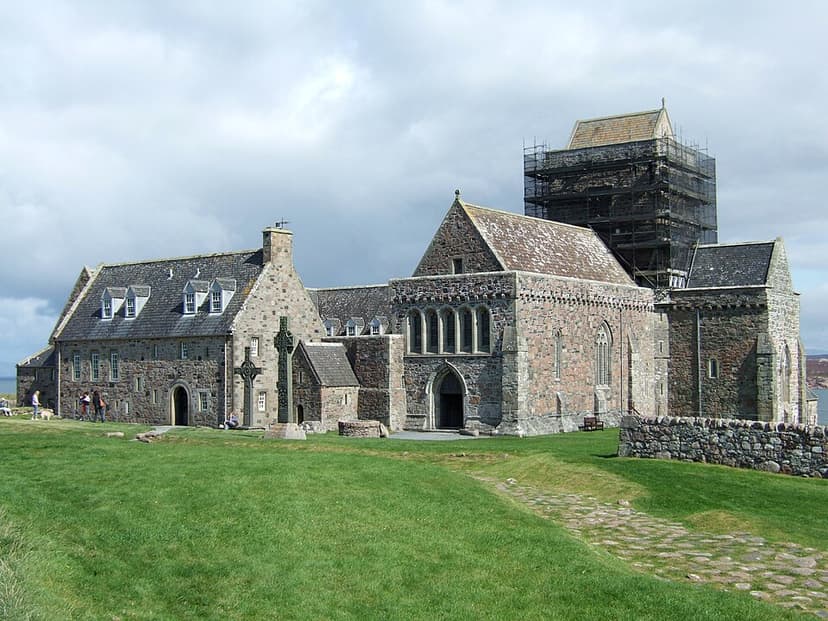
Iona Abbey
Iona Abbey is one of the oldest Christian centers in Western Europe, established on the island of Iona off the west coast of Scotland. Founded by Saint Columba in 563, it served as a crucial hub for the spread of Christianity throughout Scotland. After periods of Viking raids and rebuilding, it became a Benedictine abbey and later the ecclesiastical capital for the Macdonald Lords of the Isles. Today, it is the spiritual home of the Iona Community, an ecumenical Christian order, and remains a significant site for Christian pilgrimage.

Abbey of St Cybard
The Abbey of Saint-Cybard was a Benedictine monastery situated outside Angoulême, France. Founded in the sixth century by Saint Eparchius, it experienced periods of royal confirmation, Viking raids, and later fell under Cluniac influence before its destruction during the Wars of Religion. Today, only remnants of its church and chapels survive.