
Hinba Monastery
Hinba Monastery was a small monastic settlement associated with the Columban church on Iona, active in the late 6th century. While its exact location remains a subject of scholarly debate, it served as a retreat for Columba and was administered by early superiors like St. Ernan and Baithéne. The monastery is primarily known through Adomnán's "Vita Columbae," which records mystical events and anecdotes about Columba's time there.
Key Facts
- ›Associated with the Columban church on Iona.
- ›Served as a retreat for Columba of Iona.
- ›Its precise location is uncertain, with several Scottish islands proposed as candidates.
- ›Key information about the monastery comes from Adomnán's "Vita Columbae."
- ›The first recorded superior was St. Ernan, an uncle of Columba.
- ›Mystical events and visions involving Columba were recorded at Hinba.

Associated With Columba of Iona, Site of Recorded Mystical Events and Visions
Columba of Iona, St. Ernan, BaithéNe Mac BréNaind, St. Comgall, St. Brendan
- Columba Received A Message From An Angel Regarding the Ordination of áEdáN Mac GabráIn.
- Columba Granted A Relaxation of Dietary Rules For Penitents.
- Columba Was Attacked With A Spear, With His Cowl Miraculously Deflecting It.
About Hinba Monastery
Hinba Monastery was a significant, albeit small, monastic settlement connected to the Columban church established on the island of Iona in Scotland. While historical accounts, primarily Adomnán's "Vita Columbae," provide details about its early superiors and mystical events associated with Saint Columba, the precise geographic location of Hinba remains a subject of considerable scholarly debate. The island's name itself has uncertain origins, with potential derivations from Goidelic roots, and its disappearance from later records is often attributed to the impact of Norse settlements on Hebridean place names.
Founding and Early Administration
The monastery is thought to have been founded in the period between 564 and 574 AD, during the influential evangelizing mission of Saint Columba in Dál Riata. Columba regarded Hinba as a favored retreat for contemplation, a practice consistent with the use of secluded 'deserts' within the Celtic monastic system. The first recorded superior of Hinba was St. Ernan, an uncle of Columba, who played a minor role before his untimely death. Following Ernan, Baithéne mac Brénaind, who later became the second abbot of Iona, is known to have administered the monasteries of both Hinba and Mag Luigne.
Mystical Accounts and Scholarly Debate
Adomnán's "Vita Columbae" recounts several notable events that took place at Hinba, highlighting its spiritual importance during Columba's lifetime. These include instances of divine visions, angelic visitations, and miraculous interventions. For example, Columba received heavenly revelations that lasted for days and was visited by an angel holding a glass book dictating the ordination of kings, an event that left a physical scar on Columba. The text also describes a miraculous incident where a monk's life was saved by wearing Columba's cowl. Despite these detailed accounts, the identification of Hinba with specific modern islands such as Eileach an Naoimh, Jura, Colonsay, Oronsay, Seil, or Canna continues to be a point of contention, with various etymological and geographical arguments presented by different scholars.
Source: Wikipedia ↗
Frequently Asked Questions
Where was Hinba Monastery located?
The exact location of Hinba Monastery is uncertain and debated among scholars. Islands such as Eileach an Naoimh, Jura, Colonsay, Oronsay, Seil, and Canna have been proposed as its site. The difficulty in pinpointing its location is partly due to the changing influence of Norse names on island nomenclature and varying interpretations of historical texts.
When was Hinba Monastery founded?
The founding date of Hinba Monastery is not precisely known, but estimates place its establishment between 564 and 574 AD. This period coincides with Columba's evangelizing mission in Dál Riata after his arrival in Scotland in 563 AD.
What is the primary source of information about Hinba Monastery?
The main source of information about Hinba Monastery is Adomnán's "Vita Columbae," a late 7th-century text detailing the life of Saint Columba. This work records various anecdotes and mystical events that occurred during Columba's visits to the island.
Who were the early superiors of Hinba Monastery?
St. Ernan, an uncle of St. Columba, is recorded as the first superior (praepositus) of Hinba. He accompanied Columba from Ireland and was appointed head of the community. Later, Baithéne mac Brénaind, who became the second abbot of Iona, is known to have administered Hinba before his succession.
What kind of monastic settlement was Hinba?
Hinba was a smaller monastic settlement, described as a 'desert' or retreat centre associated with the larger Columban church on Iona. It was a place Columba favored for contemplation and spiritual retreats.
Related Monasteries

Kilrimont Monastery
Kilrimont Monastery, also known as St Mary's Collegiate Church or St Mary of the Culdees, originated from an ancient association of clergy called the Culdees (Céli Dé). Established as a collegiate church in the 1240s, it served as Scotland's first and functioned as a secular college of priests. The institution played a role in ecclesiastical disputes and royal affairs until its decline following the Scottish Reformation, with little of its original structure surviving today.
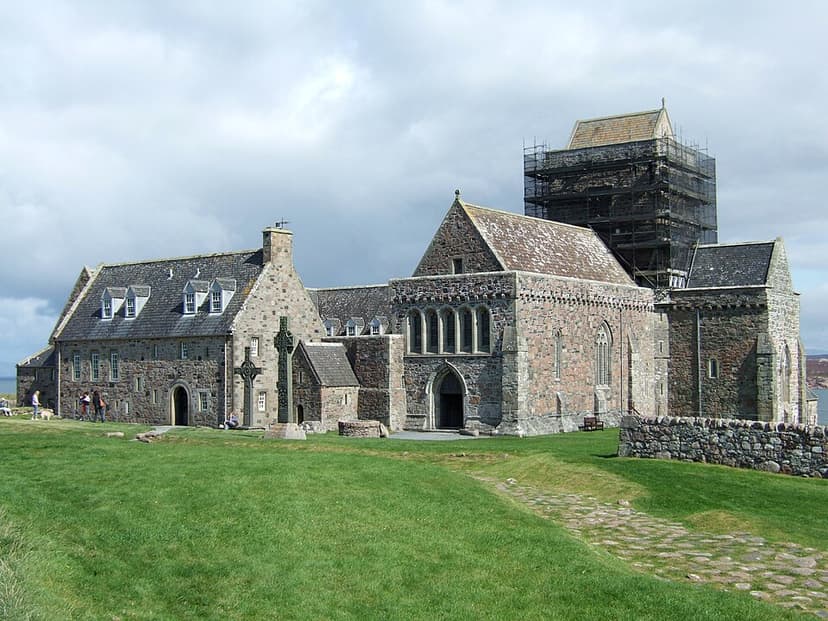
Iona Abbey
Iona Abbey is one of the oldest Christian centers in Western Europe, established on the island of Iona off the west coast of Scotland. Founded by Saint Columba in 563, it served as a crucial hub for the spread of Christianity throughout Scotland. After periods of Viking raids and rebuilding, it became a Benedictine abbey and later the ecclesiastical capital for the Macdonald Lords of the Isles. Today, it is the spiritual home of the Iona Community, an ecumenical Christian order, and remains a significant site for Christian pilgrimage.

Abbey of St Cybard
The Abbey of Saint-Cybard was a Benedictine monastery situated outside Angoulême, France. Founded in the sixth century by Saint Eparchius, it experienced periods of royal confirmation, Viking raids, and later fell under Cluniac influence before its destruction during the Wars of Religion. Today, only remnants of its church and chapels survive.