
Inislounaght (Suir)
Inislounaght Abbey was a significant 12th-century Cistercian monastery located on the river Suir near Clonmel, County Tipperary, Ireland. Originally dedicated to the Blessed Virgin, the abbey site had an earlier monastic foundation. It experienced periods of importance, including hosting a peace treaty in 1397, but declined significantly by the 16th century, with its lands falling under the control of the Butler dynasty and its structures largely dismantled by the time of the Reformation.
Key Facts
- ›Founded between 1142 and 1148 as a Cistercian monastery.
- ›The site was an ancient monastery predating the 7th century.
- ›Received land donations from Malachy O'Phelan and King Donald O'Brien.
- ›Hosted a peace treaty meeting between the Earls of Desmond and Ormond in 1397.
- ›No physical trace of the abbey remains at its original location.
- ›Its stonework is believed to have been repurposed for local buildings.

Innislounaght, Inislounacht, De Surio, Abby Slunnagh
Saint Pulcherius, Malachy O'Phelan, Donald O'Brien, Congan, Malmaire O'Brien, Abbot Patrick, Richard Loundres, Dermot O'Heffernan, William O'Dineen, Thomas Ochael, Walter Butler, James Butler, Nicholas Fagan, Laurence Fitzharris
- Peace Treaty Between the Earls of Desmond and Ormond Sealed Here In 1397.
About Inislounaght (Suir)
Inislounaght Abbey: A Lost Cistercian Foundation
Inislounaght Abbey, also known by variations such as Innislounaght and Inislounacht, was a significant 12th-century Cistercian monastery established on the banks of the River Suir, near Clonmel in County Tipperary, Ireland. The site itself held earlier monastic significance, with records indicating a monastery founded there before 656 by Saint Pulcherius. The Cistercian foundation, originally dedicated to the Blessed Virgin, was established between 1142 and 1148 on lands generously donated by local magnates, including Malachy O'Phelan, lord of the Decies, and Donald O'Brien, king of Munster. Its location in fertile agricultural land was advantageous, though the abbey later faced periods of disruption and decline.
Historical Context and Decline
The abbey played a role in regional politics, notably hosting a meeting in 1397 between the Earls of Desmond and Ormond to seal a treaty of peace, though this accord proved temporary. However, by the 16th century, Inislounaght Abbey had fallen into a state of disrepair and moral disrepute. Its lands came under the control of the Butler dynasty, and historical accounts from the period describe its abbot engaging in misconduct and neglecting the abbey's religious duties and lands. This decline coincided with the broader Reformation period, during which many religious houses faced dissolution and repurposing.
Legacy and Absence
Tragically, no physical remnants of Inislounaght Abbey can be found at its original location today. Efforts by the Ordnance Survey in the 1840s to locate its foundations were unsuccessful. It is believed that much of the abbey's stonework was salvaged and incorporated into the construction of local mills, the present-day church in Marlfield, and civic structures in Clonmel, such as the Main Guard. Literary historians have suggested that Inislounaght may have served as an inspiration for the satirical 14th-century poem, "The Land of Cokaygne." The abbey is mentioned in historical texts such as Geoffrey Keating's "Foras Feasa ar Éirinn," underscoring its historical presence even as its physical form has vanished.
Source: Wikipedia ↗
Frequently Asked Questions
When was Inislounaght Abbey founded?
The abbey was refounded as a Cistercian settlement between 1142 and 1148. An ancient monastery existed on the site even earlier, founded before 656 by Saint Pulcherius.
Where was Inislounaght Abbey located?
Inislounaght Abbey was situated on the river Suir, approximately three kilometers west of Clonmel in County Tipperary, Ireland. Its exact location is believed to be slightly west of the 19th-century St. Patrick's Church graveyard, near the village of Marlfield.
What is known about the decline of Inislounaght Abbey?
By the 16th century, the abbey's lands came under the control of the Butler dynasty. Historical accounts describe the abbey's decay due to mismanagement and the spending of church goods on personal luxuries. Much of its stonework was later used in the construction of local mills and buildings.
Are there any remains of Inislounaght Abbey today?
No trace of the abbey now remains at its former location. While an arch was noted in the early 19th century, most of the stonework is thought to have been dismantled and reused in local structures.
What was the religious tradition of Inislounaght Abbey?
Inislounaght Abbey belonged to the Cistercian order, a branch of the Benedictine monastic tradition.
Related Monasteries
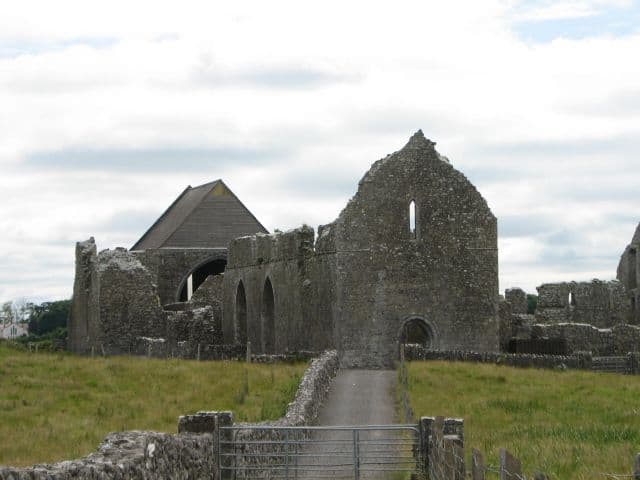
Abbeyknockmoy
Abbeyknockmoy is a historic Cistercian abbey founded in 1190 in County Galway, Ireland, by the King of Connacht, Cathal Crobhdearg Ua Conchobair. The abbey served as the burial site for King Cathal and is renowned for its surviving medieval wall paintings and sculptures, which show connections to other Cistercian sites in western Ireland. Although now in ruins, it remains a significant historical and artistic monument.

Abbeymahon Abbey
Abbeymahon Abbey, also known as the Cistercian Abbey of St Mary de Fonte Vivo, is a ruined medieval Cistercian monastery located near Timoleague, County Cork, Ireland. Despite a "dearth of documentary evidence," it was a significant and wealthy institution until its suppression in the 16th century. The abbey's current site was established in the 1270s, relocating from an earlier foundation to a more spacious location on a salt-water estuary.

Baltinglass Abbey
Baltinglass Abbey, a ruined medieval Cistercian monastery in County Wicklow, Ireland, was founded in 1148 by Diarmait Mac Murchada. It served as a daughter house of Mellifont Abbey and later became the mother house of Jerpoint Abbey. The abbey was suppressed in 1536 during the Dissolution of the Monasteries and is now a National Monument.