
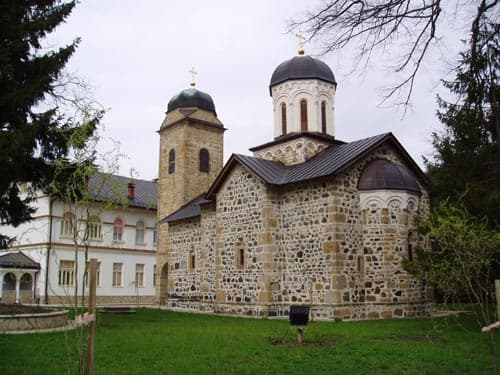
Gomionica Monastery
Gomionica Monastery is a Serbian Orthodox monastery dedicated to the Presentation of Mary, situated in Kmećani, Bosnia and Herzegovina. It serves as the spiritual heart of the Zmijanje region and boasts a history dating back to before 1536. The monastery has undergone numerous refurbishments and endured significant damage during World War II, but remains a cultural monument with a rich treasury of icons and manuscripts.
Key Facts
- ›Founded before 1536, with its exact foundation date unknown.
- ›Known as Zalužje in 16th-century Ottoman sources.
- ›Served as a spiritual center for the Zmijanje region.
- ›House of writer Petar KočIć's elementary school.
- ›Designated a National Monument of Bosnia and Herzegovina in 2006.
- ›Treasury contains icons from the 16th-19th centuries and manuscripts from the 14th-17th centuries.

- Icons Created In the 16th To 19th Centuries
- Manuscripts and Printed Books Created In the 14th To 17th Centuries
ZalužJe
Serafim šTrkić, Petar KočIć
- Referred To As ZalužJe In 16th-Century Sources
- Abbot Credited By Ottomans For Peaceful Population Attitude In the Second Half of the 16th Century
- May Have Been Abandoned At the End of the 17th Century
- May Have Been Abandoned During the 1730s
- Church Refurbished Several Times During the 18th and 19th Centuries
- Badly Damaged During World War Ii
- Abbot Serafim šTrkić Murdered In 1941
- Became A Female Monastery After World War Ii
- Designated A Cultural Monument of Yugoslavia In 1953
- Proclaimed A National Monument of Bosnia and Herzegovina In 2006
About Gomionica Monastery
Gomionica Monastery is a significant Serbian Orthodox monastic complex dedicated to the Presentation of Mary. It is situated in the village of Kmećani, approximately 42 kilometers west of Banja Luka, within the Republika Srpska entity of Bosnia and Herzegovina. The monastery holds a special place as the spiritual heart of the historical region known as Zmijanje.
History and Significance
The origins of Gomionica Monastery are traced back to before 1536, though its precise foundation date remains unrecorded. In 16th-century Ottoman documents, it was referred to by the name Zalužje, with its current name derived from a nearby river. During the latter half of the 16th century, the abbot of Gomionica was recognized by Ottoman authorities for fostering a peaceful coexistence among the population in the surrounding area. The monastery may have experienced periods of abandonment, possibly at the end of the 17th century following the Great Turkish War, and again during the 1730s. Its church underwent multiple renovations throughout the 18th and 19th centuries. Notably, the renowned writer Petar Kočić received his elementary education at a school organized within the monastery's premises.
World War II and Post-War Era
Gomionica Monastery suffered considerable damage during World War II. Its abbot, Serafim Štrkić, tragically lost his life in 1941, murdered by the Ustaše, a Nazi-affiliated Croatian fascist organization. In the post-war period, Gomionica transitioned into a female monastery.
Cultural Heritage
In recognition of its historical and cultural importance, Gomionica Monastery was designated a cultural monument of Yugoslavia in 1953. More recently, on January 20, 2006, it was officially proclaimed a National Monument of Bosnia and Herzegovina by KONS. The monastery's treasury is a repository of valuable artifacts, including icons created between the 16th and 19th centuries, alongside manuscripts and printed books dating from the 14th to the 17th centuries. Historically, the monastery also possessed a notable silver-gilt woodcarved cross from 1640, which later found its way into a private collection and is now housed at the Courtauld Institute of Art.
Source: Wikipedia ↗
Frequently Asked Questions
When was Gomionica Monastery founded?
The exact date of Gomionica Monastery's foundation is not precisely known, but historical records indicate it was established before 1536. Its early history is noted in 16th-century sources under the name Zalužje.
What is the spiritual significance of Gomionica Monastery?
Gomionica Monastery is recognized as the spiritual center of the Zmijanje region. It has historically played a role in the peaceful disposition of the local population, as noted by Ottoman authorities in the 16th century.
Has Gomionica Monastery suffered damage in its history?
Yes, Gomionica Monastery has experienced damage throughout its history. It was significantly harmed during World War II, and its abbot, Serafim Štrkić, was murdered in 1941. The church itself has been refurbished multiple times, particularly in the 18th and 19th centuries.
What notable items are held within Gomionica Monastery's treasury?
The treasury of Gomionica Monastery houses a significant collection of religious artifacts. This includes icons dating from the 16th to the 19th centuries, as well as important manuscripts and printed books from the 14th to the 17th centuries.
What is the current status of Gomionica Monastery?
Following World War II, Gomionica Monastery became a female monastery. It is recognized as a cultural monument and was proclaimed a National Monument of Bosnia and Herzegovina in 2006, indicating its protected historical and cultural status.
Related Monasteries
Ozren Monastery
Ozren Monastery is a Serbian Orthodox monastery dedicated to Saint Nicholas, located near Petrovo in Bosnia and Herzegovina. While folk tradition attributes its founding to King Dragutin in the late 13th century, historical evidence suggests it was likely established in the latter half of the 16th century. It serves as the spiritual center for the Mount Ozren region and houses 17th-century frescoes and notable icons, including a Pietà by Emmanuel Lambardos.

Žitomislić Monastery
Žitomislić Monastery is a Serbian Orthodox monastery located near Mostar, Bosnia and Herzegovina, dedicated to the Annunciation. Founded in 1556 by the Miloradović-Hrabren family on the ruins of an older church, it developed into a significant religious and cultural center with a renowned scriptorium and substantial landholdings. Despite periods of destruction and reconstruction, including severe damage during World War II and the Bosnian War, the monastery has been meticulously rebuilt and continues to function as an active monastic community.

Moštanica Monastery
Moštanica Monastery is a Serbian Orthodox female monastery situated in the Kozara mountain region of Bosnia and Herzegovina, dedicated to Archangel Michael. Founded in the early 16th century, it has endured significant destruction throughout its history, being rebuilt seven times between 1556 and 1993. The monastery is recognized as a protected cultural heritage monument and is ecclesiastically part of the Eparchy of Banja Luka.