
Goldcliff Priory
Goldcliff Priory was a Benedictine monastery founded in 1113 by Robert de Chandos near Newport, South Wales. Originally a subsidiary of the Abbey of Bec in Normandy, it was later made a cell of Tewkesbury Abbey. Despite its significant monastic population by the 13th century, the priory eventually passed into the ownership of Eton College following the Dissolution of the Monasteries, and today only remnants of its structure remain.
Key Facts
- ›Founded in 1113 by Robert de Chandos as a Benedictine priory.
- ›Initially a dependency of the Abbey of Bec in Normandy.
- ›Housed 25 monks by the 13th century, who unusually wore white habits.
- ›Became a cell of Tewkesbury Abbey in 1442.
- ›Its records are held in the archives of Eton College.
- ›Modern evidence suggests foundations of a large structure measuring 37m by 11m.

Drainage System Developed By Monks, Evidence of Foundations of A Large Structure, Adjacent Bivallate Earthwork Enclosure
Silver Monachorum, Monksilver
Robert De Chandos, William De Goldcliff, Henry, Maurice, Jean De Plessis, Walter, Osbert, Ralph De Runceville, William De St Albino, Philip De Gopylers, Thomas Leonc, Bertand Maheil, William De St. Vedast, German De St. Vedast, Lawrence De Bonneville, John Twining, Hugh Morainville
- Established As A Subsidiary House of the Abbey of Bec In Normandy .
- Endowed With the Manor of Monksilver .
- Robert De Chandos's Son Buried In the Church of St Mary Magdalene, Goldcliff .
- Charged With Stealing Cargo From A Wrecked Vessel .
- Patronage Granted To Henry Earl of Warwick .
- Made A Cell of Tewkesbury Abbey .
- Monks Expelled By the Welsh .
- Regained By Tewkesbury Abbey .
- Gifted To Eton College By Henry Vi .
- Ownership Vested In Eton College At the Dissolution of the Monasteries.
About Goldcliff Priory
Goldcliff Priory was a Benedictine monastic institution located in Goldcliff, near Newport, in South Wales. Founded in 1113 by Robert de Chandos, it initially served as a dependent house of the Abbey of Bec in Normandy. The priory was established on a coastal site, now part of Hill Farm. By the 13th century, it had grown to accommodate 25 monks, who were noted for wearing white habits, a departure from the traditional black attire of Benedictine monks.
Over its history, Goldcliff Priory underwent several changes in its affiliation. In 1442, it was formally made a cell of Tewkesbury Abbey. The priory's estates were valued at £200 annually during this period. Historical accounts mention disruptions, such as the expulsion of three monks by the Welsh in 1445, though the priory was reclaimed the following year. In 1450, King Henry VI gifted the priory to Eton College.
Following the Dissolution of the Monasteries, the full ownership of the parish was transferred to Eton College, which retained control into the early 20th century. Today, Goldcliff Priory exists as ruins. While historical records and writings from the 1950s noted visible outlines of buildings as grass patterns or crop marks, by the 1970s, only a portion of a cellar remained within the farmhouse. More recent aerial photography from 2010 has provided evidence of the foundations of a substantial structure, measuring approximately 37 meters by 11 meters, situated adjacent to an earthwork enclosure.
Source: Wikipedia ↗
Frequently Asked Questions
When was Goldcliff Priory founded?
Goldcliff Priory was established in 1113 by Robert de Chandos.
What religious order was Goldcliff Priory a part of?
Goldcliff Priory was a Benedictine monastery. Uniquely among Benedictine houses, its monks wore white habits.
What happened to Goldcliff Priory?
Following the Dissolution of the Monasteries, full ownership of the priory's parish was vested in Eton College, which retained it until the early 20th century. Today, only remnants of its structures are visible.
Where was Goldcliff Priory located?
The priory was situated in Goldcliff, near Newport, in South Wales, on a coastal site that is now the land of Hill Farm.
What evidence remains of Goldcliff Priory today?
In the mid-20th century, outlines of buildings were visible as grass patterns or crop marks. By the 1970s, only part of a cellar in the farmhouse remained. Aerial photography in 2010 revealed foundations of a large structure.
Related Monasteries

Kidwelly Priory
Kidwelly Priory was a Benedictine monastic house established in Kidwelly, Carmarthenshire, Wales, around 1110 by Roger, Bishop of Salisbury. It served as a religious institution following the Norman Conquest of Wales, with its lands granted by Bishop Roger to Sherborne Abbey. The priory was dissolved in 1539 during the reign of Henry VIII, and today only the parish church of St Mary's remains as a remnant.

Basingwerk Abbey
Basingwerk Abbey, located near Holywell in Flintshire, Wales, was a ruined Cistercian monastery founded in 1132. It played a strategic role in medieval Welsh history and maintained extensive lands, notably in Derbyshire. Following its dissolution in 1536, the abbey's assets were dispersed, and its buildings fell into ruin, though parts were later repurposed. Today, the site is managed by Cadw and is a Grade I listed ruin within Greenfield Valley Heritage Park.
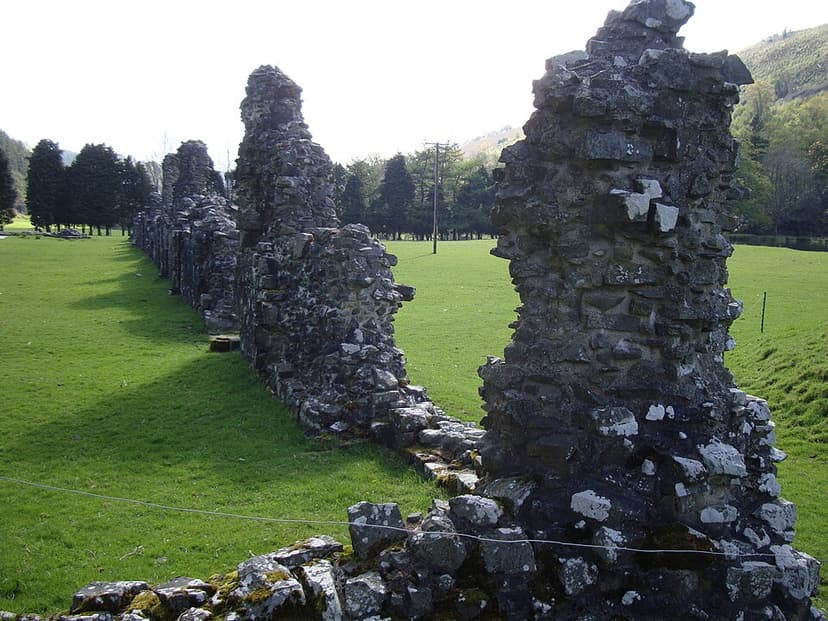
Cwmhir Abbey
Cwmhir Abbey was a Welsh Cistercian monastery founded in 1176 by Cadwallon ap Madog, though a spurious tale attributed its origin to an earlier date and founder. Situated near Llandrindod Wells in Powys, the abbey endured significant hardship due to feuds with the Mortimer family and damage during English conflicts, including the uprising of Owain Glyndŵr. Despite an ambitious construction project for its church, it was abandoned due to ongoing troubles, leading to a drastic decline in its community size by the time of its dissolution in 1536.