
Glenluce Abbey
Glenluce Abbey was a Cistercian monastery founded around 1190 by Rolland, Lord of Galloway. After the Scottish Reformation in 1560, the abbey fell into disuse and its lands were controversially acquired by the Kennedy family. Today, the ruins of Glenluce Abbey are a scheduled monument, having undergone partial restoration.
Key Facts
- ›Founded around 1190 by Rolland, Lord of Galloway.
- ›Belonged to the Cistercian monastic order.
- ›Known also as the Abbey of Luce or Vallis Lucis.
- ›Fell into disuse following the Scottish Reformation in 1560.
- ›Its lands were controversially acquired by Gilbert Kennedy, 4th Earl of Cassilis.
- ›The ruins were partially restored in 1898.

- Ruins Consolidated and Partly Restored In 1898
- Scheduled Monument
Abbey of Luce, Vallis Lucis
Rolland, Lord of Galloway, Gilbert Kennedy, 4th Earl of Cassilis, John Gordon of Lochinvar, Thomas Hay, Cuthbert Kirkpatrick, Allan Stewart, Mary, Queen of Scots, Peter Young, Peter Macgregor Chalmers
- Founded Around 1190
- Scottish Reformation In 1560 Led To Disuse
- James Iv Erected 'Ballinclach In Glenluce' Into A Burgh of Barony In 1497
- John Gordon of Lochinvar Took Possession In 1560
- Gilbert Kennedy, 4th Earl of Cassilis Acquired Lands Through Alleged Forgery and Murder
- Mary, Queen of Scots Stayed At Glenluce On 9 August 1563
- Peter Young Sought Manuscripts In March 1587
- Ruins Consolidated and Partly Restored In 1898
About Glenluce Abbey
Glenluce Abbey, situated near the village of Glenluce in Scotland, was a significant Cistercian monastery. Founded around 1190 by Rolland, Lord of Galloway and Constable of Scotland, it was also known by the names Abbey of Luce and Vallis Lucis. The abbey played a role in the local landscape and economy for centuries.
Post-Reformation Period
The trajectory of Glenluce Abbey dramatically shifted following the Scottish Reformation in 1560, after which it gradually fell into disuse. The subsequent decades saw a contentious period of land acquisition. In 1497, James IV had established a burgh of barony named Ballinclach in Glenluce in favor of the abbey, though its operation is not documented. Later, after the Reformation, John Gordon of Lochinvar briefly took possession before surrendering it to Gilbert Kennedy, 4th Earl of Cassilis. Kennedy is noted for his aggressive methods in securing the abbey's lands, allegedly employing forgery and even murder to consolidate his claim. The abbey briefly hosted Mary, Queen of Scots, on August 9, 1563.
Preservation and Legacy
By March 1587, efforts were underway to recover manuscripts once held by the last Abbot. In the late 19th century, the ruins of Glenluce Abbey underwent consolidation and partial restoration, undertaken by architect Peter MacGregor Chalmers in 1898. Today, the remains of Glenluce Abbey are recognized as a scheduled monument, offering a glimpse into Scotland's monastic past.
Source: Wikipedia ↗
Frequently Asked Questions
When was Glenluce Abbey founded?
Glenluce Abbey was founded around the year 1190. The founding was carried out by Rolland, also known as Lochlann, who was the Lord of Galloway and Constable of Scotland.
What religious order did Glenluce Abbey belong to?
Glenluce Abbey was a Cistercian monastery. The Cistercian order is a branch of the Benedictine monastic tradition, known for its austere lifestyle and emphasis on manual labor and prayer.
What happened to Glenluce Abbey after the Scottish Reformation?
Following the Scottish Reformation in 1560, the abbey was largely abandoned and fell into disuse. The lands and property of the abbey were subsequently subjects of controversy and acquisition by secular figures.
Who was involved in the controversial acquisition of Glenluce Abbey's lands?
After 1560, Gilbert Kennedy, 4th Earl of Cassilis, played a significant role in acquiring the abbey's lands through dubious means, including the alleged forgery of deeds and the murder of a monk who facilitated it. John Gordon of Lochinvar also took possession of the abbey initially.
Are there any notable historical visitors to Glenluce Abbey?
Yes, Mary, Queen of Scots, stayed at Glenluce Abbey on 9 August 1563. This visit occurred during a period when the abbey's fortunes were in decline following the Reformation.
What is the current status of Glenluce Abbey?
Glenluce Abbey is now in ruins. Significant consolidation and partial restoration of the ruins were undertaken in 1898 by architect Peter MacGregor Chalmers. It is recognized as a scheduled monument.
Related Monasteries
Arbroath Abbey
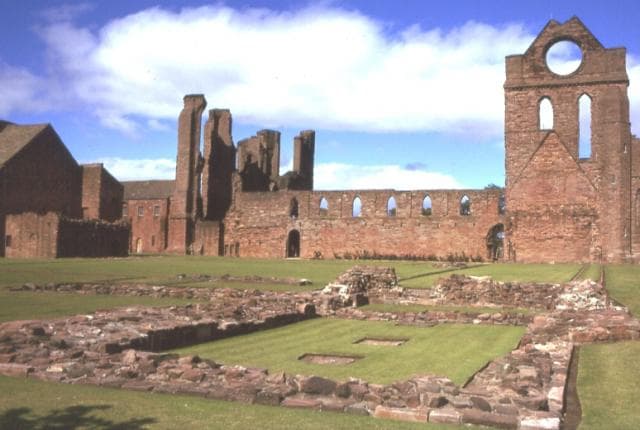
Arbroath Abbey, a ruined Cistercian monastery located in Arbroath, Scotland, was founded in 1178 by King William the Lion. It is renowned as the site where the Declaration of Scottish Independence was likely drafted in 1320. The Abbey, once the wealthiest in Scotland, is now managed by Historic Environment Scotland and is a popular tourist attraction, notable for its distinctive red sandstone ruins.

Dundrennan Abbey
Dundrennan Abbey was a Cistercian monastery established in 1142 in Dundrennan, Scotland. Known for its Romanesque architecture, the abbey reflects the austere Cistercian ideal and is noted for the preservation of its original forms due to its hard-weathering grey sandstone construction. Although extensively ruined, it holds historical significance as the site where Mary, Queen of Scots, spent her final night in Scotland in 1568 before fleeing.

Jedburgh Abbey
Jedburgh Abbey is a ruined Augustinian abbey located in the Scottish Borders. Founded in the 12th century, it was dedicated to the Virgin Mary and grew to significant stature, with its abbot even invited to Scottish Parliaments. The abbey endured numerous attacks and destructions throughout its history, especially during periods of conflict between Scotland and England, before its end with the Scottish Reformation in 1560. Today, it is a scheduled monument managed by Historic Environment Scotland and a popular tourist attraction.