
Évron Abbey
Christian·France·Active (as Community of Saint Martin and Basilica)·7th century
Évron Abbey was a Benedictine monastery located in Évron, France, with its foundation traditionally attributed to the 7th century. Dissolved during the French Revolution in 1791, its monastic church remains as the Basilica of Notre-Dame de l'Épine. Today, the site serves as the home of the Community of Saint Martin, an association of priests and deacons.
Key Facts
- ›Foundation attributed to the 7th century.
- ›Dissolved in 1791 during the French Revolution.
- ›The former monastic church is now the Basilica of Notre-Dame de L'Épine.
- ›Currently houses the Community of Saint Martin, an association of priests and deacons.
- ›Located in Évron, Mayenne department, France.

Basilica of Notre-Dame De L'éPine
Abbayé Notre-Dame D'éVron
- Dissolution In 1791 During the French Revolution
About Évron Abbey
Évron Abbey, also known by its French name Abbaye Notre-Dame d'Évron, is a former Benedictine monastery situated in the town of Évron, located within the Mayenne department of France. Historical tradition attributes its foundation to the 7th century, though specific details regarding its earliest years are scarce.
History and Dissolution
The abbey operated as a significant religious institution for centuries. However, its monastic life came to an end in 1791 when it was dissolved during the upheaval of the French Revolution. Despite the abbey's dissolution, its former monastic church managed to survive the period intact. This structure is now renowned as the Basilica of Notre-Dame de l'Épine, commonly translated as "Our Lady of the Thorn."
Contemporary Use
In the present day, the site of Évron Abbey serves a new purpose. It is now the established seat of the Community of Saint Martin. This community is an association comprised of priests and deacons who live and pursue their apostolate in a communal setting, continuing a spiritual presence on the historical grounds.
Source: Wikipedia ↗
Frequently Asked Questions
When was Évron Abbey founded?
The foundation of Évron Abbey is traditionally ascribed to the 7th century. Specific details about the exact date and circumstances of its founding are not widely documented.
What happened to Évron Abbey?
Évron Abbey was dissolved in 1791 during the French Revolution. Its former monastic church, however, survived and is now known as the Basilica of Notre-Dame de l'Épine.
What is the current use of the Évron Abbey site?
The site of Évron Abbey is now the seat of the Community of Saint Martin. This community consists of priests and deacons who live and carry out their apostolate together.
What is the significance of the Basilica of Notre-Dame de l'Épine?
The Basilica of Notre-Dame de l'Épine is the former monastic church of Évron Abbey. It is notable for having survived intact after the abbey's dissolution during the French Revolution.
Related Monasteries

Fécamp Abbey
Fécamp Abbey, officially the Abbey of the Holy Trinity at Fécamp, is a Benedictine monastery located in Fécamp, France. Originally founded as a nunnery in the 7th century, it was destroyed and later refounded in the late 10th century. The abbey played a significant role in Norman history, particularly in the Norman Conquest of England, and is historically known as the first producer of the herbal liqueur Bénédictine.
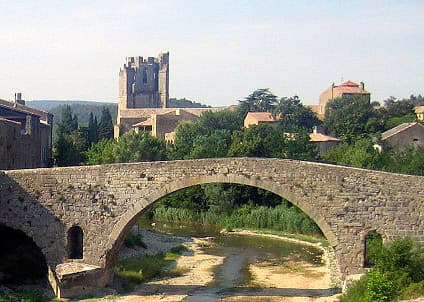
Lagrasse Abbey
The Abbey of St. Mary of Lagrasse, originally founded in the 7th century, is a significant Romanesque abbey located in southern France. It transitioned from a Benedictine monastery to its current status as home to a community of canons regular in 2004. The abbey boasts a rich architectural history, incorporating Romanesque, classical, and medieval elements, and has undergone extensive restoration.

Abbey of Saint-Germer-de-Fly
The Abbey of Saint-Germer-de-Fly is a former Benedictine abbey in Picardy, France, renowned for its church, which showcases early Gothic architectural elements. Originally founded in 630, it has a long history of destruction and rebuilding, notably transitioning to a Cistercian order before returning to Benedictine rule. The surviving church is considered a significant example of the transition from Romanesque to Gothic styles, featuring a 13th-century Marian chapel that echoes the Sainte-Chapelle of Paris.