
Eastminster Abbey
Eastminster Abbey, also known as New Abbey or St Mary Graces, was a Cistercian monastery established by King Edward III in 1350. Situated on Tower Hill in London, it was endowed by royal patrons and courtiers, with its primary function being the perpetual singing of masses. The abbey was dissolved in 1538, and its site later became home to the Royal Mint before its sale for diplomatic use.
Key Facts
- ›Founded by King Edward III in 1350.
- ›Belonged to the Cistercian Order.
- ›Located on Tower Hill, immediately outside the Roman London Wall in London.
- ›Dissolved in 1538.
- ›The site was later occupied by the Royal Mint for over 180 years.
- ›Archaeological excavations of the abbey site occurred between 1983 and 1988.
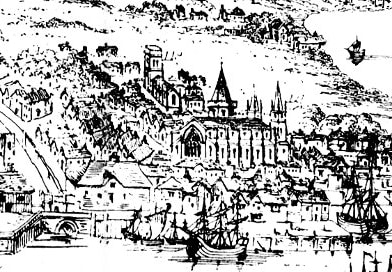
Location Adjacent To the Roman London Wall, Endowments From Royal Patrons and Courtiers
New Abbey, St Mary Graces
Edward Iii
Founded By Edward Iii, Dissolved
About Eastminster Abbey
Eastminster Abbey, also known by alternative names such as New Abbey and St Mary Graces, was a significant Cistercian monastery situated on Tower Hill in London. Its establishment in 1350 by King Edward III marked a notable royal foundation, strategically located just outside the ancient Roman London Wall. The abbey was endowed primarily by courtiers and royal figures, with a particular endowment from Edward III in 1350 concerning the manor of Shere in Surrey, which later became known as Towerhill due to the abbey's patronage. Another significant bequest came from Sir Nicholas de Loveyne in 1375, intended to fund perpetual masses.
History and Dissolution
The history of Eastminster Abbey is marked by its royal connections and its eventual dissolution. Benefactors were mainly from the royal court, reflecting its status as a foundation favored by nobility. The abbey met its end in 1538 as part of the wider dissolution of the monasteries. Following its dissolution, the site underwent significant transformations. From 1805 to 1966, it served as the home of the Royal Mint, a period of over 180 years. In more recent times, the site was sold for conversion into a new London embassy for the People's Republic of China.
Archaeology and Legacy
Extensive archaeological work has been conducted on the site of Eastminster Abbey. A large-scale excavation took place between 1983 and 1988, yielding valuable insights into the abbey's layout and history. The analysis of the uncovered archaeological and documentary evidence has been published, contributing to the understanding of monastic life in London during the medieval period. While the physical structures of the abbey are largely gone, its historical presence is commemorated through these archaeological findings and the historical records that document its existence and function.
Source: Wikipedia ↗
Frequently Asked Questions
When was Eastminster Abbey founded?
Eastminster Abbey was founded in 1350 by King Edward III. This was immediately outside the Roman London Wall.
What religious order was Eastminster Abbey part of?
Eastminster Abbey was a Cistercian abbey. The Cistercian Order is a branch of the Catholic Church.
What happened to Eastminster Abbey after it was dissolved?
Following its dissolution in 1538, the site of Eastminster Abbey was used for various purposes. From 1805 to 1966, it was the home of the Royal Mint. More recently, it was sold for conversion into a new London embassy.
Who were the main benefactors of Eastminster Abbey?
The main benefactors of Eastminster Abbey were primarily courtiers. It attracted relatively few bequests from the merchants of the City of London.
Has the site of Eastminster Abbey been excavated?
Yes, a large-scale excavation of the site of Eastminster Abbey took place between 1983 and 1988. The findings have been published by Museum of London Archaeology.
Related Monasteries
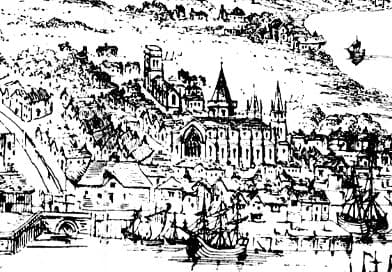
St. Mary Graces Abbey
St. Mary Graces Abbey, also known as Eastminster or New Abbey, was a Cistercian monastery founded by King Edward III in 1350. Situated just outside the Roman London Wall, it received endowments from royal courtiers and played a role in the local landscape, with one manor even named Towerhill due to its patronage. The abbey was dissolved in 1538 and its site later became home to the Royal Mint.

English Benedictine Congregation
The English Benedictine Congregation (EBC) is a historic association of Catholic Benedictine monastic communities, technically the oldest of the nineteen congregations affiliated with the Benedictine Confederation. Founded in 1216 by the Holy See to unite English Benedictine abbeys, its roots extend to the 6th and 7th centuries. After its suppression during Henry VIII's Dissolution, the congregation was re-established in 1619 through the unification of exiled English Benedictine groups and a small community of monks who maintained continuity.
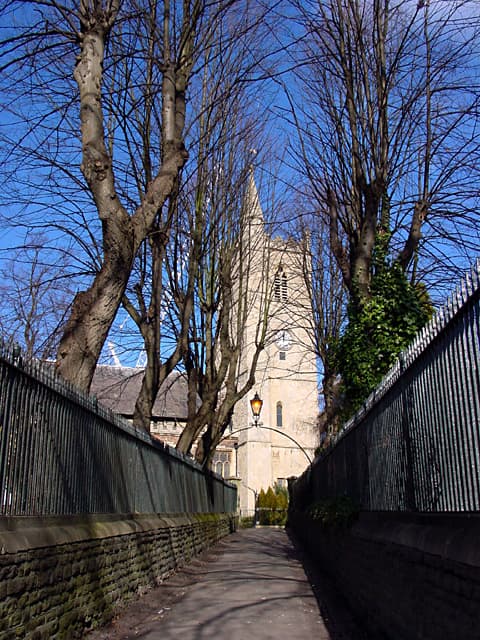
St James's Priory, Bristol
St James's Priory in Bristol was founded between 1124 and 1137 as a Benedictine priory by Robert, Earl of Gloucester. It served as Bristol's first religious house and established a planned suburb and a large cemetery. While most of the priory buildings were demolished after the Dissolution of the Monasteries in 1540, the nave of the church survived and continues to function as an active place of worship today, now serving the Catholic Diocese of Clifton.