
St. Mary Graces Abbey
St. Mary Graces Abbey, also known as Eastminster or New Abbey, was a Cistercian monastery founded by King Edward III in 1350. Situated just outside the Roman London Wall, it received endowments from royal courtiers and played a role in the local landscape, with one manor even named Towerhill due to its patronage. The abbey was dissolved in 1538 and its site later became home to the Royal Mint.
Key Facts
- ›Founded by King Edward III in 1350.
- ›A Cistercian monastery located on Tower Hill in London.
- ›Received endowments, including the manor of Shere in Gomshall from Edward III.
- ›Dissolved in 1538.
- ›The site was later occupied by the Royal Mint from 1805 to 1966.
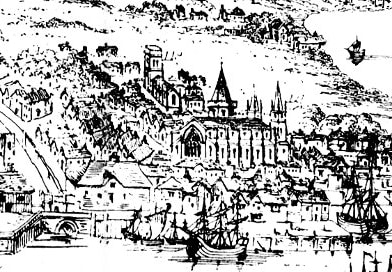
- Site of A Large-Scale Excavation Between 1983 and 1988.
Eastminster, New Abbey, St Mary Graces
Edward Iii
Founded In 1350 By Edward Iii., Dissolved In 1538.
About St. Mary Graces Abbey
St. Mary Graces Abbey: A Royal Foundation in London
St. Mary Graces Abbey, also known by variant names such as Eastminster and New Abbey, was a significant Cistercian monastery established in London. Its foundation in 1350 by King Edward III marked it as a royal endowment, situated strategically just outside the ancient Roman London Wall in what is now the Tower Hamlets area.
History and Endowments
The abbey's establishment was a royal initiative, and its endowments reflected this patronage. Among its significant holdings was the reversion of a manor in Shere, Surrey, granted by Edward III in 1350, which subsequently became known as Towerhill due to the abbey's connection. Further support came from courtiers, though it attracted fewer bequests from London's merchant class. A notable benefactor, Sir Nicholas de Loveyne, bequeathed the reversion of the Crash Mills to the abbot and convent in 1375, stipulating perpetual masses for his soul.
Dissolution and Legacy
St. Mary Graces Abbey met its end with the dissolution of monasteries in 1538. The site later underwent significant transformation, most notably becoming the home of the Royal Mint from 1805 until 1966. Extensive archaeological excavations between 1983 and 1988 have helped to uncover and document the abbey's historical footprint. More recently, the site, renamed Royal Mint Court, has been sold for development into a new embassy.
Source: Wikipedia ↗
Frequently Asked Questions
When was St. Mary Graces Abbey founded?
St. Mary Graces Abbey was founded in 1350 by King Edward III. This immediately placed it outside the historic Roman London Wall.
What religious order was St. Mary Graces Abbey a part of?
St. Mary Graces Abbey was a Cistercian monastery. The Cistercian order is known for its austere lifestyle and focus on manual labor and prayer.
What happened to St. Mary Graces Abbey after its dissolution?
The abbey was dissolved in 1538. Following its dissolution, the site was used for various purposes, most notably as the home of the Royal Mint from 1805 to 1966.
Where was St. Mary Graces Abbey located?
St. Mary Graces Abbey was located on Tower Hill at East Smithfield in London, immediately outside the Roman London Wall. Excavations of the abbey site took place between 1983 and 1988.
Related Monasteries
Eastminster Abbey
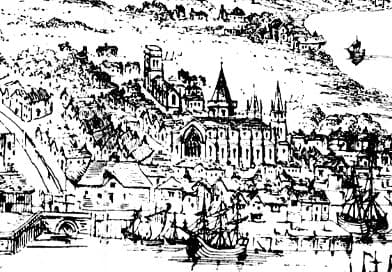
Eastminster Abbey, also known as New Abbey or St Mary Graces, was a Cistercian monastery established by King Edward III in 1350. Situated on Tower Hill in London, it was endowed by royal patrons and courtiers, with its primary function being the perpetual singing of masses. The abbey was dissolved in 1538, and its site later became home to the Royal Mint before its sale for diplomatic use.

London Charterhouse
The London Charterhouse is a historic complex in Clerkenwell, London, originally founded as a Carthusian priory in 1371 on a Black Death burial site. After its dissolution in 1537, it was transformed into a Tudor mansion before being acquired by Thomas Sutton in 1611. Sutton established it as a school and an almshouse, which continues to operate today, providing residence for older people.

Hitchin Priory
Hitchin Priory, a Carmelite friary founded in 1317, was closed during the Dissolution of the Monasteries in the reign of Henry VIII. While the original priory was largely dismantled and its site used as a quarry, parts of it were incorporated into the current hotel building, which was constructed around 1700 and later rebuilt in 1770-71. The complex has been a Grade I listed building since 1951 and now operates as a hotel.