
Cressing Preceptory
Christianity·England·Visitor attraction·12th century
Cressing Temple was one of the earliest and largest estates of the Knights Templar in England, established in 1136. Following the suppression of the Templars, it was transferred to the Knights Hospitaller and later confiscated by the Crown. Today, the site is a visitor attraction, renowned for its remarkably preserved medieval barns, including what is claimed to be the oldest standing timber-framed barn in the world.
Key Facts
- ›Founded in 1136 by Matilda of Boulogne, wife of King Stephen.
- ›One of the earliest and largest possessions of the Knights Templar in England.
- ›Features two Grade I listed medieval barns, one claimed to be the oldest standing timber-framed barn globally.
- ›Transferred to the Knights Hospitaller in 1309 and later confiscated by King Henry VIII in 1540.
- ›The site includes a reconstructed Tudor garden and is open to the public as a visitor attraction.
- ›Protected as an ancient monument.

Medieval, Tudor
Barley Barn, Wheat Barn, Granary, Reconstructed Tudor Gardens
Matilda of Boulogne, King Stephen, King John, Peter De Rossa, King Edward Ii, King Henry Viii, Sir William Huse, John Smyth
Suppression of the Knights Templar, Transfer To the Knights Hospitaller, Attack During the Peasants' Revolt, Confiscation By King Henry Viii, Demolition of the 'Great House'
About Cressing Preceptory
Cressing Temple
Cressing Temple, located in Essex, England, stands as a historically significant medieval site that was once a prominent possession of the Knights Templar. Established in 1136 by Matilda of Boulogne, the estate quickly grew to become one of the largest and earliest Templar holdings in England. Its strategic location near major roads facilitated its role as a considerable agricultural enterprise, with its produce contributing to Templar activities in the Middle East.
History and Transition
The Knights Templar managed Cressing Temple until their suppression in the early 14th century. Following papal directives, the estate was transferred to the Order of the Knights Hospitaller in 1309. This new administration continued to operate Cressing as a significant manor, though it faced challenges, including an attack during the Peasants' Revolt in 1381. The Reformation brought further upheaval, with King Henry VIII confiscating the property in 1540. Subsequent ownership saw the manor granted to Sir William Huse and John Smyth, whose family held it for over a century. While a mansion known as the 'Great House' existed in the late sixteenth century, it was demolished in the eighteenth century.
Architectural and Archaeological Significance
Today, Cressing Temple is celebrated for its remarkably preserved medieval structures. The site boasts two Grade I-listed timber-framed barns: the Barley Barn, dating to around 1220, and the Wheat Barn, built circa 1280. The Barley Barn is particularly notable, claimed to be the oldest standing timber-framed barn in the world. A later granary, built after 1575, is also a significant structure. Complementing these ancient buildings is a reconstructed Tudor garden. Extensive archaeological investigations in the 1990s have further illuminated the site's rich past. Cressing Temple is now managed by Essex County Council and is open to the public as a visitor attraction, preserving its heritage for future generations.
Source: Wikipedia ↗
Frequently Asked Questions
When was Cressing Temple established?
Cressing Temple was granted to the Knights Templar in 1136 by Matilda of Boulogne. It was one of their earliest estates in England.
What is Cressing Temple famous for architecturally?
The site is renowned for its two Grade I-listed medieval barns, the Barley Barn and the Wheat Barn. One of these, the Barley Barn, is claimed to be the oldest standing timber-framed barn in the world.
What happened to Cressing Temple after the Knights Templar?
After the suppression of the Knights Templar, Cressing was handed over to the Order of the Knights Hospitaller in 1309. Later, it was confiscated by King Henry VIII in 1540 during the Reformation.
Can I visit Cressing Temple?
Yes, Cressing Temple is open to the public as a visitor attraction. Visitors can explore the medieval barns and the reconstructed Tudor gardens.
What was the original purpose of Cressing Temple?
The original 1400-acre site was a significant agricultural enterprise for the Knights Templar. Its proceeds were sent to fund Templar activities in the Crusader states in the Middle East.
Related Monasteries

Dover Priory
Dover Priory, originally known as the Priory of St. Mary the Virgin and St. Martin of the New Work or Newark, was a significant monastic institution in Dover, England. Its history spans multiple traditions, beginning with secular canons, transitioning to canons regular of the Augustinian rule, and finally becoming a Benedictine monastery. The priory played a role in local governance and religious life before its dissolution in 1538, with parts of its medieval structures surviving today, integrated into Dover College.
Furness Abbey
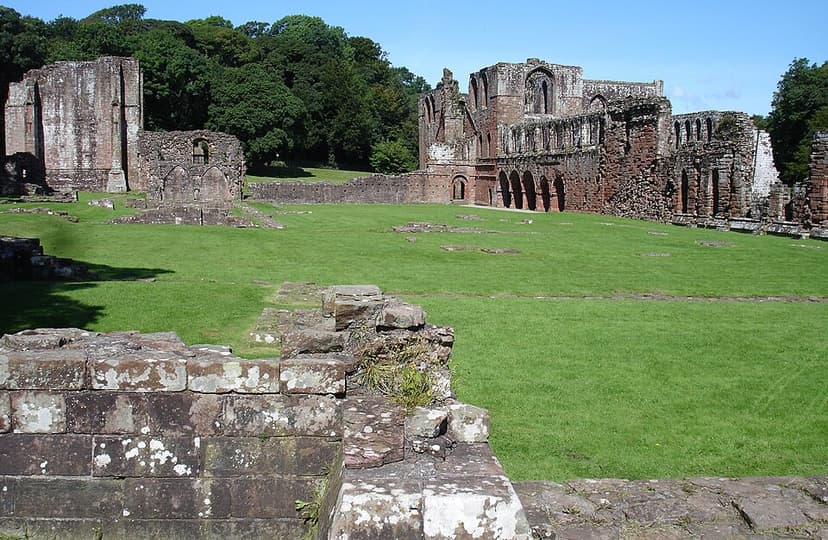
Furness Abbey, originally founded in 1123 as part of the Order of Savigny, became a prominent Cistercian monastery by the 15th century, renowned as the second wealthiest and most powerful in England. Situated in Cumbria, England, its extensive ruins, constructed from local sandstone, showcase significant examples of early Gothic and Perpendicular Gothic architecture. The abbey played a crucial role in regional governance and trade before its dissolution during the English Reformation in 1537. Today, it stands as a substantial historical site, attracting visitors and undergoing conservation efforts.

Torre Abbey
Torre Abbey, located in Torquay, Devon, was founded in 1196 as a monastery for Premonstratensian canons. It is now the best-preserved medieval monastery in Devon and Cornwall, featuring medieval and Georgian rooms, formal gardens, and the third-largest art collection in Devon. The site transitioned from a monastic institution to a private residence and is now a municipal art gallery and museum.