
Corbie Abbey
Corbie Abbey was a significant Benedictine monastery in Corbie, France, founded in 661 by Queen Balthild. It gained renown for its scriptorium, which was instrumental in developing Carolingian minuscule and manuscript illumination, and for its extensive library that preserved classical texts. The abbey also held close ties to the Carolingian dynasty and played a role in intellectual life throughout the Middle Ages.
Key Facts
- ›Founded in 661 CE by Queen Balthild, widow of Clovis II.
- ›Renowned scriptorium was a center for manuscript illumination and developed Carolingian minuscule.
- ›Housed a celebrated library that preserved many classical and patristic works.
- ›At its height in the 9th century, it housed 300 monks.
- ›Associated with notable scholars like Ratramnus, Paschasius Radbertus, and Hadoard.
- ›Suffered damage during World War I, particularly the church.

Gothic
Scriptorium, Library, Carolingian Minuscule Development, Manuscript Illumination
Balthild, Clovis Ii, Clotaire Iii, Saint Columbanus, Theodefrid, Saint Adalard, Ratramnus, Radbertus Paschasius, Hadoard, Saint Gerald of Sauve-Majeure, Saint Colette of Corbie, Cardinal Mazarin, Jean Mabillon
- Founded In 661
- Desiderius, Last King of the Lombards, Exiled Here
- Charles, Future Archbishop of Mainz, Confined Here
- Sent Colony To Found Abbey of Corvey
- Fire Destroyed Monastic Buildings
- Commendatory Abbots Introduced
- Incorporated Into Congregation of Saint Maur
- Suppressed In 1790
- Heavily Shelled During the Battle of the Somme
About Corbie Abbey
Corbie Abbey, situated in the present-day Picardy region of France, was a historically significant Benedictine monastery founded in 661 CE. Established under the Merovingian royal patronage of Queen Balthild, the widow of Clovis II, and her son Clotaire III, the abbey quickly became a prominent center of religious and intellectual life.
Foundation and Early Significance
The initial monks at Corbie were sent from Luxeuil Abbey, carrying forward a tradition of respect for classical learning. The abbey's scriptorium emerged as a vital hub for manuscript illumination when the art was relatively new in Western Europe. It is also recognized as the place where the clear and legible Carolingian minuscule script was developed, alongside a distinctive style of illumination. Historical research indicates that Corbie acted as a "laboratory for new scripts" in the 8th century, with evidence suggesting experimentation with scripts predating Charlemagne's reign.
Medieval Prominence and Intellectual Contributions
Throughout the medieval period, Corbie Abbey maintained close ties with the royal house of the Carolingians. It served as a place of exile for Desiderius, the last King of the Lombards, after his defeat by Charlemagne, and later as a confinement for Charles, the future Archbishop of Mainz. Members of the Carolingian dynasty occasionally held positions as abbots, including Saint Adalard, a cousin of Charlemagne, under whom the monastic school achieved great renown.
At its zenith in the 9th century, Corbie Abbey was a substantial institution, housing 300 monks and surpassing other major abbeys like St. Martin's at Tours and Saint Denis at Paris in size. Its scholars, such as Ratramnus, Paschasius Radbertus, and Hadoard, contributed significantly to theological and scholarly discourse. The abbey also served as a source for founding new monastic communities, notably the Abbey of Corvey in Saxony.
Library and Cultural Heritage
Corbie was exceptionally renowned for its library, which amassed texts from as far afield as Italy. Catalogues from the 11th and 12th centuries detail its holdings, which included patristic writings and, importantly, works of classical antiquity, facilitating their transmission to the Middle Ages. The library's collection was of particular interest to scholars of Tertullian, as it contained unique copies of his works, including unorthodox Montanist treatises. The abbey also played a role in the renewal of interest in geometry and surveying techniques, drawing from ancient sources.
Later History and Legacy
A fire in 1137 led to the rebuilding of monastic structures on a larger scale. The introduction of commendatory abbots in 1550, including Cardinal Mazarin, marked a shift in administration. In 1618, the abbey became one of the first to be incorporated into the Congregation of Saint Maur, which sought to revive monastic discipline. The abbey was suppressed in 1790, leading to the partial demolition of its buildings, though the church, with its notable portal and western towers, still stands.
In modern times, Corbie Abbey's legacy is also tied to Jean Mabillon, a pivotal figure in the development of paleography, who was a monk there. The village of Corbie experienced proximity to conflict during the Battle of the Somme in World War I, with the church sustaining damage from shelling in 1918.
Over two hundred manuscripts from Corbie's once-great library are known to survive in various collections today, attesting to its enduring cultural importance.
Source: Wikipedia ↗
Frequently Asked Questions
When was Corbie Abbey founded?
Corbie Abbey was founded in 661 CE. Its establishment was under the Merovingian royal patronage of Queen Balthild and her son Clotaire III.
What was Corbie Abbey most famous for?
Corbie Abbey was most celebrated for its scriptorium, a hub for manuscript illumination and the development of the Carolingian minuscule script. Its extensive library was also a major point of renown, preserving numerous classical and patristic works.
What religious order was Corbie Abbey a part of?
Corbie Abbey was a Benedictine monastery. The rule of its founders was based on the Benedictine rule, as modified by Saint Columbanus.
Did any famous historical figures have connections to Corbie Abbey?
Yes, Corbie Abbey had connections to several notable figures. Queen Balthild founded the abbey, and members of the Carolingian royal house sometimes served as abbots, including Saint Adalard, one of Charlemagne's cousins. Jean Mabillon, the father of paleography, was also a monk there.
What happened to Corbie Abbey's library?
The library of Corbie Abbey was renowned for its vast collection. During the French Revolution, the library was closed, with many manuscripts transferred to Amiens and others dispersed, with some eventually reaching institutions in Paris and St. Petersburg.
Is Corbie Abbey still an active monastery?
Corbie Abbey is a former monastery. While parts of its church remain, the monastic community was suppressed in 1790, and its buildings were partly demolished.
Related Monasteries
Serrabone Priory
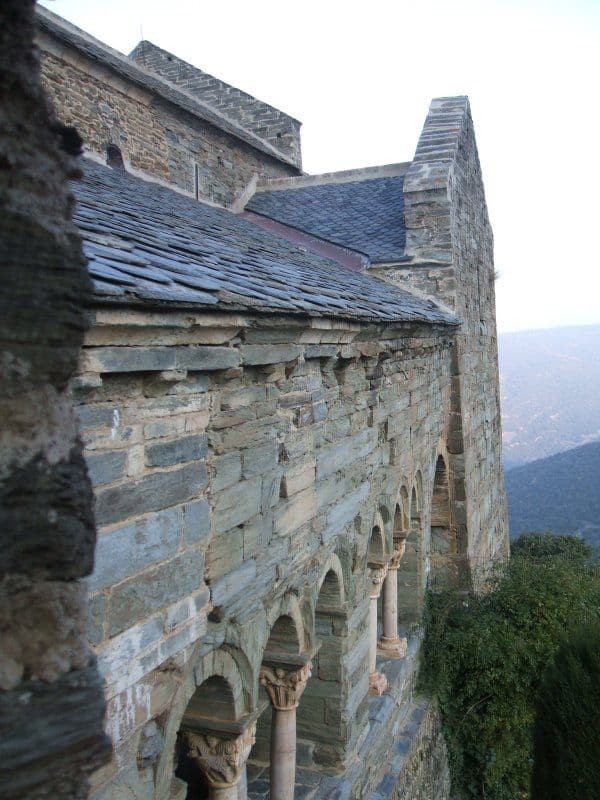
Serrabone Priory is a former monastery of Canons Regular located in the Pyrénées-Orientales region of France. Originally founded in the 10th or 11th century and re-established as an Augustinian priory in 1082, it is renowned for its exquisite 12th-century marble rostrum, considered a masterpiece of Romanesque art. The priory's architecture features a striking contrast between its schist walls and the pink marble detailing from the Conflent region.

Abbey of Saint-Germer-de-Fly
The Abbey of Saint-Germer-de-Fly is a former Benedictine abbey in Picardy, France, renowned for its church, which showcases early Gothic architectural elements. Originally founded in 630, it has a long history of destruction and rebuilding, notably transitioning to a Cistercian order before returning to Benedictine rule. The surviving church is considered a significant example of the transition from Romanesque to Gothic styles, featuring a 13th-century Marian chapel that echoes the Sainte-Chapelle of Paris.

Abbey of St Maur
Saint-Maur Abbey, originally known as Abbaye des Fossés, was a significant Benedictine monastery founded in 639 in what is now Saint-Maur-des-Fossés, France. Over its history, it underwent periods of reform, decadence, and reconstruction, playing a role in medieval political events and artistic development. Though the abbey buildings are largely gone, replaced by a park and a square, remnants like the Rabelais tower and old fortifications survive, with the site classified as historical monuments.